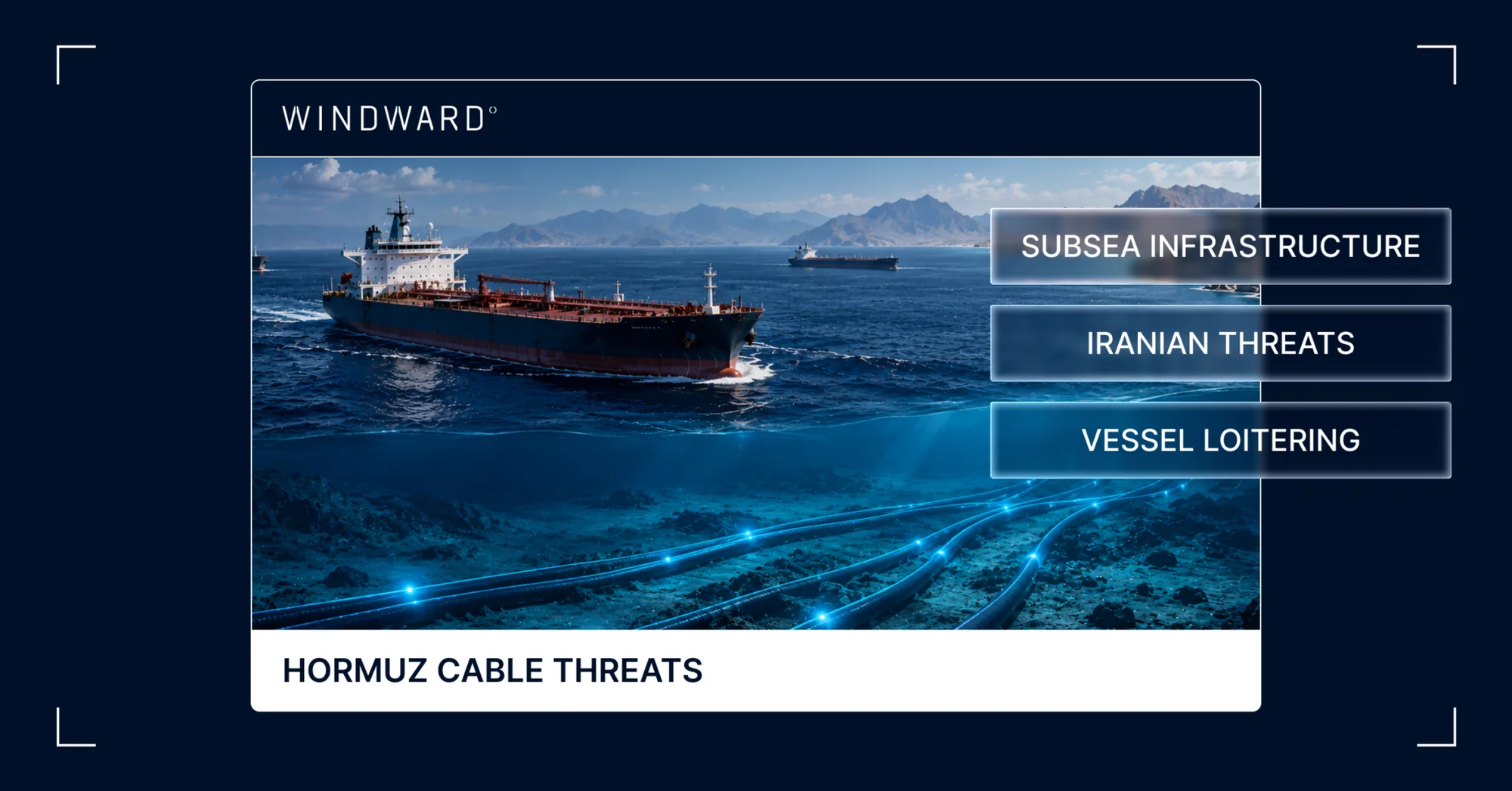
Iran Threatens the Hormuz Internet Cables: Four Gulf States Have No Subsea Route That Avoids the Strait
Image File
Original HTML

Iran Threatens the Hormuz Internet Cables: Four Gulf States Have No Subsea Route That Avoids the Strait

What’s inside?

At a Glance

- IRGC spokesman Hossein Mohebbi said on October 19 that seven major internet cables run beneath the Strait of Hormuz and that new targets and new weapons would be unveiled.

- Six live cables cross the strait today, with FIG and SEA-ME-WE 6 due in 2027, which brings the count close to Iran’s figure.

- Iraq, Kuwait, Bahrain and Qatar have no subsea route to the outside world that avoids Hormuz, because every cable they use lands inside the Gulf.

- Windward identified two OFAC-sanctioned tankers linked to Iran that drifted for days directly over regional cable corridors in the two weeks before the statement.

- FALCON and GBI land in Iran at Bandar Abbas and Bushehr, so cutting them would sever Iran’s own links as well.

Iran Named the Cables Before Naming the Targets

On October 19, IRGC spokesman Hossein Mohebbi told a ceremony in Tehran that seven major internet cables run beneath the Strait of Hormuz, and that new targets and new weapons would be unveiled. He added that this time the response would be much harsher.

The statement did not come out of nowhere.

Earlier in October, Supreme National Security Council secretary Mohsen Rezaei said Iran could strike U.S.-linked cables, data centers and AI facilities in a new war. In May, the IRGC said every cable crossing the strait could be placed under Iranian permits.

The count is close to accurate. Six live cables cross the strait today. 2Africa, AAE-1, FALCON, GBI, Tata TGN-Gulf and OMRAN/EPEG. Two more, FIG and SEA-ME-WE 6, are under construction and due in 2027, which takes the total to eight. Iran’s figure of seven sits between the current and the near-future count, per TeleGeography data.

The Cables That Cross the Strait

- 2Africa: Gulf branch to Iraq, Kuwait, Bahrain, Qatar, Saudi Arabia, UAE and Oman. Meta, Orange, Vodafone, China Mobile, center3, Telecom Egypt, WIOCC, Bayobab.

- AAE-1: Qatar branch, UAE, Oman, Saudi Arabia. Consortium including e&, Ooredoo, Zain, Omantel, Mobily, China Unicom, PCCW.

- FALCON: Iraq, Kuwait, Bahrain, Qatar, Saudi Arabia, UAE, Oman and Iran. FLAG.

- Gulf Bridge International: Iraq, Kuwait, Bahrain, Qatar, Saudi Arabia, UAE, Oman and Iran.

- Tata TGN-Gulf: Bahrain, Qatar, Saudi Arabia, UAE, Oman.

- OMRAN/EPEG: Oman at Khasab, Diba and Barka, and Iran. Zain Omantel, Vodafone.

- FIG (under construction for 2027): Iraq, Kuwait, Bahrain, Qatar, Saudi Arabia, UAE, Oman. Ooredoo.

- SEA-ME-WE 6 (under construction for 2027): Bahrain, Qatar, UAE, Oman, Saudi Arabia.

Four Countries Have Nowhere Else to Route

Exposure is not evenly distributed, and the difference comes down to geography rather than cable count.

Iraq, Kuwait, Bahrain and Qatar are the most exposed, because every cable they use lands inside the Gulf. All of their subsea traffic to the outside world has to pass through Hormuz.

Iraq has three live cables, all landing at Al Faw. Kuwait has five, Bahrain five and Qatar seven, but FOG, Qatar-UAE and Kuwait-Iran never leave the Gulf. That leaves Kuwait with three routes out, Bahrain with four and Qatar with five. Iraq is building a land route from Al Faw to the Turkish border with Ooredoo.

The UAE is better placed. Six cables land on its Gulf coast, but 14 land at Fujairah and Kalba on the Gulf of Oman, outside the strait though still within Iran’s reach.

Oman has two cables at Khasab, 11 on its Gulf of Oman coast, and five at Salalah and Qalhat on the Arabian Sea.

Saudi Arabia is the least exposed, with four cables at Al Khobar and 14 on the Red Sea at Jeddah, Yanbu, Duba and Haql. Even that is not immunity. Two Red Sea cables were cut near Jeddah in September 2025.

Sanctioned Tankers Were Already Above the Cables

The statement on October 19 followed vessel activity rather than preceding it.

In the two weeks before Mohebbi spoke, Windward tracked two OFAC-sanctioned tankers linked to Iran drifting for days directly over regional cable corridors, both in ballast, both with no commercial reason to stop.

The first was sanctioned by OFAC in September 2024 for moving cargo for Iran’s IRGC Quds Force. After idling off Khor Fakkan, it sailed to Muscat at 11 knots, slowed to under one knot at the cable corridors on September 30, and drifted for 73 hours before resuming speed and heading for Suez.

Inside that window, the behavior is specific. It arrived under power, drifted at an average of 0.6 knots with the engine off, crossed the edges of the AAE-1, Bay of Bengal Gateway and 2Africa corridors, passed within half a nautical mile of FALCON, GBI and MENA, then left to the southeast at 10 to 11 knots. Four days before the drift, it had changed its MMSI, call sign, and flag code.

EO imagery captured the vessel on station there on October 1 at 06:52 UTC, confirming its position independently of what it was broadcasting.

The second vessel, sanctioned by OFAC in November 2025 for carrying Iranian LPG, was running from the Malacca Strait toward a transfer off Dubai. On October 4, it stopped in the central Arabian Sea, 660 nautical miles out, and loitered for 115 hours at a median of 0.6 knots.

The drift crossed the AAE-1, FEA, SEACOM/TGN-Eurasia, IMEWE and SeaMeWe-4 routes in water roughly 3,700 meters deep. It was the longest drift recorded on that corridor since late May.

Neither drift can be characterized as a confirmed survey. What can be said is narrower. Two sanctioned vessels with Iranian links, both empty, both with destinations already set, made multi-day stops over cable routes in the weeks before Iran publicly threatened those cables, and both resumed normal speed immediately afterward.

Mapping does not require touching the seabed. A hull-mounted multibeam sonar covers a swath roughly 3.5 times the water depth, and deep-water systems built into a container can be fitted to a merchant vessel. Whether that happened here is not established.

Cutting the Cables Would Cut Iran Too

One constraint sits inside the threat.

FALCON and GBI land in Iran, at Bandar Abbas and Bushehr. Cutting either would sever Iran’s own links alongside the Gulf states’. OMRAN/EPEG runs between Oman and Iran, with the same problem.

That does not make the threat empty. It makes it selective. 2Africa and Tata TGN-Gulf do not land in Iran, and the two cables due in 2027 do not either. Any action that distinguishes between these systems would require knowing precisely where each one runs, which is what makes the loitering activity worth watching rather than dismissing.

What to Watch

Three things will indicate whether the threat is rhetoric or preparation.

Further loitering by Iranian-linked vessels over Gulf and Arabian Sea cable corridors, particularly over systems that do not land in Iran. Progress on Iraq’s land route to Turkey, which is the only alternative any of the four exposed states is actively building. And whether the FIG and SEA-ME-WE 6 routes, both due in 2027 and both running through the same strait, are redesigned in response.

The physical vulnerability is not new, and it is not fixable in the near term. What has changed is that it has been named publicly by the party best positioned to exploit it, and that vessels linked to that party were observed above the cables before the naming.

Written by Maya Romi, Senior Content Manager, Windward; analysis by Gilad Karo, Maritime Analyst, MIOC.
Class (B2B/B2C)
B2B
Ingest Status
Rewritten
Dedupe hash
3be88cdc738422d6d6aa71e16be6ae1c
Press Eligible
Yes
Press Eligible Reason
Manuelle Prüfung nötig. Risiko: MEDIUM. Flags: ['numbers', 'legal']. Stichprobe: False
Source Name
Windward
Original Summary

<p>At a Glance Iran Named the Cables Before Naming the Targets On October 19, IRGC spokesman Hossein Mohebbi told a ceremony in Tehran that seven major internet cables run beneath the Strait of Hormuz, and that new targets and new weapons would be unveiled. He added that this time the response would be much harsher....</p>
<p>The post <a href="https://windward.ai/blog/iran-threatens-the-hormuz-internet-cables/">Ir… Threatens the Hormuz Internet Cables: Four Gulf States Have No Subsea Route That Avoids the Strait</a> appeared first on <a href="https://windward.ai">Windward</a>.</p&gt;

Image URL
https://windward.ai/wp-content/uploads/2026/10/In-the-Spotlight-1-9.png
Source Node
Content Hash (SHA-256, erste 32 hex)
3d4ebb1d53034924fe704be881b0c1b4
Shadow Fleet Interdiction Starts With Flag Verification
Image File
Original HTML

Shadow Fleet Interdiction Starts With Flag Verification

What’s inside?

At a Glance

- France has boarded six suspected shadow fleet tankers since September 2025, most recently south of Réunion on October 12, 2026.

- The cases turned on the same question: whether the flag the tanker claimed was real.

- AIS carries whatever flag a crew chooses to broadcast, so tracking alone cannot settle identity.

- Behavioral history shows which tanker is worth a helicopter and a boarding team.

- Allied navies need the same identity picture before anyone boards.

What Factors Go Into a Shadow Fleet Boarding Decision

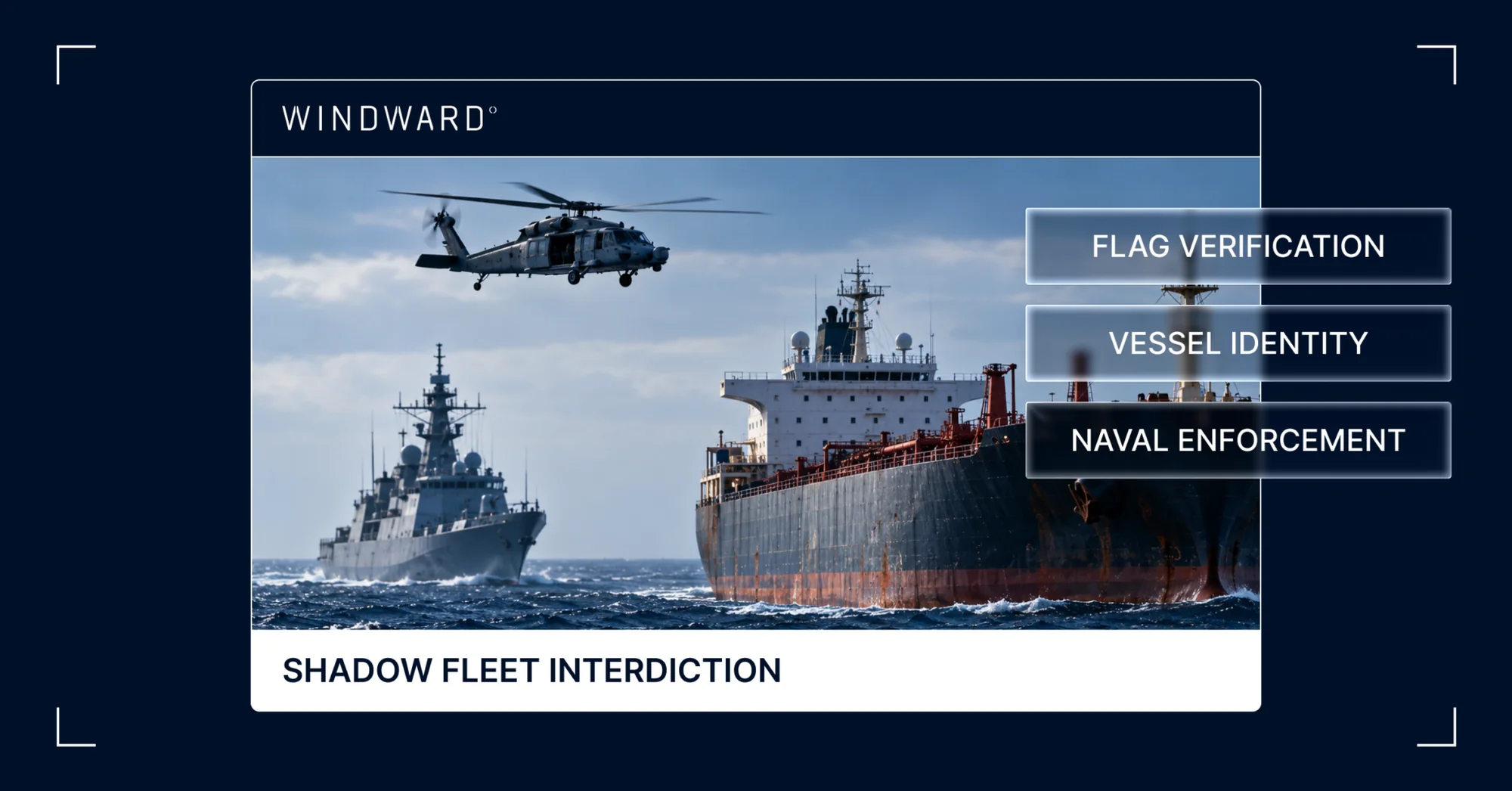
Six times since September 2025, French Navy boarding teams have gone aboard a suspected shadow fleet tanker. The latest came on October 12, 2026, when the Marine Nationale boarded DF PEAK more than 450 nautical miles south of Réunion on suspicion of sailing under a false flag. In June, DELIVER was boarded off Sicily, France’s fifth such operation.

Naval planners often talk about preparing for high-intensity warfare, meaning a large-scale conflict between major military powers. The shadow fleet shows that pressure at sea is already rising well before that point. French warships are repeatedly stopping and boarding commercial tankers. Moscow calls these operations piracy. Paris says they enforce the international law of the sea.

The helicopter and the boarding team are what the public sees. The work that decides whether a boarding happens, and whether it holds up afterward, starts much earlier with one question. Is this ship really who it says it is?

Flag Doubts Ran Through Every French Boarding

Shadow fleet tankers hide both where they are and who they are. They switch off AIS, sometimes for days at a time, and they disguise their identity through flag-hopping, invalid registrations, and repeated name changes. That identity problem is the reason most French boardings started with a doubt about the flag rather than the cargo.

The pattern runs through every case.

The legal reason is straightforward. French authorities have described these operations as carried out under UNCLOS, and for DF PEAK the French Armed Forces General Staff cited Article 110, which gives warships a right of visit on the high seas when a ship is suspected of being stateless or fraudulently flagged. In other words, the flag is what gave France its legal basis. French authorities boarded DF PEAK because they suspected its flag was false, which is one of the situations Article 110 covers.

That makes identity the first thing to test and the last thing a boarding team should be guessing about. By the time the helicopter is airborne, the command has already decided which ship, whether its flag is likely invalid, and whether the evidence will survive the legal challenge that follows. The Kremlin called the TAGOR seizure illegal and an act of piracy, and French prosecutors took BORACAY‘s captain and first officer into custody.

A Position Report Cannot Prove a Flag Is Real

AIS was built for collision avoidance, not identity assurance. The flag, name, and destination a tanker broadcasts are entered on board, and nothing in the signal checks them against a registry.

The gap is wide. Windward’s Q2 2026 Maritime Risk Report counted 275 internationally trading tankers broadcasting the flag of a fraudulent registry and identified 22 fraudulent registries in use, including new false claims to Syria and Myanmar, neither of which operates an international registry. By the end of September, the IMO’s list of falsely flagged ships had reached 613, up 39% since January.

Position data is no safer. The Q2 report found that GPS spoofing had generated 3.35 million false ship-to-ship meetings worldwide since late February 2026, with vessels appearing to rendezvous when no meeting took place.

Proving a flag is false means checking the broadcast against evidence the ship does not control, such as registry records, IMO data, ownership chains, and the vessel’s past names and flags. Windward’s Q2 assessment found that the boardings that best withstood legal scrutiny were backed by verified flag-state data that contradicted what the vessel was broadcasting. A false flag tanker gives itself away in the records, not in its position report.

Behavioral History Tells Navies Which Tanker Deserves the Helicopter

There are far more candidate tankers than boarding teams.

One in three Aframax and LR2 tankers worldwide is now in Windward’s tracked dark fleet, and 78% of that fleet is sanctioned by the U.S., UK, or EU, according to Windward’s Q3 2026 report. Windward’s MIOC estimated that the six European boardings in the first three months of 2026 amounted to an interception rate below 2%.

Every sortie spent on the wrong ship is one not spent on the right one.

Behavioral history is how that list gets ranked. A tanker’s record of flag changes, name changes, dark periods, and ownership links says far more about the likelihood of a false flag than any single position report.

DEYNA shows what that record can look like.

In an analysis published after the French boarding, Windward’s MIOC traced the tanker’s voyage from Murmansk. It entered Russian waters on February 22, 2026, went dark for about 48 hours, and reappeared with a new MMSI number under the Mozambican flag.

After a second dark period of similar length, its draft had risen from 8 to 14 meters, a sign it had loaded. Since 2020, the vessel had changed identity 13 times, including 8 flag changes in 13 months, and six jurisdictions had sanctioned it.

None of those indicators alone proves a false flag. Read together and checked against registry data, they move a tanker to the top of the list long before anyone decides to board it.

Allied Navies Need the Same Picture Before the Boarding

None of these operations was purely national.

USNI News reported that earlier French seizures in the Mediterranean were supported by fast patrol boats of the Royal Navy’s Gibraltar Squadron, which shadowed the suspect tankers and reported their movements. French military officials said that the UK gathered and shared the intelligence that enabled the GRINCH interception. DELIVER was stopped with help from the Royal Navy and EUNAVFOR MED.

The political framework is coalition-based as well. In January 2026, fourteen European states issued a joint letter warning shadow fleet vessels that they could be boarded and seized under UNCLOS provisions on stateless ships.

The target set is also shifting. Russia moved 84 dark fleet tankers onto its own registry in Q3 2026 and is now the largest flag in the dark fleet. Each tanker that reflags to Russia leaves the pool of suspected false flags, and the vessels that remain get harder to find and to prove.

Allies who shadow, report, and board together need to work from the same identity picture, with the same history behind each vessel, before anyone commits a boarding team. A disagreement about a flag discovered on deck comes too late.

Identity Intelligence Is the Layer Under Every Boarding

Each boarding in this campaign is the visible end of a quieter task. Someone decided which ship, tested its flag against the records, weighed its history, and shared that picture with the allies standing by.

All-source intelligence is built for that task. It fuses AIS with satellite imagery, RF detection, registry and ownership data, sanctions lists, years of behavioral history, and any other source the mission calls for, then tests what a vessel claims against what it has actually done. The result is a ranked, evidence-backed view of which shadow fleet tankers are most likely sailing under a flag they have no right to fly.

Windward will be at Euronaval in Paris, November 3 to 6, in Hall 6 at booth J128. To go deeper, explore Windward’s shadow fleet coverage or book a meeting.

Class (B2B/B2C)
B2B
Ingest Status
Need Review
Dedupe hash
a833e462094f49149df9406b734be4b4
Press Eligible
Yes
Press Eligible Reason
QA FAIL (need review): The target says 'nearly every case' turned on flag verification, but the source states the flag issue ran through every French boarding ('The pattern runs through every case'). This is a factual inaccuracy that diverges from the source's explicit claim.
Source Name
Windward
Original Summary

<p>At a Glance What Factors Go Into a Shadow Fleet Boarding Decision Six times since September 2025, French Navy boarding teams have gone aboard a suspected shadow fleet tanker. The latest came on October 12, 2026, when the Marine Nationale boarded DF PEAK more than 450 nautical miles south of Réunion on suspicion of sailing...</p>
<p>The post <a href="https://windward.ai/blog/shadow-fleet-interdiction-starts-with-flag-ver… Fleet Interdiction Starts With Flag Verification</a> appeared first on <a href="https://windward.ai">Windward</a>.</p&gt;

Image URL
https://windward.ai/wp-content/uploads/2026/10/In-the-Spotlight-1-10.png
Source Node
Generated Article_json
{"target_audience": "b2b", "is_medical": false, "ai_generated_title": "France's Shadow Fleet Boardings Hinge on Flag Verification", "body_html": "<p><strong>Paris -- [CURRENT_DATE] --</strong> France has boarded six suspected shadow fleet tankers since September 2025, and nearly every case turned on whether the flag the vessel claimed was real, according to maritime risk analytics provider Windward.</p><p>The latest boarding came on October 12, 2026, when the Marine Nationale stopped DF PEAK more than 450 nautical miles south of Réunion on suspicion of sailing under a false flag. In June, DELIVER was boarded off Sicily, the fifth such French operation. Moscow calls the operations piracy, while Paris says they enforce the international law of the sea.</p><h5>Article 110 gives France its legal basis when a flag is suspected false</h5><p>For DF PEAK, the French Armed Forces General Staff cited Article 110 of UNCLOS, which gives warships a right of visit on the high seas when a ship is suspected of being stateless or fraudulently flagged. The Kremlin called the TAGOR seizure illegal and an act of piracy. French prosecutors took the captain and first officer of BORACAY into custody.</p><h5>AIS broadcasts cannot prove a flag is real</h5><p>The flag, name, and destination a tanker broadcasts are entered on board, and nothing in the AIS signal checks them against a registry. Windward's Q2 2026 Maritime Risk Report counted 275 internationally trading tankers broadcasting the flag of a fraudulent registry and identified 22 fraudulent registries in use. These include new false claims to Syria and Myanmar, neither of which operates an international registry.</p><p>By the end of September, the IMO's list of falsely flagged ships had reached 613, up 39% since January. Position data is also unreliable: GPS spoofing generated 3.35 million false ship-to-ship meetings worldwide since late February 2026.</p><p>Windward's Q2 assessment found that the boardings that best withstood legal scrutiny were backed by verified flag-state data contradicting what the vessel was broadcasting.</p><h5>Dark fleet scale held European interceptions below 2% in Q1</h5><p>One in three Aframax and LR2 tankers worldwide is now in Windward's tracked dark fleet, and 78% of that fleet is sanctioned by the U.S., UK, or EU, according to the company's Q3 2026 report. Windward's MIOC estimated that the six European boardings in the first three months of 2026 amounted to an interception rate below 2%.</p><p>Behavioral history ranks the targets. Windward's MIOC traced DEYNA from Murmansk: the tanker entered Russian waters on February 22, 2026, went dark for about 48 hours, and reappeared with a new MMSI number under the Mozambican flag. After a second dark period of similar length, its draft had risen from 8 to 14 meters, indicating it had loaded.</p><p>Since 2020, the vessel had changed identity 13 times, including 8 flag changes in 13 months, and six jurisdictions had sanctioned it.</p><h5>Royal Navy and EUNAVFOR MED support French boardings</h5><p>USNI News reported that earlier French seizures in the Mediterranean were supported by fast patrol boats of the Royal Navy's Gibraltar Squadron, which shadowed the suspect tankers and reported their movements. French military officials said the UK gathered and shared the intelligence behind the GRINCH interception. DELIVER was stopped with help from the Royal Navy and EUNAVFOR MED.</p><p>In January 2026, fourteen European states issued a joint letter warning shadow fleet vessels that they could be boarded and seized under UNCLOS provisions on stateless ships.</p><h5>Russia reflags 84 dark fleet tankers, shrinking the false-flag pool</h5><p>Russia moved 84 dark fleet tankers onto its own registry in Q3 2026 and is now the largest flag in the dark fleet. Each tanker that reflags to Russia leaves the pool of suspected false flags, making the remaining vessels harder to find and to prove.</p>", "meta_description": "France has boarded six suspected shadow fleet tankers since September 2025, and flag verification, not AIS tracking, decides which ships get stopped.", "seo_keywords": "shadow fleet, French Navy, tanker boarding, false flag, AIS, UNCLOS Article 110, dark fleet, Windward, sanctions enforcement, maritime security", "companies": ["Windward"], "industries": ["Transportation & Mobility"], "markets_regions": ["Europe", "France"], "news_type": ["market_analysis", "regulatory_update"], "products": [], "themes": ["maritime_security", "sanctions_enforcement", "supply_chain"], "events": ["Euronaval"], "cta_text": "Explore Windward's shadow fleet coverage", "learn_more": "", "fact_check": {"accuracy_score": 100, "legal_risk": "low", "corrections_made": [], "recommendation": "publish"}}
Content Hash (SHA-256, erste 32 hex)
1657f8702e5ef2eda8c4d53284e70dc2
AI NO DEFENSE ACT is Law
Image File
Original HTML

Advocacy

We just delivered a major accountability win: The AI No Defense Act (AB 316), co-sponsored by the Organization for Social Media Safety, is now law in California!

When AI-based features on social media cause harm, companies can no longer blame “the AI” and escape liability. Because of our coalition and co-sponsorship, the AI No Defense Act puts responsibility on Big Social when social media platforms choose to deploy this new technology.

When AI steers our children to sexual content, drugs, or self-harm on social media, platforms now cannot simply shrug and say “the AI did it.” They will be held accountable, and our families will be safer.

— Marc Berkman, CEO, Organization for Social Media Safety

WHY THIS MATTERS

Newly deployed AI companions and chatbots accessed through social media have already caused harm, feeding children sexually explicit content, promoting illicit drug use, and encouraging self-harm.  Recently, in Florida, 16-year-old Adam Raine tragically died by suicide. His parents “say that he had been using [an] artificial intelligence chatbot as a substitute for human companionship in his final weeks, discussing his issues with anxiety and trouble talking with his family, and that the chat logs show how the bot went from helping Adam with his homework to becoming his “suicide coach.” (Source) AB 316 makes clear: companies deploying dangerous AI chatbots will be held accountable in California.

A special thank-you to Assemblymember Maggy Krell for authoring the legislation.

MORE PROTECTIONS WE HELPED ADVANCE THIS YEAR IN CALIFORNIA

- Cyberbullying (Off-Campus) Model Policy (AB 772): The California Department of Education must adopt a model policy for off-campus cyberbullying; school districts must adopt it or a locally developed equivalent. Our Teen Board of Directors Member Aerin Cohn bravely testified in support of this legislation, helping secure its passage. Thank you to Assemblymember Josh Lowenthal for authoring the legislation.

- Stronger protections against non-consensual pornographic deepfakes (AB 621) Builds on the malicious pornographic deepfake fight the Organization for Social Media Safety began in 2019, adding new enforcement tools to deter the creation and distribution of sexually explicit videos depicting an individual without consent. Thank you to Assemblymembers Bauer-Kahan and Berman for authoring the legislation.

WE ARE ON A MISSION

OFSMS is leading the fight to make social media safer. Our policy, education, research, and technology initiatives are built to eliminate social media-related harm.

Ingest Status
Rejected
Dedupe hash
e32690c8ed18f45d29f11fbaab611f8f
Press Eligible Reason
JSON nicht lesbar - manuelle Pruefung noetig: Inhalt konnte nicht als JSON geparst werden
Source Name
The Organization for Social Media Safety
Original Summary

<p>We just delivered a major accountability win:&#160;The AI No Defense Act (AB 316), co-sponsored by the Organization for Social Media Safety, is&#160;now&#160;law in California! When AI-based features on social media cause harm, companies can no longer blame&#160;“the AI” and escape liability. Because of our coalition&#160;and co-sponsorship, the AI No Defense Act&#160;puts responsibility on Big Social...</p>
<p>The post <a href="https://www.socialmediasafety.org/blog/news-ab-316-ai-no-defense-act-ca… NO DEFENSE ACT is Law</a> appeared first on <a href="https://www.socialmediasafety.org">Organization for Social Media Safety</a>.</p>

Image URL
https://www.socialmediasafety.org/wp-content/uploads/sites/75/2025/10/Website-Post-AI-NO-DEFENSE-ACT-Signed-into-law-today-1000-x-600-px.png
Content Hash (SHA-256, erste 32 hex)
884ea4003e90a65a5cb6e6b4bebe1f35
9 Best Urgent Care Queue Management Systems in 2026
Image File
Original HTML

See How WaitWell Works

Take a quick, self-guided tour

WaitWell recognized in Canada’s 2026 Top Growing Companies ranking. Read more

We evaluated 9 urgent care queue management systems across remote patient check-in, walk-in queue management, appointment scheduling integration, HIPAA compliance, EHR connectivity, multi-location visibility, and pricing transparency.

The results show that WaitWell is the best urgent care queue management system for clinics that need unified walk-in queuing and appointment scheduling, with HIPAA-ready infrastructure, Waillo AI routing, and real-time visibility across locations. WaitWell is also the platform of choice for complex, multi-site healthcare enterprises, and is trusted by several large healthcare chains to manage patient flow at scale.

Solv Health leads for US urgent care chains that need deep EHR integration alongside a patient acquisition marketplace, and ScanQueue is the top pick for independent clinics that want triage-aware queuing with the simplest possible setup.

If your urgent care lobby overflows at peak hours, patients walk out before being seen, and front-desk staff spend more time answering “how much longer?” than managing intake, you’ve outgrown manual queue management.

The best urgent care queue management system in 2026 lets patients check in from their phones, wait from their cars, and get notified when it’s their turn, while staff can see and manage the entire queue in real time.

Patients walking out before being seen, known as left-without-being-seen (LWBS), is the most expensive operational failure in urgent care. Every LWBS event is lost revenue, a negative review risk, and a patient who may never return.

The root cause is almost always the same: patients have no visibility into how long the wait will actually be, and the front desk has no system to manage the flow.

This guide evaluates 9 platforms across the criteria that matter most to urgent care operations: remote check-in methods (phone, kiosk, QR, SMS), walk-in queue management with real-time visibility, appointment scheduling integration, HIPAA compliance with BAA availability, EHR/PM system connectivity, multi-location dashboards, and pricing transparency.

Whether you run a single walk-in clinic or a multi-site urgent care group, this breakdown will help you find the right fit.

Our team evaluated each platform across seven weighted dimensions. The scoring reflects what matters most in urgent care: reducing LWBS rates, freeing front-desk staff from manual queue management, and giving patients the remote check-in and wait-time visibility they now expect.

Best for: Urgent care clinics and walk-in centers that need unified walk-in queuing and appointment scheduling with HIPAA-ready infrastructure, AI-powered patient routing, and real-time visibility across locations.

Score: 9.4/10

WaitWell is a queuing and appointment management platform designed for healthcare environments where patient flow management is an operational priority.

Unlike tools that only handle a waitlist or only handle appointments, WaitWell manages both walk-in queues and booked appointments in a single system.

Patients check in from their phone, kiosk, or web link, wait in their car, and receive a notification when it’s their turn. Staff can see the entire queue on a single dashboard, with real-time wait times and patient status.

WaitWell serves urgent care centers, walk-in clinics, hospital outpatient departments, and multi-site urgent care groups across the US and Canada.

The platform is SOC 2 Type 2 certified and HIPAA-ready, with BAA documentation, addressing the non-negotiable compliance requirements for healthcare deployments.

Every patient who walks out before being seen is lost revenue, a potential negative review, and a patient who may choose a competitor next time.

The root cause is almost always the same: patients sitting in a crowded lobby with no idea when they will be called.

WaitWell eliminates this by letting patients join a virtual queue from their phone, see their real-time position and estimated wait time, and wait from their car or wherever they choose. Patients who can see progress don’t leave.

For urgent care clinics where unpredictable walk-in volume is the norm, this virtual queue is the most effective tool for reducing LWBS rates without adding staff or expanding the lobby.

Most urgent care clinics handle a mix of walk-in patients and pre-booked appointments.

Running these through separate systems creates the exact chaos a queue management system should eliminate: staff toggle between a sign-in sheet and a scheduling app, patients with appointments wait alongside walk-ins with no priority logic, and operations leaders have no unified view of demand.

WaitWell manages both in one queue with fair sequencing.

Staff see every patient in a single dashboard regardless of how they arrived. Waillo AI Chat lets patients describe what they need in plain language and routes them to the correct service or provider without front-desk triage.

For multi-site urgent care groups, knowing what’s happening at a single clinic at a time isn’t enough.

Waillo Insights provides cross-location dashboards showing wait times, throughput, LWBS trends, and staffing pressure per site in real time.

Operations leaders can spot a clinic hitting capacity and redirect patients or adjust staffing before the problem becomes a walkout.

Starter at $29/month per location. Basic at $55/month per location. Enterprise and Campus plans are custom-priced with Waillo AI, SSO, API access, SLA guarantees, and dedicated support.

All plans include unlimited staff accounts. No per-user fees.

HIPAA-ready with BAA on all plans.

Read more about WaitWell for urgent care here

Outlook, Google Calendar, Microsoft Teams, Zoom, Google Meet, Salesforce.

Enterprise plans include webhooks and full API access for EHR/PM system connectivity and custom integrations.

Two to four weeks with hands-on onboarding.

Cloud-native.

No third-party implementation partner required.

WaitWell doesn’t offer native bidirectional EHR integration with systems like Epic or Cerner out of the box.

Urgent care chains deeply embedded in specific EHR ecosystems that need scheduling data to flow directly into clinical records may prefer Solv Health, which integrates natively with Epic, Athena, and Cerner.

Single-site clinics that only need a simple SMS waitlist with no appointment scheduling may find ScanQueue or NextMe faster to deploy and less expensive.

Starter includes knowledgebase and live chat. Basic adds email support.

Enterprise customers receive a dedicated customer success representative, priority support, and SLA commitments.

Dallas Animal Urgent Care deployed WaitWell to manage walk-in patient flow, replacing crowded lobby waiting with a virtual queue where pet owners check in from their phones and wait in their cars until notified.

Read more in this guide to patient queue management systems>

Looking into the best urgent care queue management software?

Best for: US urgent care chains and multi-site groups that need deep EHR integration, AI-powered queue management, and a patient acquisition marketplace.

Score: 8.2/10

Solv Health is the dominant patient engagement platform for US urgent care.

The platform combines online scheduling and waitlist, digital registration, insurance card capture, kiosk and mobile check-in, AI-managed queue, two-way messaging, review management, and patient acquisition through Google, Apple Maps, and the Solv marketplace.

Solv has powered over 100 million visits.

Solv’s AI agents include Maya (answers calls 24/7 and books visits while the patient is on the phone) and ClearPay (real-time insurance eligibility and cost estimates).

Results reported by partners include 50% call reduction, 2-3 incremental visits per clinic per day, 75% digital registration adoption, and patients seen up to 46% faster.

Solv integrates natively with Epic, AthenaHealth, and Cerner.

Custom per-location pricing. Not published.

Annual, quarterly, and monthly payment terms available. EHR integration is included or additional, depending on the package.

Contact Solv for a personalized quote.

Solv is purpose-built for the US urgent care market with deep EHR integration. Organizations outside the US or outside the urgent care vertical may find the platform less applicable.

Custom pricing requires a sales engagement.

The Solv marketplace drives patient acquisition, but also means your clinic appears alongside competitors.

No published pricing makes budget planning difficult without engaging sales.

Best for: Government health clinics and high-volume public facilities with established virtual queuing requirements.

Score: 7.4/10

QLess is a virtual queue management and appointment scheduling platform with brand recognition in government and healthcare.

The platform supports walk-in queuing, appointments, callback queuing, and virtual meetings.

Machine learning delivers wait time forecasts.

QLess serves 300+ cities/counties and 200+ colleges/universities.

Note: QLess filed for Chapter 11 bankruptcy in June 2024 and exited in September 2024.

Custom pricing. Not published. Historically cited as expensive by enterprise buyers.

QLess doesn’t publish pricing.

User reviews cite difficulty making configuration changes without support involvement and a no-test environment.

No native staff scheduling or integrated payments.

Vendor stability concerns following the 2024 bankruptcy filing.

Best for organizations already in the QLess ecosystem or government facilities where QLess has established contracts.

Best for: Urgent care centers that want deep service analytics alongside iPad kiosk check-in for structured walk-in environments.

Score: 7.2/10

Qminder is a queue management platform built around iPad kiosk check-in and service analytics.

Visitors check in on a tablet, staff manage the queue from a dashboard, and managers get insights into wait times, service durations, and staff performance.

Class (B2B/B2C)
B2B
Ingest Status
Rewritten
Dedupe hash
9f6179533bf24a0ef56ea2880f5380ef
Press Eligible
Yes
Press Eligible Reason
Manuelle Prüfung nötig. Risiko: MEDIUM. Flags: ['finance', 'numbers', 'legal']. Stichprobe: False
Source Name
WaitWell
Original Summary

<p>The post <a href="https://waitwellsoftware.com/resources/articles/best-urgent-care-queue-… Best Urgent Care Queue Management Systems in 2026</a> appeared first on <a href="https://waitwellsoftware.com">WaitWell</a>.</p&gt;

Image URL
https://waitwellsoftware.com/wp-content/uploads/2026/07/urgent-care.jpg
Source Node
Content Hash (SHA-256, erste 32 hex)
514cc9eb9965f05a44b39ef3fc570710
6 Best Enrollment Management Software for Higher Education in 2026
Image File
Original HTML

See How WaitWell Works

Take a quick, self-guided tour

WaitWell recognized in Canada’s 2026 Top Growing Companies ranking. Read more

We evaluated 6 enrollment management software platforms for higher education across recruitment CRM depth, student-services experience, communication automation, SIS integration, multi-campus support, and total cost of ownership.

Slate by Technolutions is the dominant recruitment and admissions CRM, used by 1,600+ institutions.

WaitWell is the best enrollment management software for the student services layer that CRMs don’t manage: advising appointments, registrar and financial aid queues, check-in, and real-time wait visibility.

Element451 leads for AI-first student engagement on a modern, accessible platform.

If your institution’s enrollment team is under pressure to grow and retain students with a leaner staff, you’re not alone.

The best enrollment management software for higher education in 2026 automates recruitment communication, tracks applicants through the funnel, and personalizes outreach at scale so a smaller team can manage more prospects without losing personal touch.

But here’s the gap most enrollment management software comparisons miss: CRMs track the recruitment funnel, but they do nothing for the on-campus experience that shapes yield and retention.

Long registrar lines during add/drop week, students waiting hours for financial aid during peak enrollment, advising no-shows, and overwhelmed front-desk staff at the registrar’s office are all problems that enrollment CRMs were never built to solve.

Higher education recruitment tools manage prospects. Student-services platforms manage the experience once students arrive.

This guide evaluates 6 education enrollment solutions across two dimensions: recruitment CRM depth for platforms that manage the admissions funnel, and student services quality for platforms that manage the in-person and virtual experiences students actually encounter.

Whether you’re a community college evaluating the best higher education recruitment software to modernize admissions, or a multi-campus university system looking to fix the student-services bottleneck alongside your CRM, this breakdown covers both sides of the enrollment equation.

Our team evaluated each platform across seven weighted dimensions.

The scoring reflects a critical insight: enrollment management isn’t just about recruiting students. It’s about retaining them. And retention is shaped by the student-services experience that most enrollment CRMs don’t manage.

Best for: Institutions that need to fix the student-services experience (advising appointments, registrar queues, financial-aid lines, check-in) alongside their enrollment CRM, improving yield and retention through a better on-campus experience.

Score: 9.4/10

WaitWell is a queuing and appointment management platform that handles the student services layer that enrollment CRMs were never built to handle.

Slate tracks the admissions funnel. Salesforce manages prospect relationships. WaitWell manages what happens when students walk into the registrar’s office, line up for financial aid during peak enrollment, or try to book an advising appointment.

This is the experience that shapes yield and retention, and it’s the layer most institutions have no system for.

WaitWell for higher education serves universities and colleges across the US and Canada, including UT Austin. The platform delivers the same booking and queue experience across admissions, the registrar, financial aid, and advising, with central reporting so leadership can see wait times and demand by office and campus-wide.

During add/drop week, enrollment deadlines, and FAFSA season, registrar and financial aid offices are overwhelmed. Students wait hours in physical lines with no visibility into when they will be seen.

WaitWell replaces these lines with a virtual queue: students join from their phones, receive real-time position and wait-time updates, and get notified when it’s their turn.

Staff can see the full queue on a single dashboard and prioritize by service type.

This is the best way to reduce long lines at your registrar and financial aid offices without adding staff. Students wait in their dorm rooms, the student union, or wherever they choose, rather than crowding hallways.

Students expect to book advising appointments the same way they book everything else: from their phone, without calling or emailing.

WaitWell provides online self-scheduling with automated SMS and email reminders that cut no-shows. Students who need to cancel or reschedule can do so from the reminder message. Waitlist backfill automatically offers canceled slots to the next student on the waitlist, keeping the advising schedule full.

Most institutions manage advising, registrar, financial aid, and admissions with different tools, or no tool at all, for the walk-in flow.

Institutions that have consolidated services into a one-stop student service center need this even more. When registration, financial aid, and enrollment services all converge at a single hub, triaging students by service type and routing them to the right staff member becomes the whole ballgame, and it’s exactly what one-stops run on WaitWell.

WaitWell delivers a consistent booking and queue experience across every office, while Waillo Insights provides campus-wide analytics: wait times, demand by office, no-show rates, and peak hours.

Enrollment leaders finally see the data behind the student-services experience that shapes retention.

Read more about why your students and staff deserve a better queuing and booking system.

Starter at $29/month per location. Basic at $55/month per location.

Enterprise and Campus plans are custom-priced with Waillo AI, SSO, API access, SLA guarantees, and dedicated support.

All plans include unlimited staff accounts. No per-user fees.

Outlook, Google Calendar, Microsoft Teams, Zoom, Google Meet, Salesforce.

Enterprise plans include webhooks and full API access for SIS connectivity, CRM integration, and campus-specific systems. WaitWell complements the enrollment CRM rather than replacing it.

Two to four weeks. Significantly faster than full CRM deployments (6-12+ months for Slate, Salesforce, Ellucian).

No consultant-heavy implementation required.

WaitWell is not a recruitment or admissions CRM. It doesn’t manage prospect databases, application processing, yield campaigns, or enrollment funnel reporting.

Institutions that need a system of record for recruitment and admissions should evaluate Slate, Salesforce Education Cloud, Element451, or Ellucian CRM Recruit.

WaitWell wins as the complement that fixes the in-person and virtual student-services experience that enrollment CRMs do not manage.

Starter includes knowledgebase and live chat. Basic adds email support.

Enterprise and Campus customers receive a dedicated customer success representative, priority support, and SLA commitments.

The University of Texas at Austin deployed WaitWell in its One Stop student services center to manage walk-in traffic for registration, financial aid, and enrollment services, replacing physical lines with a virtual queue that gives students real-time wait visibility.

Looking into the best enrollment management software?

Best for: Institutions that need the industry-standard recruitment and admissions CRM with the deepest higher-ed customization.

Score: 8.4/10

Slate is the dominant enrollment management CRM in US higher education, purpose-built for the sector and trusted by over 1,600 colleges and universities.

The platform covers the entire student lifecycle: recruitment, applications, reading and review, decision release, yield campaigns, student success, and advancement (alumni/fundraising).

Slate provides a unified interface for CRM, communications, travel management, online applications, event management, and reporting.

Slate’s all-inclusive licensing covers all features, unlimited users and records, customer support, training, updates, and cloud hosting. This eliminates hidden module fees.

The platform is highly customizable but requires dedicated administrators and carries a significant learning curve. Implementations typically take 6-12 months.

Annual licensing based on application volume or FTE.

Starts at approximately $30,000/year for institutions receiving fewer than 1,500 applications. Most clients pay around $50,000/year. Larger institutions pay $50,000 to $175,000+ annually.

All-inclusive licensing with no per-user fees.

Long implementation timelines (6-12 months). Steep learning curve requiring dedicated Slate administrators. Staff turnover creates repeated training cycles.

Communication and marketing tools lag behind more modern platforms.

Slate manages the recruitment funnel but doesn’t manage the on-campus student services experience (registrar queues, advising appointments, financial aid lines). WaitWell fills that gap as a complement.

Best for: Large institutions with existing Salesforce investments that need an enterprise CRM platform covering recruitment through alumni engagement.

Score: 8.0/10

Salesforce Education Cloud is the education-specific offering built on the Salesforce platform. It covers recruitment, admissions, student success, advancement, and is building next-generation SIS capabilities.

The platform leverages the full Salesforce ecosystem: AI agents, marketing automation, and thousands of AppExchange integrations.

Salesforce is the strongest choice for institutions already invested in the Salesforce ecosystem. The platform’s customization depth is virtually unlimited. Education Data Architecture (EDA) provides a higher-ed-specific data model.

Starting from $87/user/month (billed annually). Enterprise and Unlimited editions available. Actual costs for institutions typically range from $50,000 to well over $100,000/year, depending on users, editions, and add-ons.

Nonprofit pricing available for qualifying institutions.

Class (B2B/B2C)
B2B
Ingest Status
Rewritten
Dedupe hash
5cca6234f373959bb5721fe1dd061ff6
Press Eligible
Yes
Press Eligible Reason
Manuelle Prüfung nötig. Risiko: MEDIUM. Flags: ['finance', 'numbers']. Stichprobe: False
Source Name
WaitWell
Original Summary

<p>The post <a href="https://waitwellsoftware.com/resources/articles/best-enrollment-managem… Best Enrollment Management Software for Higher Education in 2026</a> appeared first on <a href="https://waitwellsoftware.com">WaitWell</a>.</p&gt;

Image URL
https://waitwellsoftware.com/wp-content/uploads/2026/07/enrollment-management.jpg
Source Node
Content Hash (SHA-256, erste 32 hex)
eb652e45ca4e74a7e60c1a7ba065ccae
10 Best Medical Practice Management Software in 2026
Image File
Original HTML

See How WaitWell Works

Take a quick, self-guided tour

WaitWell recognized in Canada’s 2026 Top Growing Companies ranking. Read more

We evaluated 10 top medical practice management software systems across patient scheduling depth, check-in and intake automation, EHR and billing integration, compliance readiness, reporting quality, and total cost of ownership.

WaitWell is the best medical practice management software for practices that need to fix patient flow: self-scheduling, check-in, and virtual queuing, working alongside the EHR and billing stack they already run.

athenaOne leads for full practice management with revenue cycle depth at group scale, and SimplePractice is the top pick for solo and small behavioral health practices.

This guide is built for practice administrators, office managers, and operations directors accountable for patient scheduling, check-in, wait times, and no-show rates.

Whether you run a single independent practice or a multi-location medical group processing hundreds of patients daily, this breakdown will help you find the right fit.

If your practice still takes every appointment by phone, checks patients in with clipboards, and finds out about no-shows when the exam room sits empty, you have already outgrown manual front-office management.

The best medical practice management software replaces that chaos with patient self-scheduling, digital check-in and intake, automated reminders, and a live view of who is waiting, where, and for how long.

This isn’t a “nice-to-have” anymore. Phone-only booking loses appointments after hours. Paper intake slows every visit. No-shows drain revenue slot by slot. And practices running separate tools for appointments and walk-ins are creating data silos that make patient flow impossible to see, let alone manage.

One honest note before the rankings: “practice management” covers two different jobs. Full PM suites (athenaOne, Tebra, PracticeSuite) own billing, claims, and charting. WaitWell owns the patient-flow layer: self-scheduling, check-in, and virtual queue, and it works alongside the clinical stack rather than replacing it. Many practices end up pairing the two.

We evaluated 10 platforms on scheduling and self-booking, check-in and queue capability, EHR and billing integration, compliance posture (HIPAA, SOC 2), analytics quality, billing depth, and pricing transparency.

Our team evaluated each platform across seven weighted dimensions based on what matters most to the people running medical front offices. We tested tools directly where possible, analyzed user reviews from G2, Capterra, and Software Advice, reviewed published pricing, and drew on firsthand experience with practices in primary care, specialty, and behavioral health.

Platforms that handle both scheduled appointments and walk-in patient flow scored higher than billing-only suites, because a growing share of practices need a modern scheduling and check-in layer more urgently than another billing migration.

Disclosure: WaitWell publishes this guide and has a commercial interest in its conclusions. We balance that by sourcing competitor data independently, naming the scenarios where a competitor is the better choice, and being explicit about what WaitWell does not do: billing, claims, and charting.

Best for: Practices and clinics that need to fix patient flow: self-scheduling, check-in, virtual queue, and real-time visibility, working alongside their existing EHR and billing system.

Score: 9.4/10

WaitWell is a patient scheduling and queue management platform built for environments where patient throughput is the metric that matters.

Clinics juggling walk-ins alongside booked patients. Diagnostic imaging centers where every late arrival cascades. Multi-site groups with no live view of which lobby is drowning. These are the environments where WaitWell operates.

One thing to be clear about up front: WaitWell is not a billing system. It doesn’t do claims, e-prescribing, or charting. It owns the front office, which is exactly the layer most PM suites treat as an afterthought.

WaitWell serves 1,700+ locations across healthcare (including multiple healthcare chains and individual locations such as Michael Garron Hospital and Avantia Medical Imaging), government (including the Nevada DMV statewide), higher education, and retail across the US and Canada.

Practices still taking every appointment by phone, lose bookings after hours, and bury front-desk staff in call volume.

WaitWell puts self-scheduling on your website. Patients book, reschedule, or cancel online, get automated confirmations and reminders by text and email, and land in the queue automatically as their appointment approaches.

The front desk stops working the phones and starts working the lobby.

Paper intake and a packed lobby slow every visit.

With WaitWell, patients check in by QR code, web link, SMS, or a kiosk on a standard tablet. Intake forms and document uploads happen before arrival. Patients wait wherever they choose, and two-stage waiting lets you cap lobby capacity and call patients in when space opens.

Avantia Medical Imaging’s medical director reports that patients now arrive within minutes of their appointment, are taken in quickly, and leave feeling like they received VIP treatment.

Most practices run bookings and walk-ins in separate systems, and staff mentally reconcile the two all day.

WaitWell handles both in a single queue with fair sequencing, so booked patients aren’t penalized for arriving on time and walk-ins aren’t indefinitely bumped. Staff see one list, not two.

Waillo Chat routes patients who describe what they need in their own words. Waillo Insights answers managers’ questions conversationally. Questions like “Which clinic had the longest average wait last Tuesday?” or “Where do we need more staff during the 11 am rush?” get direct answers, no report building required.

Appointments and payments are included on every plan. WaitWell doesn’t charge per provider or per staff member, which is a significant cost advantage for growing groups.

WaitWell is built for practices whose pain is flow, not billing. If your problem is claims, collections, and charting, you need a full PM suite: athenaOne, Tebra, or PracticeSuite, and WaitWell layers on top rather than replacing them.

Solo behavioral-health practices that mostly need notes, telehealth, and claims will be better served by SimplePractice.

Waillo AI and staff scheduling require Enterprise plans, so smaller practices on Starter and Basic get the queue and scheduling core without the AI layer.

Avantia Medical Imaging replaced phone-heavy scheduling and lobby congestion with WaitWell’s patient queue. Admin staff now spend measurably less time managing patients by phone and in person, and patients arrive within minutes of their appointment and move straight through to imaging.

Looking into medical practice management software?

Best for: Larger groups and multi-specialty practices that want billing, claims, charting, and scheduling from one enterprise vendor.

Score: 8.2/10

athenaOne is one of the most established full practice management platforms in US healthcare, combining PM, EHR, and revenue cycle management in a single cloud suite.

Its center of gravity is the revenue cycle: claims scrubbing and submission, denial management, and payer rules continuously updated across athenahealth’s national provider network.

Scheduling, registration, patient portal, and engagement tools round out the suite, with network-level benchmarking that large groups value.

Front-desk flow (walk-in queuing, lobby visibility, capacity-managed waiting) trails the billing depth, which is why athenaOne practices are a common pairing for a patient-flow layer.

Clearinghouses, labs, pharmacies, HIEs, and a large partner marketplace. Consumer calendar and CRM tools are not the design focus.

Best for: Independent practices that want scheduling, charting, billing, telehealth, and online presence in one suite.

Score: 7.8/10

Tebra, formed from the merger of Kareo and PatientPop, is an all-in-one platform aimed squarely at independent practices.

It covers scheduling, charting, e-prescribing, billing and claims, telehealth, automated reminders, and practice-growth tools like review management and web presence.

For a practice modernizing off paper or a legacy system, adopting one suite for everything is the appeal.

The tradeoff is that it’s a package deal: you generally adopt the platform wholesale to get its scheduling and engagement features.

Strong within its own suite, with clearinghouse and e-prescribing connectivity. Third-party integration breadth is narrower than open-API platforms.

Best for: Solo and small behavioral health practices that want an affordable all-in-one with minimal setup.

Score: 7.6/10

SimplePractice is the dominant platform for solo and small behavioral-health practices: scheduling, notes and treatment plans, telehealth, a client portal, and insurance claims in one clinician-friendly system.

Clients self-schedule through the portal, complete intake digitally, and meet by built-in telehealth.

It is intentionally scoped to therapy-style workflows: one clinician, one client, one room. Practices with waiting rooms, walk-ins, and multi-step visits will feel the edges quickly.

Best for: Cost-conscious practices that want published, modular pricing and an integrated suite without enterprise complexity.

Score: 7.4/10

RXNT (founded 1999) offers practice management, EHR, EPCS-certified e-prescribing, and billing as a-la-carte modules or a full suite, all cloud-based with mobile apps.

Its standout trait in this market is publishing its prices, which makes budgeting possible before a sales call.

Setup, training, and support are included at no additional cost.

Best for: Billing companies and RCM-heavy practices that live in claims, denials, and collections.

Score: 7.

Class (B2B/B2C)
B2B
Ingest Status
Rewritten
Dedupe hash
765c006fa8a03c34b39640148c05e872
Press Eligible
Yes
Press Eligible Reason
A comparison of medical practice management software for healthcare administrators and professionals.
Source Name
WaitWell
Original Summary

<p>The post <a href="https://waitwellsoftware.com/resources/articles/best-medical-practice-m… Best Medical Practice Management Software in 2026</a> appeared first on <a href="https://waitwellsoftware.com">WaitWell</a>.</p&gt;

Image URL
https://waitwellsoftware.com/wp-content/uploads/2026/07/medical-practicesoftware.jpg
Source Node
Content Hash (SHA-256, erste 32 hex)
2036f0192e0f59d2bbee7bf8d97b11c4
WaitWell’s SOC 2 Type 2, HIPAA, and NIST CSF compliance: Your questions answered
Image File
Original HTML

What does NIST CSF alignment mean day to day?

NIST CSF, the National Institute of Standards and Technology Cybersecurity Framework, gives us a structured way to think about security across five areas: identifying risks, protecting against them, detecting threats, responding when something happens, and recovering quickly if it does.

In practical terms, our security program isn’t ad hoc. Every control WaitWell has maps back to a recognized standard. We’re asking whether we can demonstrate, against an established benchmark, that we’re doing the right things. For government clients especially, NIST alignment signals that we speak their language and take security as seriously as they do.

What does HIPAA compliance cover, and what’s WaitWell’s status?

WaitWell is HIPAA compliant, meaning we meet the federal requirements for handling protected health information, or PHI. In practice, this covers how we store, transmit, and control access to any data that could be linked to an individual’s health.

This matters most in healthcare-adjacent settings, like clinics or hospital outpatient departments, that use our platform to manage patient flow and appointments. HIPAA compliance means those organizations can deploy WaitWell with confidence that patient information is handled according to federal law. We also have Business Associate Agreements in place with healthcare clients, which HIPAA requires whenever a vendor handles PHI on behalf of a covered entity.

How is patient and customer data actually protected?

A few layers work together here. Every client on WaitWell has a completely isolated database, so your data never sits alongside another organization’s, and that separation has been independently verified through penetration testing.

All data is encrypted, whether it’s moving between systems or sitting in storage, using the same standards banks and government agencies rely on. Access is tightly controlled through role-based permissions, so staff only see what they need to do their job and nothing more. Organizations can also add single sign-on and multi-factor authentication, using SAML to integrate with tools like Azure and ADFS, or federate through Google and Microsoft. And how much personal information gets collected in the first place is entirely up to the client: they can choose to collect as little as a ticket number, with no personal information at all, and can anonymize or purge PII from the database at any time.

On top of that, our servers run in parallel across separate AWS data centers in North America, so service keeps running even if one location is affected, and we monitor our systems around the clock for threats, run daily automated security scans, and bring in an independent firm every year to try to find vulnerabilities before anyone else does. In our most recent test, they found zero critical or high-risk issues.

Class (B2B/B2C)
B2B
Ingest Status
Need Review
Dedupe hash
58a0a0e17557f409773bef584a520efa
Press Eligible
Yes
Press Eligible Reason
QA FAIL (need review): The target overstates the source: the source says 'Every control WaitWell has maps back to a recognized standard' in the context of NIST CSF alignment, but the target asserts every security control 'maps to the NIST Cybersecurity Framework,' which is not explicitly stated. All other factual points match.
Source Name
WaitWell
Original Summary

<p>See how WaitWell meets SOC 2 Type 2, HIPAA, and NIST CSF standards to keep your data secure. Get clear answers to the compliance questions that matter most.</p>
<p>The post <a href="https://waitwellsoftware.com/resources/articles/waitwells-soc-2-type-2-… SOC 2 Type 2, HIPAA, and NIST CSF compliance: Your questions answered</a> appeared first on <a href="https://waitwellsoftware.com">WaitWell</a>.</p&gt;

Image URL
https://waitwellsoftware.com/wp-content/uploads/2026/07/See-how-WaitWell-meets-SOC-2-Type-2-HIPAA-and-NIST.jpg
Source Node
Generated Article_json
{"target_audience": "b2b", "is_medical": false, "ai_generated_title": "WaitWell Maps Security Controls to NIST CSF, Claims HIPAA Compliance", "body_html": "<p><strong>North America -- [CURRENT_DATE] --</strong> WaitWell, a queue and appointment management platform, says every security control it operates maps to the NIST Cybersecurity Framework, and that its latest independent penetration test found zero critical or high-risk issues.</p><h5>WaitWell ties its security program to the five NIST CSF functions</h5><p>The company organizes security around the framework's five areas: identifying risks, protecting against them, detecting threats, responding to incidents and recovering from them. WaitWell says this alignment lets it demonstrate its practices against an established benchmark rather than run an ad hoc program, a point it stresses for government clients.</p><h5>HIPAA compliance and Business Associate Agreements cover healthcare clients</h5><p>WaitWell states it is HIPAA compliant, covering how it stores, transmits and controls access to protected health information. It targets clinics and hospital outpatient departments that use the platform for patient flow and appointments. The company holds Business Associate Agreements with healthcare clients, which HIPAA requires when a vendor handles PHI for a covered entity.</p><h5>Isolated client databases verified by penetration testing</h5><p>Each client runs on a fully isolated database, and independent penetration testing has verified that separation. Data is encrypted in transit and at rest, and role-based permissions limit staff access to what their jobs require. Clients can add single sign-on and multi-factor authentication through SAML, integrating with Azure and ADFS or federating via Google and Microsoft.</p><p>Clients also control data collection. They can gather as little as a ticket number with no personal information, and can anonymize or purge PII from the database at any time.</p><h5>Parallel AWS data centers and annual third-party testing back uptime</h5><p>WaitWell's servers run in parallel across separate AWS data centers in North America, so service continues if one location is affected. The company monitors systems around the clock and runs daily automated security scans. An independent firm attempts to find vulnerabilities every year, and its most recent test returned zero critical or high-risk findings.</p>", "meta_description": "WaitWell says its controls map to NIST CSF, it is HIPAA compliant, and its latest independent penetration test found zero critical or high-risk issues.", "seo_keywords": "WaitWell, NIST CSF, HIPAA compliance, penetration testing, data encryption, multi-factor authentication, AWS data centers, protected health information", "companies": ["WaitWell"], "industries": ["Information & Communication Technology (ICT)"], "markets_regions": ["North America"], "news_type": ["compliance_update"], "products": ["WaitWell"], "themes": ["cybersecurity", "regulatory_compliance", "data_privacy"], "events": [], "cta_text": "Review WaitWell's security and compliance documentation for NIST CSF alignment and HIPAA requirements", "learn_more": "", "fact_check": {"accuracy_score": 100, "legal_risk": "low", "corrections_made": ["Removed promotional language such as 'signals' and 'speak their language'", "Attributed compliance and testing claims to the company", "Used North America as dateline location since no city was named in the source"], "recommendation": "publish"}}
Content Hash (SHA-256, erste 32 hex)
b2555a17e9caffc9d3d3d04e28ea4339
What’s new at WaitWell – July 2026
Image File
Original HTML

What’s new at WaitWell – July 2026

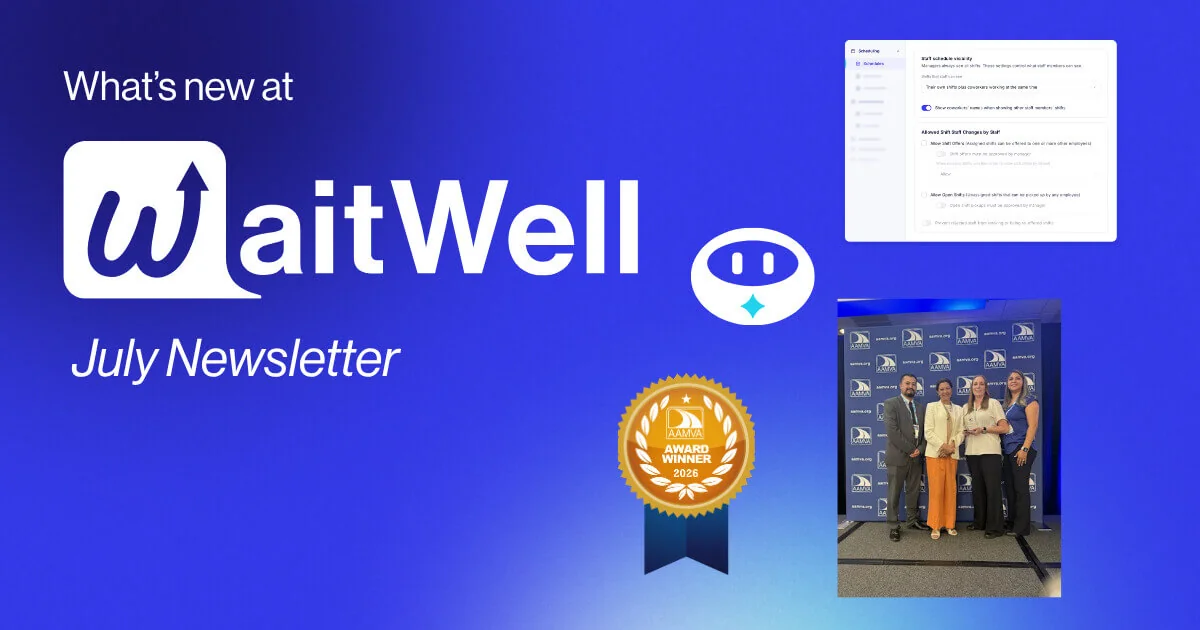
Your monthly roundup of what’s new at WaitWell. This issue covers the latest product release, where our team has been on the road, four new articles from the blog, and the free live sessions you can join in August.

👋 Hi WaitWell Community,

Filling a gap in the schedule just got easier. Managers can post open shifts for staff to claim, and staff can hand off a shift they can’t work to a coworker. Turn on approval if you want the final say.

Waillo Assist also went live. Ask a settings question in plain language, get a step-by-step answer and a link to the right page.

More below, including AAMVA Region 4 and four new articles.

Product updates

This release brings two new ways to fill gaps in your staff schedule, Waillo Assist for your settings questions, and a safeguard against overwriting customer records.

Staff scheduling updates

Shift offers and open shifts are both now available in the staff scheduling module. Managers post open shifts for staff to claim, and staff offer their own shifts to coworkers who can pick them up. Either way, your team fills gaps without waiting on a manager to rebuild the schedule.

Open shifts: post it, let your team claim it (manager side)

When you create a shift, you no longer have to name the person working it. Leave it open instead, and set the number of slots you need to fill.

You also choose who sees it:

- Everyone at the location

- Only staff in certain positions

- Only specific people you pick

Eligible staff see the open shift on their own schedule and claim it in one step. This helps when you know you are short-staffed but don’t yet know who is free.

Shift offers: hand off a shift you can’t work (staff side)

Plans change. A staff member who can’t work an assigned shift can now offer it to one coworker or to several at once.

Each coworker accepts or declines. The owner can cancel the offer at any time. And if everyone declines, nothing breaks. The shift simply stays with the original owner.

No more chasing down coworkers by text to find a replacement.

Optional manager approval

Some teams let staff sort out coverage on their own. Others need a manager to sign off. You decide.

Turn on approval for open shift claims, shift offers, or both. Pending requests then collect in a new Shift Requests tab. Managers review them in one place, approve or deny each change, and add an optional note.

A new “My Schedule” team view (staff side)

Staff get a week and day calendar of their own shifts. Coworkers’ shifts and open shifts appear alongside.

That context helps them see who to offer a shift to and which open shifts are worth claiming. You control how much of the team schedule staff can see.

Notifications keep everyone in the loop

Offers, claims, approvals, and denials all send notifications by SMS, email, and in the app. These follow your existing Scheduling Communications settings, so there is nothing new to set up.

Turning it on

Already using staff scheduling? Open shifts and shift offers are enabled per location under Settings > Scheduling. Turn on one or both, and choose whether manager approval is required.

Not using it yet? Contact your account manager. They’ll walk you through what the module does and how to add it to your subscription.

Ingest Status
Rejected
Dedupe hash
8b610282c03fe986811334e107744d65
Source Name
WaitWell
Original Summary

<p>Your monthly roundup of what's new at WaitWell. This issue covers the latest product release, where our team has been on the road, four new articles from the blog, and the free live sessions you can join in August.</p>
<p>The post <a href="https://waitwellsoftware.com/resources/articles/whats-new-at-waitwell-j…’s new at WaitWell &#8211; July 2026</a> appeared first on <a href="https://waitwellsoftware.com">WaitWell</a>.</p&gt;

Image URL
https://waitwellsoftware.com/wp-content/uploads/2026/07/WaitWell-July-newsletter.jpg
Source Node
Content Hash (SHA-256, erste 32 hex)
bb169f0ae195dab8c9e938f9a422f28f
What’s new at WaitWell – August 2026
Image File
Original HTML

What’s new at WaitWell – August 2026

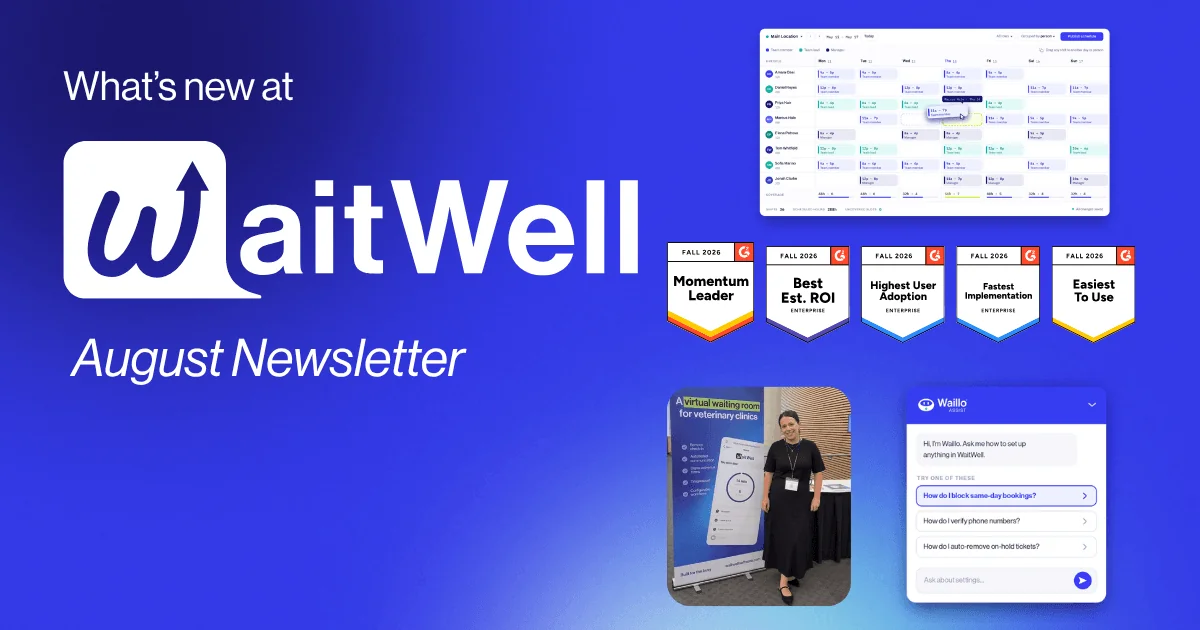
Your monthly roundup of what’s new at WaitWell. This issue covers our biggest release yet, where our team has been on the road, new articles from the blog, and the free live sessions you can join in September.

👋 Hi WaitWell Community,

This month brings a big release, plus a refresh across the app with clearer wording and a cleaner look.

Staff booking links lead the way. Each staff member can create up to 10 per location, and the link opens your booking site with that person already selected, photo and bio included.

Staff scheduling got a major upgrade too. It now opens on a full-week Staff view you can click, drag, and paste your way through.

Everything here is covered briefly, so reach out to your Client Success Manager to go deeper. Further down: where we have been this month, and the story behind Nevada’s award-winning DMV turnaround.

Product updates

This release brings staff booking links, a rebuilt staff scheduling view, better customer records and reporting, and a long list of smaller changes across bookings, queue, and setup.

Links that point straight to your staff

Each staff member can create their own booking links, up to 10 per location. The link opens your booking site with that person already selected, photo and bio included.

- Fix a link to one service, or let the customer pick

- Name it, like “Student advising”

- Set an expiry date, or leave it open

- Turn it off or delete it any time

- See how many times it has been opened

- Copy the link or open its QR code from the list

Staff can also add their own meeting link to their profile, now in its own section under account preferences. When they are assigned to a ticket, that link gets used. No link on file? We create one, same as always.

Customers and reporting

- The customers report has its own spot in the left menu, plus notes and tags on every record

- A refreshed tickets tab, showing each past visit’s service, status, staff member, location, and time

- Search customers at one location or all of them, with date of birth in the results

- Reporting tabs, so you can organize your reports instead of scrolling one long list

- Appointment search now opens on the last three months, and you can choose any date range

- See who created each appointment, and when, in the results

- A bounced and failed messages report, showing texts that failed and emails that bounced, with a link to the ticket

- See party size instead of ticket counts in tickets by agent

Bookings and queue

- Swap the customer on a saved ticket or appointment

- Give each person in a party their own service type

- Cap how many appointments get booked at the same time, or set a maximum for specific hours of the day. Leave a cell empty for no limit

- Send on-hold tickets to the bottom of the queue

- Send a waiver or form for the customer to fill in themselves, even if you cannot edit it

- Require a staff member on every bookable slot

- Services that send customers to another site stay out of the additional services list

Setup and everyday use

- Assign a staff role across a whole region in one step

- Give someone access to schedules, positions, and staff service times, without opening up the rest of your settings

- Drag your service type categories into the order you want them on your customer site and kiosk

- The workflow page in communication templates is now called walk-in

- Better keyboard and screen reader support throughout

- Clearer wording throughout the app, so your team moves through their day with confidence

- Waillo Assist remembers your conversation after a page refresh

Staff scheduling just got a major upgrade

Build the week faster, cover gaps in a click, and let staff see their shifts in their own calendar.

A new way to see the week

Scheduling now opens on the staff view: one row per person, the full week across the top, hours and daily totals built in. Weeks load noticeably faster, too.

- Click any empty day to add a shift

- Drag a shift to another day, or another person

- Copy a week or a single day, then paste it anywhere

- Shifts are colour-coded by position

One change to note: each shift now belongs to one person. To cover a busy day, add a shift per person. Multi-person shifts you have already built keep working as they did.

Fewer surprises

- Mark someone off sick straight from their shift

- Swap one person for another, or add extra staff to a busy date

- Discard unpublished changes and go back to your last published schedule

- When you publish, we flag booked appointments left without staff so you can reassign or cancel in one go

- Scheduled breaks block online booking

Shifts in your staff’s own calendar

Staff can add their WaitWell shifts to Google, Apple, or Outlook calendars. Their calendar updates on its own when the schedule changes, and time-off requests sit alongside their shifts.

Not using staff scheduling yet? Talk to your Client Success Manager about a free 3-month test run.

Mark your calendar for November

You have told us where WaitWell stops and your other systems start. In November, that gap closes. It is the biggest thing we have ever built, and it means far more of your day happens in one place. Stay tuned.

There is a lot in this release, and it is easier to show than to describe. Contact your Client Success Manager for a walkthrough.

Another season at the top of the G2 charts

WaitWell is leading the charts again in G2’s Fall Report. Reviews from the people who use our platform every day put us at the top in six categories – plus three badges for speed, savings, and ease of use.

Leader in:

- Enterprise

- Online Appointment Scheduling

- Patient Intake

- Patient Scheduling

- Queue Management

- Visitor Management

Momentum Leader in:

- Online Appointment Scheduling

- Patient Intake

- Queue Management

- Visitor Management

And three standout wins:

- Easiest Admin – Patient Intake

- Best Estimated ROI – Enterprise Visitor Management

- Fastest Implementation – Enterprise Online Appointment Scheduling

Every one of these badges comes from real customer reviews. Thank you to everyone who took the time to share how WaitWell works for their team.

If you are a WaitWell customer please leave us a review on G2 and receive a $50 gift card!

On the road

Four events in August, in four different corners of the work our customers do.

Florida Tax Collectors Association was the highlight. We spent it with our Florida customers, a lot of them in one room, catching up on what is working and what they want next.

TC TECH let us meet up with Georgia county officials, talking through what happens between a customer walking in and reaching the counter.

Colorado County Clerks Association brought together offices that handle motor vehicles, recording, and licensing at the same counter. That mix is exactly what queueing and appointments are built for.

VetBolus in Banff was close to home for our Alberta team. Clinics run on booking, reminders, and check-in, and we heard plenty about all three.

In September we are at the SD Counties Annual Convention in Pierre, and at IVECCS in Savannah from September 14 to 17. Come find us if you will be there!

New on the blog

How Nevada won the West’s top DMV customer service award – Nevada’s DMV took AAMVA’s Region 4 Customer Convenience Award, and the numbers explain why. After its rural offices moved to appointment-only service, the average wait dropped from 78 minutes to 18. That is a 77% reduction with the same buildings, the same staff, and the same customers. The piece walks through how Nevada got there, from a two-office pilot in early 2024 to every rural office by last December, and what other agencies can borrow from it.

Join a live session, or watch one on demand

Every week we run free live sessions to help you get more out of WaitWell. Some walk through features step by step. Others dig into bigger topics like cutting wait times, reducing no-shows, and running a smoother service operation. Bring your questions, because our team is there live to answer them.

Can’t make a time that works? Our on-demand library is open whenever you are. Watch a past session start to finish, or skip to the part you need.

Either way, you get the same thing: a live demo of the platform, real results from teams like yours, and a chance to talk through the service challenges you are working on.

See upcoming sessions and watch on demand

Until next time, The WaitWell team 💙

Class (B2B/B2C)
B2B
Ingest Status
Rewritten
Dedupe hash
a4cbbe685f095dbce627a4f3eba13a59
Press Eligible
Yes
Press Eligible Reason
Manuelle Prüfung nötig. Risiko: MEDIUM. Flags: ['numbers', 'finance']. Stichprobe: False
Source Name
WaitWell
Original Summary

<p>Your monthly roundup of what's new at WaitWell. This issue covers our biggest release yet, where our team has been on the road, new articles from the blog, and the free live sessions you can join in September.</p>
<p>The post <a href="https://waitwellsoftware.com/resources/news/newsletter/whats-new-at-wai… new at WaitWell &#8211; August 2026</a> appeared first on <a href="https://waitwellsoftware.com">WaitWell</a>.</p&gt;

Image URL
https://waitwellsoftware.com/wp-content/uploads/2026/09/August-newsletter-waitwell.png
Source Node
Content Hash (SHA-256, erste 32 hex)
b069b747b5685fec43899852cc3b195c
WaitWell Ranks No. 57 on Canada’s Top Growing Companies List
Image File
Original HTML

Front-line service is broken. We set out to fix it.

Staff at hospitals, campuses, government offices and stores lose hours every day to work that keeps them from serving people. They check people in, chase forms, handle transactions and redirect someone who has waited 20 minutes in the wrong line.

We call this the middle work. Most service software ignores it. WaitWell takes it on, so staff can focus on the part only a person can do.

“We did not grow by automating people out of service. We grew because we made service better for the staff at the counter, the person in front of them and the admin who has to make resource allocation decisions,” said Steve Vander Meulen, WaitWell’s CEO and co-founder. “That principle is why we are now building AI into the platform, and why we are building it to take work off staff rather than take staff off the floor.”

The same challenges, on both sides of the border

Over the past three years, thousands of service locations across the United States and Canada have chosen WaitWell. They face the same pressures: more people to serve, fewer staff to serve them, and a public that expects service to work as easily as everything else on their phone.

Where our growth came from

Our growth came from two places.

- New clients across the US and Canada, including the Nevada DMV, Vancouver Coastal Health, SKIMS and UC Berkeley.

- Existing clients who widened their use of WaitWell. This drove a significant portion of our growth.

Clients expand by handing over more of their service operations. A client might start with queue management, then add scheduling. Then they add more locations and more types of service. Over time, WaitWell shapes how they organize service itself.

Like most of our enterprise clients, GLENTEL, for example, has continued to expand WaitWell into hundreds more locations.

“At GLENTEL, we are always looking for ways to enhance the customer experience and support our retail teams. WaitWell has been a valuable partner in that effort, helping us streamline appointment management, improve in-store traffic flow, and deliver a more seamless service experience. Their willingness to listen, innovate, and adapt alongside our business has made the partnership especially beneficial. We are proud to work with a Canadian company that shares our commitment to innovation and service excellence,” said Tarik Belarbi, Senior Director of Retail Operations, Projects & Customer Service at GLENTEL.

The numbers

- No. 57 of 375 on Canada’s Top Growing Companies

- 500% growth over three years

- Nearly 45 million people served

- More than 12.8 million hours of waiting saved

Class (B2B/B2C)
B2B
Ingest Status
Rewritten
Dedupe hash
ebf01a608943df0bdfbc7290ecec850d
Press Eligible
Yes
Press Eligible Reason
Manuelle Prüfung nötig. Risiko: MEDIUM. Flags: ['numbers']. Stichprobe: False
Source Name
WaitWell
Original Summary

<p>The Globe and Mail has named WaitWell to its 2026 Report on Business ranking of Canada's Top Growing Companies. We ranked No. 57 out of 375 companies after growing 500% over three years. Here's how we got there.</p>
<p>The post <a href="https://waitwellsoftware.com/resources/news/waitwell-ranks-canada-top-g… Ranks No. 57 on Canada&#8217;s Top Growing Companies List</a> appeared first on <a href="https://waitwellsoftware.com">WaitWell</a>.</p&gt;

Image URL
https://waitwellsoftware.com/wp-content/uploads/2026/09/Report-on-business-WaitWell-Globe-and-Mail-2026-ranking.png
Source Node
Content Hash (SHA-256, erste 32 hex)
2f07e71f1e550b096e977668306e4a81