Celebrating World Maritime Day 2026
Image File
Original HTML

September 23, 2026

From Policy to Practice: Powering Maritime Excellence

At Teekay, we know that achieving excellence starts with investing in people. By equipping seafarers with the right training, mentorship and hands-on experience, we help transform standards and expectations into everyday actions.

The theme “Maritime Excellence” reflects the shared goal of creating a safe, secure, efficient and environmentally sustainable shipping industry that continually strives for improvement.

We support this commitment by investing in the next generation of maritime professionals through cadet training, mentorship and hands-on learning opportunities.

Through our cadet programs, onboard training initiatives and commitment to continuous learning, we are helping turn maritime policy into everyday practice, one future seafarer at a time.

Class (B2B/B2C)
Ignore
Ingest Status
Rejected
Dedupe hash
eb3658c46b838b58179eeede3753508c
Press Eligible
No
Press Eligible Reason
Text too short (116 words. Min: 150)
Source Name
Teekay Shipping (Canada) Ltd.
Original Summary

<p>From Policy to Practice: Powering Maritime Excellence At Teekay, we know that achieving excellence starts with investing in people. By equipping seafarers with the right training, mentorship and hands-on experience, we help transform standards and expectations into everyday actions. The &#8230; <a href="https://www.teekay.com/blog/2026/09/23/celebrating-world-maritime-day-2… More</a></p>
<p>The post <a href="https://www.teekay.com/blog/2026/09/23/celebrating-world-maritime-day-2…; rel="nofollow">Celebrating World Maritime Day 2026</a> appeared first on <a href="https://www.teekay.com&quot; rel="nofollow">Teekay</a>.</p>

Image URL
https://www.teekay.com/wp-content/uploads/2026/09/07-WINNER-2O-John-Michael-C-Ibanez-Summit-Spirit-Bridge.jpg
Content Hash (SHA-256, erste 32 hex)
8bffc852ec1d7a209884d9b5df5a76b6
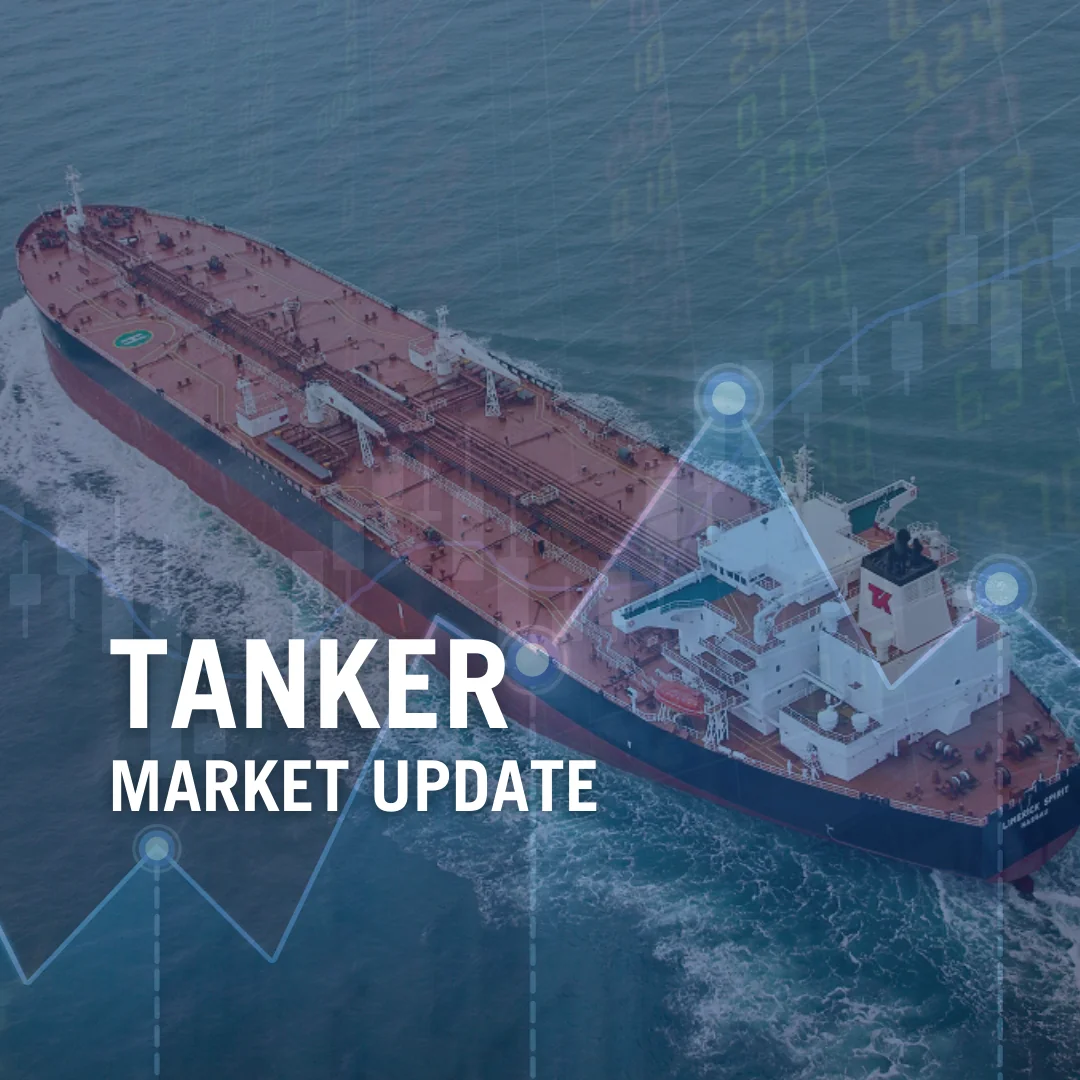
Teekay Tankers’ Market Update, September 2026
Image File
Original HTML

September 29, 2026

Geopolitical disruptions and trade inefficiencies drive spot tanker rates to record highs.

A series of geopolitical events impacting vessel transits and oil flows, most notably through the Strait of Hormuz and the Red Sea, have combined to create longer voyage distances and increased trade inefficiency in recent months, culminating in an increase in spot tanker rates to record highs during September.

Crude oil exports from the Middle East Gulf have undergone a recovery, despite ongoing attacks against ships, as several producers have taken to shuttling crude on a dedicated fleet of VLCCs through the Strait of Hormuz for ship-to-ship (STS) transfer in the Gulf of Oman. This soaks up a large number of ships and also generates added inefficiencies such as extended waiting times, helping to boost VLCC spot rates to record highs.

Meanwhile, renewed Houthi attacks on Saudi Arabian shipping and oil infrastructure in the Red Sea has forced exports from the port of Yanbu north through the Suez Canal / SUMED pipeline rather than south via the Bab el-Mandeb Strait, further adding to voyage distances.

Finally, strong Asian refinery demand is keeping the arbitrage for long-haul movements from the Atlantic to Pacific wide open, creating additional tanker tonne-mile demand. When combined, the net impact of a growing shuttle / STS trade from the Middle East Gulf, disruptions and diversions in the Red Sea, and continued demand for Atlantic barrels in Asia has led to spot tanker rates reaching record highs in September.

Looking ahead, geopolitical developments will remain the primary driver of tanker markets in the near-term, with future rate direction hinging on the outcome of key geopolitical factors. However, ongoing trade inefficiencies and longer voyage distances are expected to keep spot tanker rates well supported into Q4-26.

Watch Christian Waldegrave‘s tanker market update for more.

Forward Looking Statements

This content contains forward-looking statements which reflect the Company’s current views with respect to certain future events and performance, including statements regarding: tanker market fundamentals, including the balance of supply and demand in the tanker market, and spot tanker charter rates. The following factors are among those that could cause actual results to differ materially from the forward-looking statements, which involve risks and uncertainties, and that should be considered in evaluating any such statement: changes in spot market tanker rates; changes in the production of or demand for oil; changes in trading patterns significantly affecting overall vessel tonnage requirements; greater or less than anticipated levels of tanker newbuilding orders or greater or less than expected level of tanker scrapping; changes in applicable industry laws and regulations and the timing of implementation of new laws and regulations; changes in the typical seasonal variations in tanker charter rates and other factors discussed in Teekay Tankers’ filings from time to time with the United States Securities and Exchange Commission, including its most recent Annual Report on Form 20-F and subsequent Reports on Form 6-K for the quarterly periods ended thereafter. The Company expressly disclaims any obligation or undertaking to release publicly any updates or revisions to any forward-looking statements contained herein to reflect any change in the Company’s expectations with respect thereto or any change in events, conditions or circumstances on which any such statement is based.

Class (B2B/B2C)
B2B
Ingest Status
Rewritten
Dedupe hash
da6b7f5cbc1940305aeee3d76ec1a269
Press Eligible
Yes
Press Eligible Reason
Manuelle Prüfung nötig. Risiko: MEDIUM. Flags: ['finance']. Stichprobe: False
Source Name
Teekay Shipping (Canada) Ltd.
Original Summary

<p>Geopolitical disruptions and trade inefficiencies drive spot tanker rates to record highs. A series of geopolitical events impacting vessel transits and oil flows, most notably through the Strait of Hormuz and the Red Sea, have combined to create longer voyage &#8230; <a href="https://www.teekay.com/blog/2026/09/29/teekay-tankers-market-update-sep… More</a></p>
<p>The post <a href="https://www.teekay.com/blog/2026/09/29/teekay-tankers-market-update-sep…; rel="nofollow">Teekay Tankers&#8217; Market Update, September 2026</a> appeared first on <a href="https://www.teekay.com&quot; rel="nofollow">Teekay</a>.</p>

Image URL
https://www.teekay.com/wp-content/uploads/2024/05/Tanker-Market-Website-Feature-Image.png
Content Hash (SHA-256, erste 32 hex)
899190c4a9c378c4614b9babe48fad10
Another Round of Sea and Shore Sportmanship
Image File
Original HTML

October 7, 2026

Coming together as One Teekay with unity, play and #TeekaySPIRIT at our annual Sportsfest.

From basketball, pickleball and badminton tournaments to tug of war, limbo rock and family activities, the event brought our colleagues together beyond their day-to-day roles.

Beyond the games and awards, Sportsfest reminded us that the strongest victories come from the friendships we build, the memories we create, and the spirit of unity that brings us together as One Teekay.

Class (B2B/B2C)
Ignore
Ingest Status
Rejected
Dedupe hash
5e20e1e927043bfc88c6038ae8c80df6
Press Eligible
No
Press Eligible Reason
Text too short (78 words. Min: 150)
Source Name
Teekay Shipping (Canada) Ltd.
Original Summary

<p>Coming together as One Teekay with unity, play and #TeekaySPIRIT at our annual Sportsfest. From basketball, pickleball and badminton tournaments to tug of war, limbo rock and family activities, the event brought our colleagues together beyond their day-to-day roles. Beyond &#8230; <a href="https://www.teekay.com/blog/2026/10/07/another-round-of-sea-and-shore-s… More</a></p>
<p>The post <a href="https://www.teekay.com/blog/2026/10/07/another-round-of-sea-and-shore-s…; rel="nofollow">Another Round of Sea and Shore Sportmanship</a> appeared first on <a href="https://www.teekay.com&quot; rel="nofollow">Teekay</a>.</p>

Image URL
https://www.teekay.com/wp-content/uploads/2026/09/Basketball-in-Action-1-scaled.jpg
Content Hash (SHA-256, erste 32 hex)
845ae61b8b8992de03f08746af5cc82d
Investing in Young and Promising Maritime Talents
Image File
Original HTML

October 8, 2026

With Teekay Foundation, we continue to show support for our next generation of maritime professionals as they celebrate their milestones and with some of our sponsored scholars earning top honors, making us even prouder.

The Saint Joseph Institute of Technology (SJIT) Maritime Academy, recently celebrated the Recognition Rites of Class of 2026, a significant milestone honoring the academic achievements, perseverance, and leadership potential of its future maritime professionals.

Guided by the theme “Forging Future Mariners: Courage, Discipline, and Honor,” the ceremony brought together students, parents, faculty members, industry partners, and guests to recognize the accomplishments of the cadets as they prepare to embark on the next stage of their maritime journey.

Adding inspiration to the occasion was the presence of Teekay Manila’s Managing Director, Rosalina Talavera who served as the Guest Speaker for the event. In her address, she congratulated the Class of 2026 for their dedication and resilience, emphasizing that their achievements represent far more than academic success. She highlighted the importance of character, discipline, and perseverance—qualities that will serve as the foundation of their future careers at sea.

Sponsored Students Earning Top Recognition

We are also proud to share that two Teekay & TK Foundation-sponsored cadets have been recognized among the Ten Outstanding Maritime Students of the Philippines (TOMSP), one of the nation’s most prestigious honors for maritime students.

Selected from approximately 50 nominees and endorsed by 26 maritime institutions nationwide, the finalists underwent a rigorous screening and evaluation process conducted by a distinguished panel of TOMSP judges. From this highly competitive pool, only 20 exceptional students were chosen as finalists. We are honored that two of our cadets were among those recognized for their outstanding academic performance, leadership potential, character, and commitment to the maritime profession.

Representing our valued partner institution, Saint Joseph Institute of Technology (SJIT), Deck Cadet Christine Tenio and Deck Cadet Kim Japhet Amarille, both currently in their third year of studies, proudly stood alongside the country’s most accomplished maritime students.

This recognition is particularly meaningful for our program and seeing a new generation of cadets achieve this milestone reflects the continued success of our scholarship and development initiatives.

See some photos of the events as shared by our teams in attendance:

Class (B2B/B2C)
B2B
Ingest Status
Rewritten
Dedupe hash
db19384c68d0469453806030b22acb20
Press Eligible
Yes
Press Eligible Reason
Company foundation supports maritime students and highlights its scholarship program.
Source Name
Teekay Shipping (Canada) Ltd.
Original Summary

<p>With Teekay Foundation, we continue to show support for our next generation of maritime professionals as they celebrate their milestones and with some of our sponsored scholars earning top honors, making us even prouder. The Saint Joseph Institute of Technology &#8230; <a href="https://www.teekay.com/blog/2026/10/08/investing-in-young-and-promising… More</a></p>
<p>The post <a href="https://www.teekay.com/blog/2026/10/08/investing-in-young-and-promising…; rel="nofollow">Investing in Young and Promising Maritime Talents</a> appeared first on <a href="https://www.teekay.com&quot; rel="nofollow">Teekay</a>.</p>

Image URL
https://www.teekay.com/wp-content/uploads/2014/06/19542311259_45294f1d2f_o.jpg
Content Hash (SHA-256, erste 32 hex)
ece59d36debeaa5cde264e9e5f4856d9
The #TeekaySPIRIT Journey
Image File
Original HTML

October 9, 2026

Raising our Teekay flag to new heights and continents, together.

What started as a personal bucket list item for Additional Master Alexander Lyakhov, quickly turned into something bigger. Fuelled with determination and pride, our Teekay flag was carried all the way to the summit of the highest peak in Europe! But its journey didn’t stop there…

The flag made its rounds through various mountain peaks and Teekay offices, getting signed by all of us. Now, it’s covered in names of our global Teekay family, standing as a powerful reminder that our #TeekaySPIRIT knows no boundaries.

This flag represents our shared heartbeat in conquering imaginable feats as we take genuine pride in each other’s successes and celebrate every win as one team.

Class (B2B/B2C)
Ignore
Ingest Status
Rejected
Dedupe hash
1206383416165214493889750c84ed1c
Press Eligible
No
Press Eligible Reason
Text too short (127 words. Min: 150)
Source Name
Teekay Shipping (Canada) Ltd.
Original Summary

<p>Raising our Teekay flag to new heights and continents, together. What started as a personal bucket list item for Additional Master Alexander Lyakhov, quickly turned into something bigger. Fuelled with determination and pride, our Teekay flag was carried all the &#8230; <a href="https://www.teekay.com/blog/2026/10/09/the-teekayspirit-journey/">Read More</a></p>
<p>The post <a href="https://www.teekay.com/blog/2026/10/09/the-teekayspirit-journey/&quot; rel="nofollow">The #TeekaySPIRIT Journey</a> appeared first on <a href="https://www.teekay.com&quot; rel="nofollow">Teekay</a>.</p>

Image URL
https://www.teekay.com/wp-content/uploads/2026/10/AM-Alexandr-Lyakhov-Mount-Elbrus.png
Content Hash (SHA-256, erste 32 hex)
1c924bdc67f379a5557df49a8acd5460
The Rise of Sovereignty: Redefining Satellite Communications for National Security
Image File
Original HTML

Secure, uninterrupted communication forms the backbone of national defense. As geopolitical tensions shift and space-based threats multiply, governments face a pressing challenge: how to maintain absolute control over their critical communication networks.

To explore this complex issue, ST Engineering iDirect’s webinar, The Rise of Sovereignty: Redefining Satellite Communications for National Security, offered an exclusive look at how nations are securing their communication infrastructure against modern threats.

Meet the Experts

The session featured a panel discussion by industry veterans who understand the intricate balance of technology and national security:

- Keith Blanchet, Vice President, Global Government, ST Engineering iDirect

- Dave Davis, Senior Technical Director, Global Government, ST Engineering iDirect

- Alison Grey, Associate Partner, PA Consulting

Together, they unpacked the strategic and technological shifts driving the future of secure connectivity.

Key Takeaways from the Discussion

The Shift Toward Sovereign Control

Governments are no longer satisfied with mere access to satellite capacity; they now demand complete control over their mission stacks. As Alison Grey noted, the concept of “sovereignty” is evolving into “assurance and resilience.” Full end-to-end in-country ownership may be unrealistic for most nations, but the practical goal is assured access, control, and resilience. Keith Blanchet further emphasized that sovereignty is defined by resiliency, sovereign control, and interoperability. In today’s landscape, control outweighs ownership, and interoperability is essential for coalition operations.

This shift is evident in programs like the UK’s Skynet 6, France’s SYRACUSE IV, and the EU’s IRIS², which underscore a growing focus on national autonomy. Nations are increasingly moving toward owning sovereign payloads, ground segments, and implementing robust national cyber policies. Governments require assured communications, particularly in scenarios where supply chains or alliances face sudden disruptions, ensuring operational continuity and resilience in an unpredictable world.

Defending Against Emerging Threats

Threats to SATCOM infrastructure go far beyond traditional interference. Today, networks face cyber compromises of ground systems, RF jamming, and spoofing. The panel stressed that defending against these threats requires a layered approach. Hardened gateways, zero-trust segmentation, encrypted traffic, spectrum agility, and quantum encryption are non-negotiable. Quantum encryption, with its ability to leverage the principles of quantum mechanics for virtually unbreakable security, ensures that sensitive data remains protected even against the most advanced cyber threats. Resilience comes from distribution. Networks must keep operating through partial degradation rather than relying on a single satellite or teleport.

Balancing Sovereignty with Interoperability

How do you maintain strict national control while staying connected with allied forces? The answer lies in hybrid SATCOM solutions. Nations can separate what must remain sovereign—like policy control, encryption, and key management—from what can remain interoperable. This allows governments to leverage allied or commercial networks for extra reach and surge capacity without compromising their core security architecture.

The Multi-Orbit Advantage

Relying on a single orbital layer is a strategy of the past. Multi-orbit architectures significantly increase network resiliency and ensure reliable communications. The panel explored how combining Geostationary Orbit (GEO), Medium Earth Orbit (MEO), and Low Earth Orbit (LEO) enhances flexibility. GEO provides wide coverage, MEO adds performance, and LEO brings low latency and rapid reconstitution. A multi-orbit design empowers nations to route mission traffic based on real-time security needs, latency requirements, and threat conditions.

Software-Defined Networks (SDN)

The transition from hardware-centric to policy-driven networks marks a major milestone for SATCOM. Software-defined networks allow sovereign users to reconfigure bandwidth, routing, and security domains instantly as missions change. Instead of redesigning an entire network to counter a new threat, nations can use software-led orchestration to adapt network behavior on the fly. This flexibility prevents proprietary lock-in and keeps infrastructure adaptable. As Dave Davis noted, encryption standards are advancing to balance domestic control with interoperability, allowing seamless transitions between sovereign and joint operational encryption. With the impending “Q Day,” when quantum computing could render traditional encryption obsolete, governments are prioritizing post-quantum encryption to secure both terrestrial and satellite networks.

Alison Grey stressed that while cryptography is vital, human error remains the greatest cybersecurity vulnerability, making automation and usability essential to safeguard systems. Keith Blanchet highlighted AI’s critical role in monitoring networks and responding to threats in real time, further enhancing resilience. Together, advancements in encryption, automation, and AI are driving a more adaptive and secure SATCOM architecture for the future.

Fostering Public-Private Partnerships

No government can build and optimize an entire sovereign SATCOM ecosystem alone. The webinar underscored the necessity of public-private partnerships. The most successful models feature governments defining the mission and sovereign requirements, while industry partners deliver modular technology, rapid innovation, and long-term sustainment.

Watch the Replay

The future of sovereign SATCOM relies on flexible ecosystems, multi-orbit architectures, and software-defined ground systems. Preparing for the next decade means investing in resilient, future-proof networks today.

The panel shared practical strategies, real-world examples, and actionable advice for navigating the rapidly evolving SATCOM domain.

Watch the replay of The Rise of Sovereignty: Redefining Satellite Communications for National Security today to gain a deeper understanding of the technologies securing our global communication networks.

Class (B2B/B2C)
B2B
Ingest Status
Rewritten
Dedupe hash
9e29155be75aafe8462860c6e72a9957
Press Eligible
Yes
Press Eligible Reason
Substantive discussion of satellite communications technology, cybersecurity, and national security infrastructure for industry professionals.
Source Name
ST Engineering iDirect
Original Summary

<p>Secure, uninterrupted communication forms the backbone of national defense. As geopolitical tensions shift and space-based threats multiply, governments face a pressing challenge: how to maintain</p>
<p>The post <a href="https://www.idirect.net/blog/the-rise-of-sovereignty-redefining-satelli… Rise of Sovereignty: Redefining Satellite Communications for National Security</a> appeared first on <a href="https://www.idirect.net">ST Engineering iDirect</a>.</p>

Image URL
https://www.idirect.net/wp-content/uploads/2026/04/SovWebBlog_1292x458.webp
Content Hash (SHA-256, erste 32 hex)
408051b34cf0277179cc4fe6901320b4
Future-Proofing SATCOM: An Approach to Innovation and Security
Image File
Original HTML

This Q&A brings together ST Engineering iDirect and Paradigm to discuss how both companies are advancing resilient, future‑proof SATCOM for government and defense users operating at the tactical edge. Keith Blanchet and Ulf Sandberg share insights on modernization, multi‑orbit readiness, secure communications, and the role of software‑defined technologies like the 450SDM and Paradigm’s PIM architecture in shaping next‑generation mission success.

Keith Blanchet – Vice President International Government & Defense at ST Engineering iDirect

Keith Blanchet is the Vice President of Government and Defense at ST Engineering iDirect, where he leads Government Relations, strategic initiatives, and oversees business development efforts in the international government and defense sectors.

Ulf Sandberg – Managing Director & Founder at Paradigm

Ulf Sandberg has over 35 years’ experience in the global satellite and telecommunications industry. Founded in 1996, Paradigm is an independent, highly regarded manufacturer of satellite communication equipment. Trusted by end-users globally Paradigm delivers the most advanced satcom, made simple.

About Paradigm

Paradigm is a Satcom solutions provider based in the United Kingdom with a global presence. Paradigm’s mission is to make the world’s most advanced Satcom simple to deploy and operate. With the intelligent Paradigm Interface Module (PIM) at the core, Paradigm terminals offer exceptional flexibility, operating across multiple frequency bands, constellations, and networks. The company’s range of secure, rapid deploy, low-SWaP terminals includes the single-case HORNET and the ultraportable, backpack-ready RAGNO – both tested and proven in demanding field environments.

With a long history of collaboration with ST Engineering iDirect, Paradigm has reinforced its market leadership through intelligent solutions powered by the unique PIM. Enabled by the ST Engineering iDirect 950mp modem and the next generation 450SDM modems, integrations like the PIM950 and PIM450 give users unparalleled flexibility, allowing seamless movement between different software defined profiles at the touch of a button.

Keith: Paradigm and ST Engineering iDirect have fostered a long-standing relationship working together over many years, how have both parties grown?

Ulf: Paradigm and ST Engineering iDirect share a common philosophy: delivering flexible, mission-ready solutions that evolve with operational demands. We both take an agnostic approach, ensuring that solutions are not constrained by a single architecture but instead built to meet real-world requirements, today and in the future.

Over time, this alignment has enabled deeper integration between modem technology and terminal design. Paradigm’s PIM-powered architecture has been central to our growth, allowing seamless integration of iDirect modems such as the 950mp and now the 450SDM into a unified, adaptable platform. The result is a collaboration that delivers not just compatibility, but future proof solutions where hardware and software work together to simplify deployment while maintaining performance and reliability in the field.

Keith: A key driver behind your success is staying aligned with rapid technological innovation. What do you mean by ‘future-proof solutions’ and how does the 450SDM contribute to that?

Ulf: For Paradigm, “future-proof’ is not about predicting every requirement, it’s about designing systems that can adapt as those requirements evolve, like a Lego model where you can add and take away. This starts with understanding the end-user; they need solutions that are reliable, easy to use, and capable of supporting multiple missions without increasing complexity.

The introduction of the 450SDM supports this approach. Its compact form factor and flexible architecture enable integration into lightweight and deployable systems, such as Paradigm’s RAGNO terminal, while also supporting multi-orbit and multi-waveform operations. Also, reinforced by Paradigm’s PIM which provides a stable, proven foundation for continuous enhancement. With our in-house design and R&D team, we can rapidly respond to emerging needs, adding capabilities without compromising reliability. Together, the PIM and the 450DSM ensure that our HORNET and RAGNO terminals are not only fit for today’s missions but remain upgradeable as technology and operational demands advance.

Keith: Do you think it is about redefining SATCOM or simply embracing modernization with the transition toward next-generation communications?

Ulf: It is less about redefining SATCOM and more about enabling its evolution. Modern operations demand greater flexibility, interoperability, and resilience across multiple domains, and this requires a shift in how networks are designed and managed with both Milsat (such as WGS application) and commercial networks.

We see this with iDirect’s first software defined modem, the 450DSM and Paradigm’s intelligent PIM controller we are both focused on the latest, greatest capabilities featured through software-design. An example would be the latest PIM tool: Multi-orbit WAN and PACE planning which is not just a hot topic but with our terminals a field-proven, loved feature. GEO remains the primary layer for its trusted reliability, but the ability to integrate additional systems ensures an “always-on” service even in contested or degraded environments, operating seamlessly across multiple orbits and frequencies. This is not simply modernization; it is a practical step toward a more adaptive and resilient SATCOM architecture, that both the PIM and appliance like the 450SDM are achieving.

Keith: With evolving threats and advancing technology, how is Paradigm strengthening security and resilience at the tactical edge?

Ulf: The priority for many of our users in the field is still secure, resilient SATCOM and Paradigm addresses this through the PIM integration of modems such as 950mp, 450SDM which are leveraging CSIR, FIPS 140-2 & 140-3 Level 3 TRANSEC, and Paradigm’s own embedded security features like anti-tamper protection.

Beyond encryption, resilience and entire data path flexibility is built into our system design with field-proven IP67 rating. Paradigm terminals are engineered to fully operate in GPS-denied environments, ensuring continuity of communications where it matters most and extending the robust capabilities of iDirect modem with intelligent terminal design. The result is a solution shaped by operational experience, one that reflects lessons listened and learnt from the field and deliver secure, reliable communications under real-world conditions.

Keith: So, with an acceleration of SATCOM modernization, how does operational efficiency remain a decisive factor for mission-success and user safety?

Ulf: Operational efficiency is driven by reducing complexity and deployment time, Paradigm terminals can be deployed in under five minutes, ready for immediate plug and play operation. The rapid deployment of Paradigm terminals is further enhanced through intuitive, AI-assisted, accurate pointing without the need for specialist expertise. This simplifies operation in high-pressure environments and reduces the risk of error. You also have to think of minimizing the downtime which Paradigm’s PIM uniquely offers through pre-configured/stored mission profiles, allowing users to get connected with minimal setup.

Combined with the high performance and reliability of iDirect modems, users benefit from consistent, seamless connectivity. The result is a system like our RAGNO with unrivalled SWaP, just like the 450SDM with a 30% reduction in size so ultimately usability and performance are faster and more powerful with the final solution.

Experience Paradigm and ST Engineering iDirect technology firsthand at upcoming events—where innovation meets mission-ready solutions:

- SOF Week (Tampa, FL) – May 18-21

- iDirect Defence Technology Day (Munich, Germany) – June 10

- DALO Industry Days (Herning, Denmark) – August 19-20

- TechNet Augusta (Augusta, GA) – August 17-20

Find out more about Paradigm solutions by contacting: enquiries@paracomm.co.uk

Class (B2B/B2C)
B2B
Ingest Status
Rewritten
Dedupe hash
0beef8e18e2c8f0058c85fba47ea88e2
Press Eligible
Yes
Press Eligible Reason
Manuelle Prüfung nötig. Risiko: MEDIUM. Flags: ['numbers']. Stichprobe: False
Source Name
ST Engineering iDirect
Original Summary

<p>This Q&#38;A brings together ST Engineering iDirect and Paradigm to discuss how both companies are advancing resilient, future‑proof SATCOM for government and defense users operating</p>
<p>The post <a href="https://www.idirect.net/blog/future-proofing-satcom-an-approach-to-inno… SATCOM: An Approach to Innovation and Security</a> appeared first on <a href="https://www.idirect.net">ST Engineering iDirect</a>.</p>

Image URL
https://www.idirect.net/wp-content/uploads/2026/04/STEi_Paradigm_Blog_WebBanner.webp
Content Hash (SHA-256, erste 32 hex)
957ed9bf020c180200ff63c50c7fd486
Why Hybrid Networks are the Fastest Path to 5G NTN
Image File
Original HTML

By Shravan K Gaddam, VP Engineering, CTO Office, ST Engineering iDirect

The conversation around 5G non-terrestrial networks (NTN) has moved beyond vision and into execution.

Across the telecom ecosystem, operators, satellite providers and technology partners now agree on the destination: seamless, ubiquitous connectivity delivered through integrated terrestrial and satellite networks. What remains under discussion is the fastest and most practical path to get there. Increasingly, the answer is clear.

Hybrid network architectures, combining existing satcom infrastructure with 5G-ready, standards-aligned platforms, are emerging as the most effective way to accelerate NTN deployments while protecting current investments.

Recent research by ST Engineering iDirect, alongside ongoing collaboration with partners like Capgemini on 5G NTN integration, confirms that hybrid architectures are not only technically viable, but they are also the model operators trusted most to deliver scalable 5G NTN services.

From standalone systems to hybrid architectures

Satellite and terrestrial networks have traditionally evolved as separate environments, each with their own core, authentication and management systems and its corresponding operational processes. While this separation enabled innovation within each domain, it also created complexity when trying to deliver unified services across both. 5G NTN changes the requirements.

To support provider roaming, mobility, service continuity and enterprise-grade performance, satellite networks must integrate directly with 5G cores just like terrestrial networks have and operate as part of a common architecture.

A hybrid model makes this possible without requiring operators to replace existing satcom platforms. In a hybrid architecture, existing multi-orbit satellite networks continue to operate, while standards-based interfaces enable integration with the 5G core. Network functions can evolve toward virtualized and cloud-native deployments, and terrestrial and satellite resources can be orchestrated through a unified management layer.

There are two ways of achieving this:

One is for satellite operators who want to use their existing (non-3GPP) satcom infrastructure to access the 5G Network. ST Engineering iDirect has already demonstrated at WSBW that with its newly developed Satellite Interworking Gateway (SIG) based on 3GPP standards that acts as an intermediary between non-3GPP networks and 5G Networks via AGF. This allows satellite operators to tap into 5G Core efficiencies while continuing to use their current satellite waveforms—protecting existing investments and enabling new non-3GPP inter-provider roaming and revenue opportunities without major infrastructure changes.

The other one is for telco and satellite operators, using native 5G NR NTN architecture including satellite optimized gNodeB and 3GPP’s 5G NR (New Radio) waveform to connect 5G UEs to the 5G Network. This is the model telcos prefer because it aligns directly with their standards-based RAN architecture, simplifies roaming, and extends terrestrial coverage seamlessly via satellite.

This hybrid approach provides options for a controlled, low-risk migration path from today’s satcom environments to full 5G NTN capability.

Industry collaboration accelerating NTN readiness

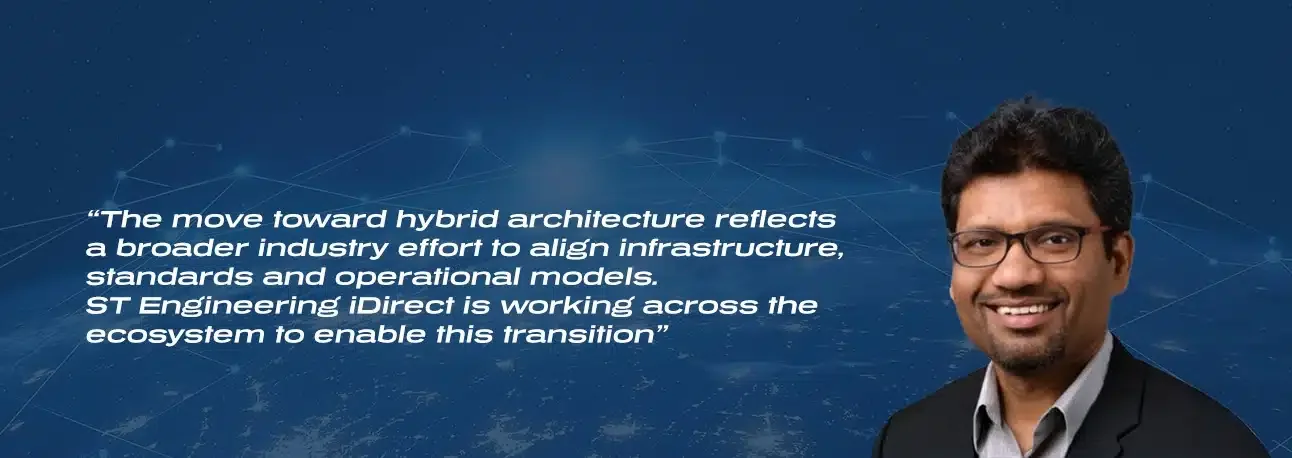
The move toward hybrid architecture reflects a broader industry effort to align infrastructure, standards and operational models. ST Engineering iDirect is working across the ecosystem to enable this transition, including a collaboration with multiple partners for different layers in the stack and components in the solution to advance 5G NTN solutions that integrate satellite and terrestrial networks into a unified architecture.

This work focuses on validating real-world deployment models, accelerating standards-based integration and helping operators adopt NTN without disrupting existing services. As the industry moves toward converged networks, collaboration between satellite technology providers, mobile operators and system integrators is becoming essential to turning 5G NTN from concept into commercial reality.

What survey data tells us about market readiness

To better understand how operators are planning for this transition, ST Engineering iDirect commissioned a global survey of 350 telecom decision-makers across seven markets, including mobile network operators, infrastructure providers and cloud service companies.

The findings show strong momentum behind satellite integration and 5G NTN adoption. Almost all respondents see satcom as strategically important, with 95% describing it as essential or important to achieving seamless global connectivity, and 93% expecting satellite to play a bigger role in their business going forward. Investment is also increasing, with 88% planning to grow spending on satellite technologies over the next five years.

The survey also shows that expanding coverage remains a top priority, with 22% naming 5G expansion as their biggest technology focus in the next 12 months, while 19% already see 5G NTN as a future growth opportunity. These results confirm that the market is ready to move forward, but only with architectures that allow integration without disruption.

Barriers to adoption remain real

Deploying 5G NTN is not just a technology challenge. Operators must manage costs, integrate with existing infrastructure and ensure interoperability across multiple vendors and network domains. In many cases, current satcom platforms, terrestrial cores and management systems were never designed to work together as a single environment.

Replacing them entirely is not realistic. Hybrid architecture allows operators to overcome these barriers by integrating satellite networks with 5G cores using standards-based interfaces while continuing to use proven infrastructure. This reduces risk, shortens deployment timelines and allows organizations to evolve their networks at their own pace.

Integration concerns are shaping architectural decisions

As operators plan their future networks, integration risk is becoming one of the most important factors in technology selection. Solutions must support 3GPP-aligned NTN standards, interoperate with existing satcom ground systems and enable migration toward virtualized and cloud-native deployments. They must also support orchestration across terrestrial and multi-orbit satellite networks.

Hybrid architectures address these requirements by allowing new capabilities to be introduced incrementally, creating a converged environment where satellite and terrestrial connectivity can be managed as part of a single network rather than separate systems.

Technology priorities for the next phase of NTN

Across the industry, several priorities are shaping the roadmap to 5G NTN. Standards alignment is critical for interoperability and long-term scalability, while cloud-native and software-defined platforms enable more flexible deployment and simpler upgrades. Intelligent orchestration is also becoming essential for managing hybrid networks across multiple orbits and access technologies.

Conclusion

Demand for global, resilient and high-performance connectivity continues to grow, and terrestrial networks alone cannot meet that demand. 5G NTN will play a key role in extending coverage and enabling new services, but adoption depends on how easily satellite can be integrated into existing environments.

Hybrid architectures provide the fastest path forward, allowing operators to align with evolving standards and scale at their own pace.

The future of connectivity will not be terrestrial or satellite alone, but hybrid networks that combine both into a single, orchestrated system.

Listen to our on-demand webinar on how hybrid architectures are enabling scalable 5G NTN deployments, discover how operators are overcoming integration challenges, accelerating deployment timelines and building the foundation for the next generation of global connectivity.

Class (B2B/B2C)
B2B
Ingest Status
Rewritten
Dedupe hash
c2097a44264d3eda5b8b03ec1589e17a
Press Eligible
Yes
Press Eligible Reason
Manuelle Prüfung nötig. Risiko: MEDIUM. Flags: ['numbers']. Stichprobe: False
Source Name
ST Engineering iDirect
Original Summary

<p>By Shravan K Gaddam, VP Engineering, CTO Office, ST Engineering iDirect The conversation around 5G non-terrestrial networks (NTN) has moved beyond vision and into execution.</p>
<p>The post <a href="https://www.idirect.net/blog/why-hybrid-networks-are-the-fastest-path-t… Hybrid Networks are the Fastest Path to 5G NTN</a> appeared first on <a href="https://www.idirect.net">ST Engineering iDirect</a>.</p>

Image URL
https://www.idirect.net/wp-content/uploads/2026/04/Shravan-blog-header.webp
Content Hash (SHA-256, erste 32 hex)
2fede140ff657f4956de320c3e83cbb9
Terminal Advantage: Powering National Security Through SATCOM
Image File
Original HTML

In an era of dynamic geopolitical challenges and rapidly evolving technology, the role of satellite communications (SATCOM) in national security has never been more critical. In our latest podcast, Dave Davis, Senior Technical Director of Global Government at ST Engineering iDirect, dives into the future of SATCOM with industry leaders Joey Williamson (Airbus Defence and Space) and Henry Nelson (Marconi Technologies UK, formerly Ultra I&C).

This discussion offers a sneak peek into the topics that will take center stage at the iDirect Defence Technology Day in Munich on June 10th. From the impact of geopolitical tensions on SATCOM demand to the rise of multi-orbit, multi-frequency capabilities, the conversation explores how innovation is reshaping the defense landscape.

Key highlights include:

- The Shift in SATCOM Priorities: How developments like the war in Ukraine and the rise of LEO constellations have transformed the way governments approach satellite communications.

- Modularity and Interoperability: Why adaptable terminals and seamless integration across constellations and networks are essential for modern defense operations.

- The Role of AI and Autonomy: How AI, machine learning and software-defined networks are enabling smarter, faster, and more resilient communication systems.

- Collaboration in the Industry: The importance of partnerships and shared innovation in delivering mission-critical solutions.

As the panelists emphasize, the future of SATCOM lies in its ability to adapt to ever-changing environments, leverage cutting-edge technologies, and prioritize user needs. Whether it’s designing terminals for Arctic conditions or integrating AI to optimize bandwidth, the focus remains on delivering flexible, future-proof solutions.

This episode is a must-listen for anyone interested in the intersection of technology, defense, and global security. Tune in to hear the conversation shaping the future of SATCOM. And don’t miss the chance to dive deeper into these topics at Defence Technology Day or keep an eye out for the wrap-up blog—where innovation meets mission readiness.

Class (B2B/B2C)
B2B
Ingest Status
Rewritten
Dedupe hash
2d7748f9e32c6b3dcb087f23d0e6730b
Press Eligible
Yes
Press Eligible Reason
Industry discussion of SATCOM technology and defense communications.
Source Name
ST Engineering iDirect
Original Summary

<p>In an era of dynamic geopolitical challenges and rapidly evolving technology, the role of satellite communications (SATCOM) in national security has never been more critical.</p>
<p>The post <a href="https://www.idirect.net/blog/terminal-advantage-powering-national-secur… Advantage: Powering National Security Through SATCOM</a> appeared first on <a href="https://www.idirect.net">ST Engineering iDirect</a>.</p>

Image URL
https://www.idirect.net/wp-content/uploads/2026/06/national-security-satcom-podcast-blog-header.webp
Content Hash (SHA-256, erste 32 hex)
9163c352e2b45a9f73729b248b67289f
What Satellite Operators and Telcos Really Want from 5G NTN
Image File
Original HTML

By Shravan K Gaddam, VP Engineering, CTO Office, ST Engineering iDirect

Interest in 5G NTN is accelerating amongst most telecom and satellite operators. The technology’s potential is increasingly clear, but so are the practical questions: can it be deployed without adding cost, complexity or risk to networks that are already under pressure to scale, modernize and deliver new services?

There is still plenty of noise around what 5G NTN promises. Seamless coverage, global mobility, integration with existing terrestrial networks and new enterprise revenue streams. But telecom operators are not short on ambition. What they are looking for is a practical path to integration, one that fits within an existing 5G core, supports commercial timelines and delivers a clear return on investment.

That shift is already visible. At industry conferences, the conversation around 5G NTN moved away from future potential and towards integration, deployment and commercial viability, reflecting how quickly the industry is moving from experimentation to execution. Most telecom operators already expect it to play a bigger role over the next five years. What matters now is how it fits.

Integration, not expansion

Historically, satellites have been primarily positioned to extend terrestrial coverage. That’s still true, but it’s not what telecom operators are focused on. They don’t want another network. They want satellite to behave like it’s a part of the one they already have.

That means integrating with the 5G core. Reusing existing functions such as authentication, billing and policy control. Delivering a consistent service, regardless of whether connectivity is terrestrial or satellite. If 5G NTN feels like a separate network, it hasn’t been implemented properly.

This is what’s driving the shift towards more unified architectures. Running siloed systems with different operational models doesn’t scale, particularly as networks become more complex. Fragmentation is quickly becoming a liability.

What telecom operators are actually looking for

The drivers behind 5G NTN adoption are practical. Recent research from ST Engineering iDirect, based on a survey of 350 senior telecom decision-makers globally, shows that 93% expect satellite to play a bigger role in their networks, with 88% planning to increase investment over the next five years. Around 94% already classify satellite as essential or important to their network strategy.

That level of alignment is telling us that this is no longer exploratory. Telecom operators are actively planning for satellite to become part of their network architecture, with 85% also highlighting the importance of partnerships with satellite providers to make that happen.

Extending terrestrial networks into low-density or remote areas remains expensive and, in many cases, hard to justify commercially. 5G NTN changes that equation, but only if it simplifies deployment rather than adding another layer of complexity.

Resilience is becoming just as important. Not just as a fallback, but as something designed into the network from the outset, with multiple connectivity paths available as part of normal operation.

These are not future use cases. They are problems operators are dealing with now.

From theory to deployment

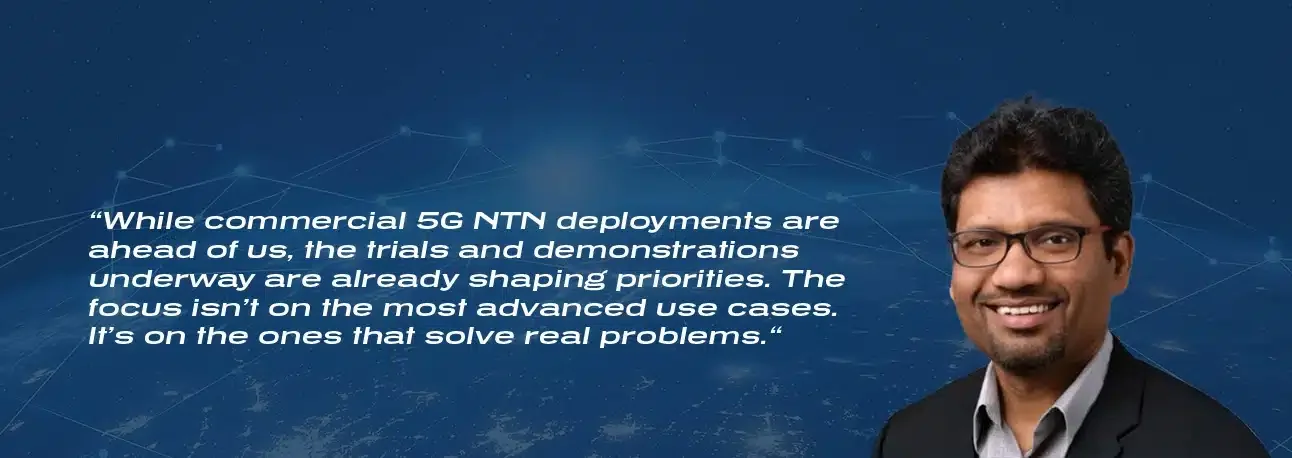
While commercial 5G NTN deployments are ahead of us (though not too far away), the trials and demonstrations underway are already shaping priorities. The focus isn’t on the most advanced use cases. It’s on the ones that solve real problems.

Resilience for critical infrastructure is one of the clearest. Energy networks, financial systems and public services all rely on connectivity that can’t fail.

Mobility is another. Satellite already plays a role here, but 5G NTN brings the potential for a more consistent experience across networks.

Enterprise connectivity follows a similar pattern. For industries operating in remote or hard-to-reach locations, 5G NTN provides a practical way to extend coverage without major infrastructure buildout.

But there is another more profoundly important milestone that 5G NTN achieves: Integrating satellite and terrestrial networks into a unified architectural standard. This is a defining moment in the industry that has never happened before. It brings significant operational and infrastructure efficiencies to telecom operators that have traditionally run two disparate networks when incorporating satellite connectivity into their suite of services.

What links these use cases is straightforward. They work because they are needed.

Making hybrid networks work

For 5G NTN, both coverage and integration matter equally. With dedicated 5G NTN satellite infrastructure still being developed, the question of how well the technology integrates with terrestrial networks is just as important as when that coverage arrives.

Hybrid roaming will be central to this as devices need to move between terrestrial and satellite networks without disruption, and over time, across different satellite providers as well.

Recent demonstrations by ST Engineering iDirect have shown that satellite networks can integrate with the 5G core as fully 3GPP-compliant systems, operating as an extension of existing networks rather than alongside them.

This reflects a broader shift across the industry, where vendors and operators are focused on making satellite part of the core network, not a separate layer.

Just as importantly, this doesn’t require a full reset. Telecom operators can start by integrating existing satellite capabilities into the 5G core, then move towards native 5G NTN over time. Existing infrastructure and waveform technologies can be retained, allowing modernization without disrupting current services or investment models.

That ability to evolve incrementally is what makes adoption realistic.

Standards, scale and what comes next

Progress will depend on how the ecosystem moves.

3GPP standards, particularly from Release 17 through to Release 18 and beyond, are laying the groundwork for integration. They reduce complexity, support interoperability and allow operators to build without locking themselves into a single approach.

At the same time, ground infrastructure is changing. Cloud-native systems and more unified network management are making it easier to operate across multiple layers without increasing overhead.

Operators are also gaining better visibility into network performance, with more advanced analytics helping them anticipate and resolve issues earlier. Work is also underway to reduce reliance on external positioning systems such as GNSS, improving resilience in environments where those signals may be unavailable or compromised.

There is still work to do. Latency, Doppler effects and mobility management remain challenges. But the direction is clear. 5G NTN is moving from concept to deployment, with standards, infrastructure and commercial models starting to align.

A simpler end state

The end goal isn’t complicated. Telecom operators are looking for a single network with multiple access layers and consistent performance.

Over the next few years, the focus will shift towards execution and scaling hybrid networks, refining interoperability and turning early deployments into repeatable models.

At that point, the distinction between terrestrial and non-terrestrial starts to matter less. What matters is that connectivity works, wherever it’s needed.

The operators that get there first will be the ones pursuing both coverage and seamless integration in parallel.

Class (B2B/B2C)
B2B
Ingest Status
Rewritten
Dedupe hash
106ce2ca2d5c45c122770bc5be1d747a
Press Eligible
Yes
Press Eligible Reason
Manuelle Prüfung nötig. Risiko: MEDIUM. Flags: ['numbers']. Stichprobe: False
Source Name
ST Engineering iDirect
Original Summary

<p>By Shravan K Gaddam, VP Engineering, CTO Office, ST Engineering iDirect Interest in 5G NTN is accelerating amongst most telecom and satellite operators. The technology’s</p>
<p>The post <a href="https://www.idirect.net/blog/what-satellite-operators-and-telcos-really… Satellite Operators and Telcos Really Want from 5G NTN</a> appeared first on <a href="https://www.idirect.net">ST Engineering iDirect</a>.</p>

Image URL
https://www.idirect.net/wp-content/uploads/2026/06/Blog3_Header_Shravan.webp
Content Hash (SHA-256, erste 32 hex)
07b289967c5fbef56092b1f5c55f1e8e