See How WaitWell Works
Take a quick, self-guided tour
WaitWell recognized in Canada’s 2026 Top Growing Companies ranking. Read more
We evaluated 9 urgent care queue management systems across remote patient check-in, walk-in queue management, appointment scheduling integration, HIPAA compliance, EHR connectivity, multi-location visibility, and pricing transparency.
The results show that WaitWell is the best urgent care queue management system for clinics that need unified walk-in queuing and appointment scheduling, with HIPAA-ready infrastructure, Waillo AI routing, and real-time visibility across locations. WaitWell is also the platform of choice for complex, multi-site healthcare enterprises, and is trusted by several large healthcare chains to manage patient flow at scale.
Solv Health leads for US urgent care chains that need deep EHR integration alongside a patient acquisition marketplace, and ScanQueue is the top pick for independent clinics that want triage-aware queuing with the simplest possible setup.
If your urgent care lobby overflows at peak hours, patients walk out before being seen, and front-desk staff spend more time answering “how much longer?” than managing intake, you’ve outgrown manual queue management.
The best urgent care queue management system in 2026 lets patients check in from their phones, wait from their cars, and get notified when it’s their turn, while staff can see and manage the entire queue in real time.
Patients walking out before being seen, known as left-without-being-seen (LWBS), is the most expensive operational failure in urgent care. Every LWBS event is lost revenue, a negative review risk, and a patient who may never return.
The root cause is almost always the same: patients have no visibility into how long the wait will actually be, and the front desk has no system to manage the flow.
This guide evaluates 9 platforms across the criteria that matter most to urgent care operations: remote check-in methods (phone, kiosk, QR, SMS), walk-in queue management with real-time visibility, appointment scheduling integration, HIPAA compliance with BAA availability, EHR/PM system connectivity, multi-location dashboards, and pricing transparency.
Whether you run a single walk-in clinic or a multi-site urgent care group, this breakdown will help you find the right fit.
Our team evaluated each platform across seven weighted dimensions. The scoring reflects what matters most in urgent care: reducing LWBS rates, freeing front-desk staff from manual queue management, and giving patients the remote check-in and wait-time visibility they now expect.
Best for: Urgent care clinics and walk-in centers that need unified walk-in queuing and appointment scheduling with HIPAA-ready infrastructure, AI-powered patient routing, and real-time visibility across locations.
Score: 9.4/10
WaitWell is a queuing and appointment management platform designed for healthcare environments where patient flow management is an operational priority.
Unlike tools that only handle a waitlist or only handle appointments, WaitWell manages both walk-in queues and booked appointments in a single system.
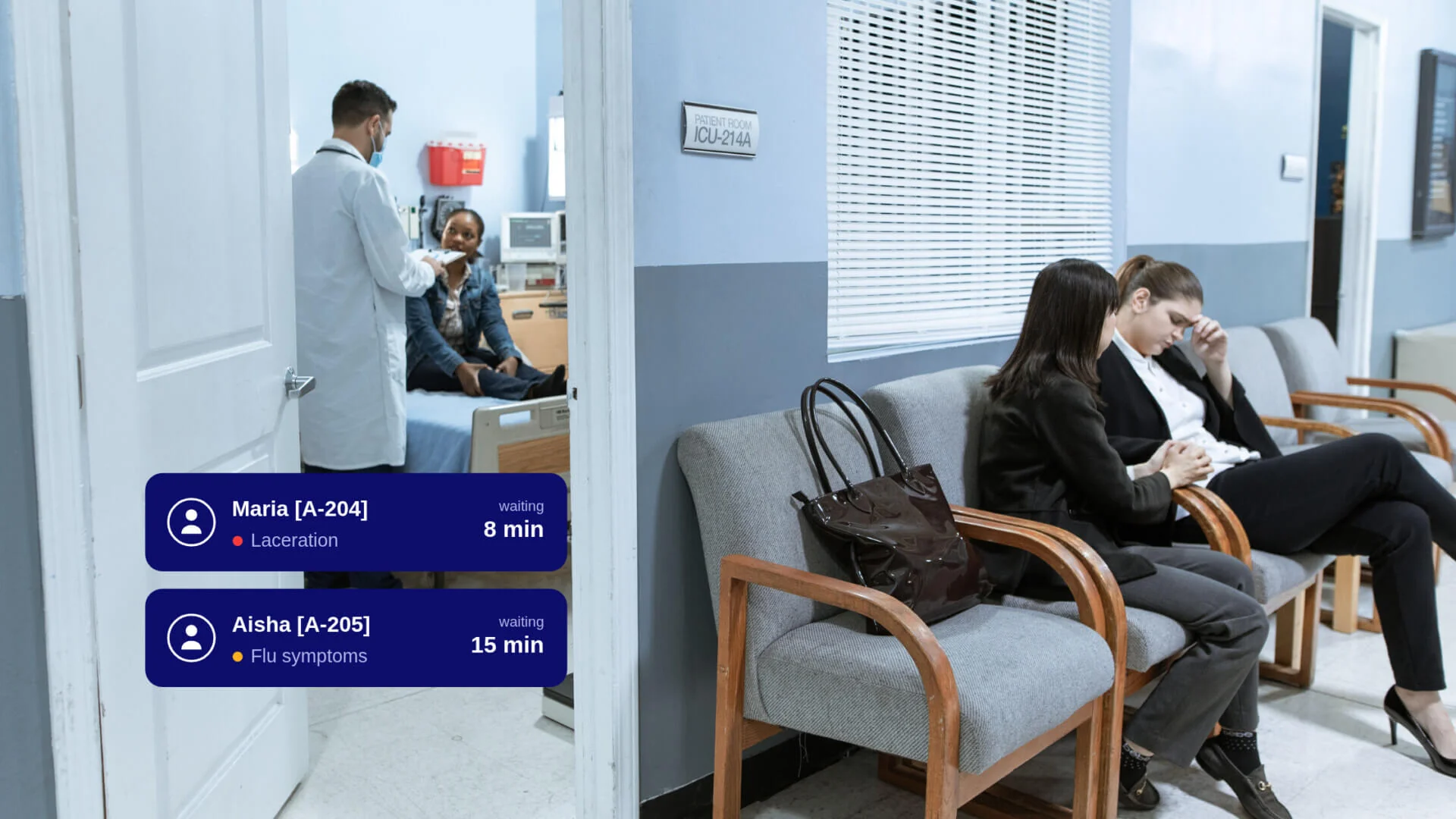
Patients check in from their phone, kiosk, or web link, wait in their car, and receive a notification when it’s their turn. Staff can see the entire queue on a single dashboard, with real-time wait times and patient status.
WaitWell serves urgent care centers, walk-in clinics, hospital outpatient departments, and multi-site urgent care groups across the US and Canada.
The platform is SOC 2 Type 2 certified and HIPAA-ready, with BAA documentation, addressing the non-negotiable compliance requirements for healthcare deployments.
Every patient who walks out before being seen is lost revenue, a potential negative review, and a patient who may choose a competitor next time.
The root cause is almost always the same: patients sitting in a crowded lobby with no idea when they will be called.
WaitWell eliminates this by letting patients join a virtual queue from their phone, see their real-time position and estimated wait time, and wait from their car or wherever they choose. Patients who can see progress don’t leave.
For urgent care clinics where unpredictable walk-in volume is the norm, this virtual queue is the most effective tool for reducing LWBS rates without adding staff or expanding the lobby.
Most urgent care clinics handle a mix of walk-in patients and pre-booked appointments.
Running these through separate systems creates the exact chaos a queue management system should eliminate: staff toggle between a sign-in sheet and a scheduling app, patients with appointments wait alongside walk-ins with no priority logic, and operations leaders have no unified view of demand.
WaitWell manages both in one queue with fair sequencing.
Staff see every patient in a single dashboard regardless of how they arrived. Waillo AI Chat lets patients describe what they need in plain language and routes them to the correct service or provider without front-desk triage.
For multi-site urgent care groups, knowing what’s happening at a single clinic at a time isn’t enough.
Waillo Insights provides cross-location dashboards showing wait times, throughput, LWBS trends, and staffing pressure per site in real time.
Operations leaders can spot a clinic hitting capacity and redirect patients or adjust staffing before the problem becomes a walkout.
Starter at $29/month per location. Basic at $55/month per location. Enterprise and Campus plans are custom-priced with Waillo AI, SSO, API access, SLA guarantees, and dedicated support.
All plans include unlimited staff accounts. No per-user fees.
HIPAA-ready with BAA on all plans.
Read more about WaitWell for urgent care here
Outlook, Google Calendar, Microsoft Teams, Zoom, Google Meet, Salesforce.
Enterprise plans include webhooks and full API access for EHR/PM system connectivity and custom integrations.
Two to four weeks with hands-on onboarding.
Cloud-native.
No third-party implementation partner required.
WaitWell doesn’t offer native bidirectional EHR integration with systems like Epic or Cerner out of the box.
Urgent care chains deeply embedded in specific EHR ecosystems that need scheduling data to flow directly into clinical records may prefer Solv Health, which integrates natively with Epic, Athena, and Cerner.
Single-site clinics that only need a simple SMS waitlist with no appointment scheduling may find ScanQueue or NextMe faster to deploy and less expensive.
Starter includes knowledgebase and live chat. Basic adds email support.
Enterprise customers receive a dedicated customer success representative, priority support, and SLA commitments.
Dallas Animal Urgent Care deployed WaitWell to manage walk-in patient flow, replacing crowded lobby waiting with a virtual queue where pet owners check in from their phones and wait in their cars until notified.
Read more in this guide to patient queue management systems>
Looking into the best urgent care queue management software?
Best for: US urgent care chains and multi-site groups that need deep EHR integration, AI-powered queue management, and a patient acquisition marketplace.
Score: 8.2/10
Solv Health is the dominant patient engagement platform for US urgent care.
The platform combines online scheduling and waitlist, digital registration, insurance card capture, kiosk and mobile check-in, AI-managed queue, two-way messaging, review management, and patient acquisition through Google, Apple Maps, and the Solv marketplace.
Solv has powered over 100 million visits.
Solv’s AI agents include Maya (answers calls 24/7 and books visits while the patient is on the phone) and ClearPay (real-time insurance eligibility and cost estimates).
Results reported by partners include 50% call reduction, 2-3 incremental visits per clinic per day, 75% digital registration adoption, and patients seen up to 46% faster.
Solv integrates natively with Epic, AthenaHealth, and Cerner.
Custom per-location pricing. Not published.
Annual, quarterly, and monthly payment terms available. EHR integration is included or additional, depending on the package.
Contact Solv for a personalized quote.
Solv is purpose-built for the US urgent care market with deep EHR integration. Organizations outside the US or outside the urgent care vertical may find the platform less applicable.
Custom pricing requires a sales engagement.
The Solv marketplace drives patient acquisition, but also means your clinic appears alongside competitors.
No published pricing makes budget planning difficult without engaging sales.
Best for: Government health clinics and high-volume public facilities with established virtual queuing requirements.
Score: 7.4/10
QLess is a virtual queue management and appointment scheduling platform with brand recognition in government and healthcare.
The platform supports walk-in queuing, appointments, callback queuing, and virtual meetings.
Machine learning delivers wait time forecasts.
QLess serves 300+ cities/counties and 200+ colleges/universities.
Note: QLess filed for Chapter 11 bankruptcy in June 2024 and exited in September 2024.
Custom pricing. Not published. Historically cited as expensive by enterprise buyers.
QLess doesn’t publish pricing.
User reviews cite difficulty making configuration changes without support involvement and a no-test environment.
No native staff scheduling or integrated payments.
Vendor stability concerns following the 2024 bankruptcy filing.
Best for organizations already in the QLess ecosystem or government facilities where QLess has established contracts.
Best for: Urgent care centers that want deep service analytics alongside iPad kiosk check-in for structured walk-in environments.
Score: 7.2/10
Qminder is a queue management platform built around iPad kiosk check-in and service analytics.
Visitors check in on a tablet, staff manage the queue from a dashboard, and managers get insights into wait times, service durations, and staff performance.