How Do You Prepare for a VA C&P Exam in 2026?
Image File
Original HTML

A VA Compensation & Pension exam is a medical evaluation VA schedules to gather findings on your claimed conditions when your existing records aren’t enough to rate them on their own, under 38 C.F.R. § 3.326. Preparing means bringing your own service and medical records, describing your symptoms on your worst days rather than your best, and knowing that missing the exam without good cause can get your claim rated on a thin file or denied outright under 38 C.F.R. § 3.655. VetsForever’s VA-accredited representatives prepare veterans for exactly what an examiner needs to see, well ahead of the appointment.

What Actually Happens During a C&P Exam?

A C&P exam is a medical evaluation VA schedules when a claim doesn’t already have enough evidence to rate it, in person or, increasingly, over telehealth. Under 38 C.F.R. § 3.326, VA can only skip it if your existing medical records are already adequate for rating purposes, which for most first-time claims they aren’t. The examiner’s job is narrow: gather findings on what’s wrong, how severe it is right now, and how it lines up with the condition you claimed. Deciding whether you get benefits happens later, at the rating desk. Exams can run fifteen minutes or well past an hour depending on how many conditions are on the table, and the length by itself says nothing about the outcome.

What Should You Bring and Know Before You Go?

Bring your own copy of your service treatment records, any private medical records VA doesn’t already have, and a written list of every condition you’re claiming with the date it started. Request your own C-file ahead of time and check what’s actually documented there, versus what you assumed was in it. That way you walk in able to back up what you say instead of hoping the examiner finds it on their own.

How Do You Describe Your Symptoms Accurately?

Describe your condition on a bad day, not a good one. Veterans routinely undersell their own symptoms out of habit. The same instinct that gets you through a normal Tuesday works against you in an exam room built to measure your worst Tuesday. If your back locks up twice a month, say twice a month, not “it’s manageable.” An exam that only captures your good days reads like a weather report that skips every day it rained.

What Happens If You Miss Your Exam?

Under 38 C.F.R. § 3.655, missing a scheduled exam without good cause carries real consequences. VA rates an original compensation claim on whatever evidence is already in the file, often not enough to support a fair rating. VA denies outright a supplemental claim, an increase request, or a previously denied claim. Good cause covers things like a documented illness or the death of an immediate family member; a scheduling inconvenience generally doesn’t qualify. Call VA as soon as you know you can’t make it. Waiting until after a no-show puts you in a much weaker position.

Who Actually Decides Your Rating?

Your whole file does, with the exam as one piece of it. Under 38 C.F.R. § 4.2, the rater has to interpret the examiner’s findings alongside your service treatment records, private medical evidence, and buddy statements, everything already in the file. That’s the same reasoning behind VA’s duty to assist under 38 C.F.R. § 3.159: building a complete record is VA’s job as much as yours, and the exam is a contribution to that record rather than a standalone verdict.

Common Questions About C&P Exam Prep

Can I bring someone with me to the appointment?

Yes. You can bring a spouse, family member, or your VA-accredited representative into the exam room in most cases, though the examiner runs the actual evaluation. Check with the facility ahead of time on their specific policy.

What if I need to reschedule, will that hurt my claim?

Not if you do it before the appointment and for a real reason. Under 38 C.F.R. § 3.655, VA must send written notice before discontinuing or reducing an existing award for a missed exam, and gives you 60 days to show good cause or agree to reschedule. Reach out to VA as early as you can. That’s what actually keeps this option open to you.

Is a virtual or telehealth C&P exam treated the same as an in-person one?

Yes. VA increasingly schedules exams by video, and the findings carry the same weight as an in-person evaluation. The format doesn’t change what you should bring or how you should describe your symptoms.

What if you disagree with what the examiner wrote afterward?

Request your exam report through your C-file and challenge it with a Supplemental Claim, a Higher-Level Review, or a Board appeal, whichever fits your situation. One exam finding you dispute can still get corrected further down the line.

Can VA schedule another exam for the same condition later?

Yes. Under 38 C.F.R. § 3.327, VA can order a reexamination whenever it needs to verify whether a rated disability has improved or changed, usually within two to five years of the last rating decision. VA generally skips future reexaminations once a condition is static, has stayed unchanged for five years or more, is permanent, or the veteran is over 55.

Class (B2B/B2C)
B2C
Ingest Status
Rewritten
Dedupe hash
322a2b01665f528f2cdcdbc26483ba42
Press Eligible
Yes
Press Eligible Reason
Manuelle Prüfung nötig. Risiko: MEDIUM. Flags: ['legal', 'numbers']. Stichprobe: False
Source Name
VetsForever
Original Summary

<p>A VA Compensation &#38; Pension exam is a medical evaluation VA schedules to gather findings on your claimed conditions when your existing records aren&#8217;t enough to rate them on their own, under 38 C.F.R. § 3.326. Preparing means bringing your own service and medical records, describing your symptoms on your worst days rather than your best, and knowing that missing&#8230;</p>
<p>The post <a href="https://vetsforever.com/how-do-you-prepare-for-a-va-cp-exam-in-2026/">H… Do You Prepare for a VA C&amp;P Exam in 2026?</a> appeared first on <a href="https://vetsforever.com">VetsForever</a>.</p&gt;

Image URL
https://vetsforever.com/wp-content/uploads/2026/09/iStock-1395651920.jpg
Source Node
Content Hash (SHA-256, erste 32 hex)
801f07e7227eeda7371f5e69bcc2d894
Does Your State Have Your Back? What Veterans Are Owed Beyond the VA Check
Image File
Original HTML

Does Your State Have Your Back? What Veterans Are Owed Beyond the VA Check

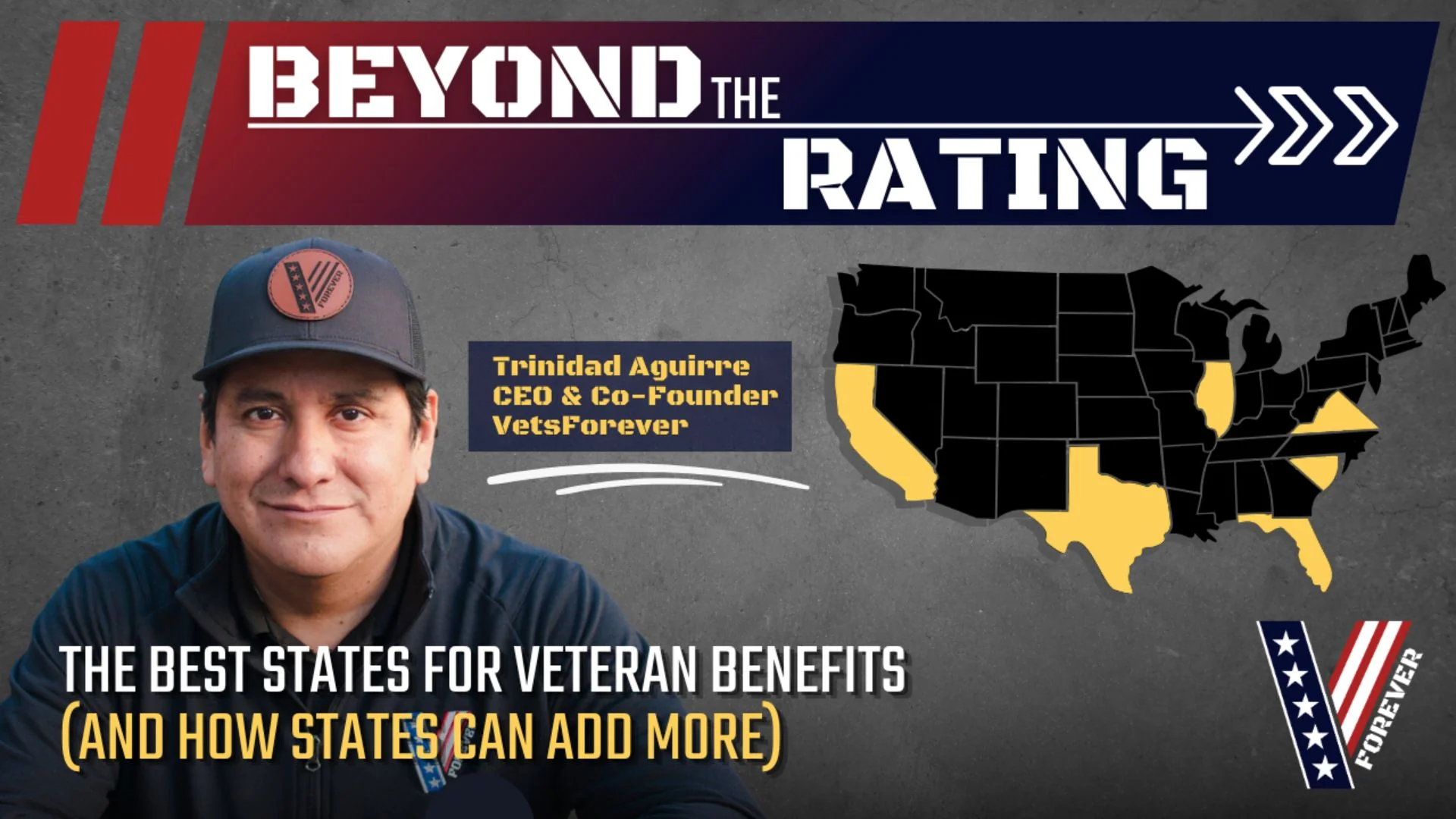
Your state can add property tax exemptions, income tax breaks, education benefits for your dependents, and housing assistance on top of your federal VA compensation. These benefits vary widely by state, they’re not automatic, and most require a separate application. Texas, Florida, Virginia, Alaska, and Illinois currently rank among the most veteran-friendly states. New laws in California and South Carolina also protect you from unaccredited operators who charge illegal fees for claims assistance.

You file the federal claim, get the rating letter, and call the paperwork finished. The property tax bill still shows up every spring, full amount, no exemption applied, because nobody ever told you the county had a box for that. You pay it anyway, for years, the same way you file the same 1040 every April without knowing your state might not tax your disability compensation at all. None of that is your fault. Nobody handed you the list.

Watch the Conversation

Beyond the Rating | The Best States for Veteran Benefits (And How States Can Add More)

Trinidad Aguirre, Navy veteran and CEO and co-founder of VetsForever, hosts this solo episode on what state governments offer veterans that has nothing to do with a VA rating decision.he list.

Trinidad Aguirre, Navy veteran and CEO and co-founder of VetsForever, hosts this solo episode on what state governments offer veterans that has nothing to do with a VA rating decision.

Chapters

- 00:00 Intro

- 00:55 What State Benefits Actually Cover

- 02:21 Examples From States with Strong Benefits

- 03:35 Examples of States Protecting Veterans

- 04:05 Why You Should Care

- 05:02 How VetsForever Can Help

- 05:28 In Closing

What State Benefits Actually Cover

Federal compensation is the floor. What your state stacks on top of that floor runs on its own rules and its own deadlines, and the gap between states is real. Depending on where you live, this can include:

- State income tax exemptions on military retirement pay, VA disability compensation, or both

- Property tax exemptions, in some states a full waiver above a certain disability rating

- Tuition waivers, scholarships, and in-state tuition rates for you and your dependents

- Hiring preferences for state government jobs and licensing reciprocity for military-trained skills

- Down payment assistance, state-run veterans homes, and assisted living options

- Financial and legal assistance, transportation, and burial benefits

You’ve probably never looked this list up, not because you weren’t paying attention, but because nobody told you it existed.

VetsForever is a veteran-founded organization.

We provide legal representation through VA-accredited representatives for VA disability claims, appeals, and military discharge upgrades. Our VA-accredited representative has direct VBMS access to your VA file. Serving veterans nationwide.

Which States Currently Lead, and What They Offer

Texas, Florida, Virginia, Alaska, and Illinois consistently rank among the strongest for state-level veteran benefits.

Texas runs the Hazlewood Act: 150 hours of tuition-free study at public colleges, transferable to a spouse or dependent child, plus low-interest home and land loans through the Veterans Land Board.

Florida offers property tax exemptions that scale starting at a 10% disability rating, along with tuition waivers for veterans and dependents at public colleges.

Virginia provides property tax exemptions and in-state tuition for veterans and dependents regardless of how long they’ve lived in the state.

Alaska offers up to a $150,000 property value exemption for veterans rated 50% or higher, plus education waivers.

Illinois covers tuition and fees at public colleges through the Illinois Veterans Grant, and gives a full property tax exemption on a primary residence to veterans rated 100% disabled.

Other states offer less, and neighboring states rarely match each other. Benefits, caps, and income limits change year to year. Check your state directly, and treat any figure here as a starting point, not the final word.

What New State Laws Protect Veterans From

States are also cracking down on a specific problem: unaccredited operators charging you illegal or excessive fees to file your VA claim. California’s SB 694, signed by Governor Newsom, and South Carolina’s Safeguarding American Veterans’ Benefits Act both target this directly, restricting who can charge a fee for claims assistance and what they’re allowed to charge.

No one can legally charge you a fee to file your first VA claim.

These laws exist because veterans were being charged for something federal law already prohibits. Under 38 U.S.C. § 5904(c)(1), no one can charge you a fee for work on an original claim before VA issues its first decision. Knowing that protection exists is just as much a part of your state’s veteran benefits picture as its tax and education programs.

Why This Matters

State benefit programs aren’t fixed once and done. A state that passes strong veteran legislation this year may add something next year that didn’t exist before. A state that lets a program lapse takes something away just as quietly. State governments decide who qualifies, when, and how much, and every legislative session can add to or take from that list.

You could go years without knowing your state offers a full property tax exemption, or that your kids qualify for in-state tuition at no cost, simply because nobody mentioned it.

None of it applies itself.

Whether your state has your back comes down to one thing: whether you go and get what’s already being offered.

Frequently Asked Questions

Are state veteran benefits automatic once I have a VA disability rating?

No. You’ll need to apply separately through a state or county office for nearly every state-level benefit, including property tax exemptions. Your VA rating decision doesn’t trigger a state benefit on its own.

What happens to my state benefits if I move to a different state?

Nothing transfers automatically. A property tax exemption approved in one state means nothing to your new state’s tax assessor, and you’ll typically have to reapply for every state-specific benefit after you establish residency somewhere new. Federal eligibility is the one thing that does carry over: a 100% rating is a 100% rating everywhere. It’s the state-level paperwork that resets.

Will using state veteran benefits reduce my federal VA compensation?

No. State and federal benefits run on entirely separate systems. A property tax exemption, an education waiver, or a state income tax break won’t touch what VA pays you monthly.

What should I do if someone offers to file my claim for a fee before VA has made a decision?

Confirm they’re VA-accredited before you pay anything. Under 38 U.S.C. § 5904(c)(1), no one can charge you a fee for work on an original claim before VA issues its first decision, and California and South Carolina have both recently passed laws specifically penalizing unaccredited operators who charge veterans anyway.

Where do I find my state’s veteran benefits list?

Most state departments of veterans affairs publish their own veteran benefits list directly on their official site. Search your state’s site directly rather than relying on secondhand summaries.

Do all 50 states offer veteran benefits beyond VA compensation?

Every state offers something, but the specifics differ widely. Some offer full property tax exemptions and tuition-free college for veterans and dependents. Others offer far less. Check your state’s department of veterans affairs site for its full list.

Both Sides of Your Claim, Covered

Our VA-accredited representative handles the federal side of your claim. Our team also identifies which state programs apply to your situation. Schedule a case review with one of our Advocates here.

Class (B2B/B2C)
B2C
Ingest Status
Rewritten
Dedupe hash
319645c52cab57d3c81712d6d7658852
Press Eligible
Yes
Press Eligible Reason
Manuelle Prüfung nötig. Risiko: MEDIUM. Flags: ['numbers', 'legal']. Stichprobe: False
Source Name
VetsForever
Original Summary

<p>A veteran&#8217;s state can add property tax exemptions, income tax breaks, education benefits for dependents, and housing assistance on top of federal VA compensation, and these benefits vary widely by state, are not automatic, and usually require a separate application. States like Texas, Florida, Virginia, Alaska, and Illinois currently rank among the most veteran-friendly. Newer state laws in California and&#8230;</p>
<p>The post <a href="https://vetsforever.com/does-your-state-have-your-back-what-veterans-ar… Your State Have Your Back? What Veterans Are Owed Beyond the VA Check</a> appeared first on <a href="https://vetsforever.com">VetsForever</a>.</p&gt;

Image URL
https://vetsforever.com/wp-content/uploads/2026/09/Does-Your-State-Have-Your-Back.jpg
Source Node
Content Hash (SHA-256, erste 32 hex)
458ade7f4ed54d501fcbabcb1e31c23c
9/11, 25 Years Later: Four Stories From Our Team
Image File
Original HTML

Everyone old enough to remember September 11th has a story about where they were. That’s part of what makes the day different from other history. It isn’t just something that happened. It’s something nearly every American still carries, specific down to the details, twenty-five years later.

We asked four members of our team to share theirs. Two were already serving in the Navy that morning. A third was going through the enlistment process. The fourth has family ties to New York City that put her in the middle of it in a different way. None of these stories matter more than anyone else’s. They’re just one way of showing how far that morning reached, and how much it still shapes us today.

The petty officer whose enlistment was almost up

Chris Ward, our CRO and VetsForever co-founder, was teaching a class of about 25 students when a TV in the back of the room showed the first plane hit the World Trade Center. The room assumed it was an accident. Then the second plane hit.

At the time, he’d already submitted his paperwork to separate from the Navy. His enlistment was almost up.

A few weeks later, the Naval Special Warfare Development Group, DEVGRU, reached out and asked if he wanted to screen for orders. He didn’t know much about the command beyond the fact that it was a Navy SEAL unit. He said yes.

That decision turned into a 26-year career and nine deployments to Afghanistan, Iraq, and the Horn of Africa. He retired a Senior Chief Petty Officer.

“It changed the entire trajectory of my life,” he said. “I ended up seeing and doing things I never imagined for myself.”

At the time, the dominant feeling was anger, sharpened by the fact that the attack targeted civilians instead of a military installation. Twenty-six years gave him room to place that anger inside a larger picture, one that shaped an entire generation of service members.

“We felt a personal responsibility to step up and answer for those innocent lives lost, and we took that fight directly to the nation’s enemies,” he said. That’s how he describes the Pearl Harbor of his generation. Not history. A debt his generation of veterans set out to answer in person.

The sailor checking into a new assignment

Jimmy Burnside, one of our Senior Advocates, was an Aviation Electronics Technician First Class, checking into a new squadron, when he watched the second plane hit the World Trade Center on a television nearby. He remembers that image most clearly. It removed any doubt the country was under deliberate attack.

He was already serving, so 9/11 didn’t call him into the military. It reshaped the service he was already performing. Readiness took on an urgency that hadn’t existed the day before.

“Vigilance became more than a military requirement,” he said. “It became part of how I performed my duties and lived my daily life.”

His work aboard P-3 aircraft became part of a larger mission: protect the country, support the people serving beside him. That responsibility stayed with him for the rest of his time in uniform.

His message to a younger generation: 9/11 changed the direction of American lives in an instant, and kept shaping careers, deployments, and families for years after. Some of that cost was visible. A lot of it wasn’t.

Waiting on Long Island

Holly Griffeth, our VP of Marketing, never served in the military. September 11 is still deeply personal for her.

Her family is New York through and through. Her parents lived on the Lower West Side of Manhattan. Holly was on Long Island that morning, planning to head into the city later to stay with them.

She was on the phone with her dad about her plans for the evening. The Today Show played in the background, like it did in countless New York homes.

They saw the first plane hit while still on the phone. Their thoughts went straight to Holly’s mom. Her daily walk usually passed through the Wall Street area around that time.

They called her cell phone. No answer.

Calls weren’t going through. Everyone was trying to reach someone. Holly and her dad had no idea if her mom was safe.

They waited nearly five hours.

Her parents were reunited after the North Tower fell. Her mom was safe, but she’d watched the towers come down from a few blocks away and been caught in the chaos of thousands fleeing Lower Manhattan.

Once Holly knew her mom was safe, the question became: what can we do?

Three days later, Holly got into Manhattan. For the next month, she volunteered with her parents, delivering meals and washing clothes for Ground Zero workers.

She remembers the fear and uncertainty of that day. But she remembers what came after it too. People volunteered. They donated, checked on neighbors, and supported first responders, military members, and complete strangers. American flags seemed to appear everywhere. There was a shared patriotism she hasn’t seen since.

Twenty-five years later, that’s still one of the things she remembers most: not just the fear, but how people showed up for each other afterward.

Seventeen years old, waiting on his Navy medical screening

Keithan Smith, our Director of Strategic Operations, wasn’t in the military yet on September 11th. He was 17, a senior in high school, waiting on his medical screening at a Military Entrance Processing Station to enlist in the Navy.

He remembers the uncertainty most, looking to the adults around him for answers and watching them try to process what was happening in real time, same as everyone else. After the second plane hit, the station was evacuated.

His recruiter told him he’d understand completely if he wanted to walk away from joining the Navy. Keithan took three days, then went back and finished enlisting.

“It didn’t make me walk into MEPS,” he said, “but after everything that happened, it didn’t make me walk away either.”

His first duty station was the National Security Agency. Later, his work took him into the Pentagon, into the section damaged by Flight 77. At Camp H.M. Smith in Hawaii, he served surrounded by the history of Pearl Harbor. Eventually he became a Navy recruiter himself, walking young people through the same MEPS doors he’d walked through at 17. Bahrain. The Joint Chiefs of Staff. A Navy warship.

“I walked into MEPS as one of the kids looking to the adults for answers,” Keithan said. “Eventually, I became one of the adults responsible for the people coming behind me.”

Twenty-five years later

No one in the world knew that morning how much September 11 would shape the years ahead. For some, it changed the course of a military career. For others, it changed what serving meant: not just a uniform, but showing up to volunteer, caring for the people around them, carrying that sense of patriotism forward. Families across the country carried a day they’d never be able to talk about without remembering exactly where they were standing and who they were worried about.

Twenty-five years later, the details are still there.

Everyone had someone they were worried about that morning. But the story of that day was always bigger than any one person’s worry, or any one family’s.

These are four stories from our team. There are millions more, from veterans, first responders, families, and Americans who lived that day in their own way.

We remember those who lost their lives. Those who ran toward the danger. Those who served in the years that followed. The families who carried the weight of it with them.

And we remember something harder to put into words: how Americans showed up for each other afterward.

We remember. We’re grateful. Never forget.

Ingest Status
Rejected
Dedupe hash
23036cb330b1405b4a7ef9ed8d9359ad
Press Eligible Reason
JSON nicht lesbar - manuelle Pruefung noetig: Inhalt konnte nicht als JSON geparst werden
Source Name
VetsForever
Original Summary

<p>Everyone old enough to remember September 11th has a story about where they were. That&#8217;s part of what makes the day different from other history. It isn&#8217;t just something that happened. It&#8217;s something nearly every American still carries, specific down to the details, twenty-five years later. We asked four members of our team to share theirs. Two were already serving&#8230;</p>
<p>The post <a href="https://vetsforever.com/9-11-25-years-later-four-stories/">9/11, 25 Years Later: Four Stories From Our Team</a> appeared first on <a href="https://vetsforever.com">VetsForever</a>.</p&gt;

Image URL
https://vetsforever.com/wp-content/uploads/2026/09/VetsForever_September_Blog_option2-1.png
Source Node
Content Hash (SHA-256, erste 32 hex)
3f8b52dee84e636347aad262cc2f3abd
7 Questions to Ask Before You Hire a VA Disability Lawyer
Image File
Original HTML

You already handed the VA your service treatment records. Your DD-214. Every private doctor’s note you could dig up, some of them older than your kids.

VA checks its own examiners. Nobody automatically checks the lawyer you’re about to hand that same file to.

Nobody but you.

Here are the seven questions that separate a real advocate from someone hoping you don’t ask them.

1. Are They Actually an Accredited Attorney?

Accreditation under 38 U.S.C. § 5901 is a legal status, not a slogan on a website. It’s a specific number you can check against VA’s own registry, and VA recognizes three separate accredited tracks under 38 C.F.R. § 14.629: attorney, claims agent, and VSO representative.

“I’ve helped a lot of veterans” answers a different question than “I’m an accredited attorney.” Ask for the accreditation number directly. Then check it yourself, before you sign anything, against VA’s Office of General Counsel accredited representative search.

2. What Can They Charge You, and When Does That Clock Start?

Under 38 U.S.C. § 5904(c)(1), nobody can charge you a fee for work on your original claim before VA issues its first decision. That’s not a courtesy, it’s the law. Once a decision exists and you move into a Supplemental Claim, Higher-Level Review, or appeal, 38 C.F.R. § 14.636(f) sets a ceiling on what’s reasonable to charge (see the quick-reference below for the exact numbers).

Nothing should be owed until VA actually decides your claim once. If someone asks for money before that, you have your answer.

3. What Happens to That Fee If Nothing Gets Recovered?

Ask this one out loud, in the room: if my claim gets nothing, what do I owe you? A standard VA fee agreement runs on contingency. The fee comes out of back pay actually recovered, never out of your own pocket up front. If an attorney describes a flat charge instead, make them walk you through why theirs works differently.

4. Can Their Accreditation Be Pulled, and What Happens to Your Case If It Is?

Under 38 C.F.R. § 14.633, VA’s Office of General Counsel can suspend or cancel an attorney’s accreditation for misconduct, incompetence, or improper fees. It happens more than veterans think.

Ask what becomes of your file and your claim’s timeline if your attorney loses accreditation mid-case. Who picks it up? Does your paperwork transfer clean, or do you start over with a stranger?

5. Will They Actually Pull Your File, or Work From What You Tell Them?

Some attorneys build your case on your memory of your own record. Others go get your actual C-file: service treatment records, prior rating decisions, exam results, the paperwork you forgot existed.

Say a shoulder MRI from three years back never made it into your VA file, and you never think to mention it because you forgot it happened. That gap either gets caught before you file, or it shows up for the first time in a denial letter. The difference is which attorney you hired.

6. What’s Their Plan If Your Claim Gets Denied?

A first-time claim and a denied claim call for different plays. A denied claim can go three directions: a Supplemental Claim with new evidence, a Higher-Level Review with no new evidence but a senior adjudicator’s second look, or a Board appeal. Each one runs on a different evidence requirement and a different clock.

Ask which lane fits your specific denial, and why, not which lane the attorney defaults to for everyone.

7. Do They Handle Your Case Personally, or Hand It Off Once You Sign?

Some firms have an attorney sign you up, then hand you to a rotating cast of paralegals and case managers, sometimes without the attorney reviewing your file again until a hearing gets scheduled.

Ask directly: who reads your evidence? Who talks to you when something changes? Is the person you’re talking to right now the person actually working your case in six months?

Quick Reference: What to Ask, What Should Worry You

Fee ceiling per 38 C.F.R. § 14.636(f): a 20% fee is presumed reasonable; anything above 33 1/3% is presumed unreasonable unless the attorney proves otherwise.

Common Questions About Hiring a VA Disability Lawyer

Can a VA disability lawyer guarantee my claim gets approved?

No. Not one attorney, accredited or not, can guarantee a specific rating or outcome. Only VA’s rating decision does that. Anyone pitching a guarantee is making a promise VA itself doesn’t let them make. Ask directly how they’d back that up.

Do I need a lawyer specifically, or can a claims agent or VSO representative handle my case?

Depends where your case is headed. Claims agents clear the same accreditation process attorneys do and can represent you through VA’s appeals process, but generally can’t take you into federal court if it reaches that stage. VSO representatives typically serve without charging a fee at all, which matters if cost is the deciding factor, though availability and caseload vary by organization.

If I switch attorneys partway through my case, do I lose progress already made?

No. Evidence and arguments already submitted to VA stay in your file no matter who’s representing you. What you lose is time: a new attorney needs to review what’s already there before picking up where the last one left off. Ask any new attorney what they need from you to get up to speed fast.

Can my attorney see documents in my file that I can’t see myself?

No. Under 38 C.F.R. § 1.577(a), you have the same right to review and copy your own C-file that your representative does. There’s no hidden tier of access reserved for attorneys only. If someone implies otherwise, ask them to point to what specifically, and request your own copy of the same record.

What happens if I disagree with my attorney’s strategy partway through?

You raise it directly, and you can end the representation if it doesn’t resolve. Ask this before you sign: what does the process look like if you want a second opinion or want to change course? An attorney confident in their own reasoning should be able to answer that without getting defensive.

Related Reading

What Does a VA C-File Review Actually Show You?

Why VA Disability Appeals Fail, and How to Respond

Ready to Talk to Someone Who’ll Answer These Straight?

Get a case review with a VA-accredited representative who answers every one of these questions without blinking.

Class (B2B/B2C)
B2C
Ingest Status
Rewritten
Dedupe hash
78bb6984b21c3032a23d889c08e9c0b1
Press Eligible
Yes
Press Eligible Reason
Manuelle Prüfung nötig. Risiko: MEDIUM. Flags: ['legal', 'numbers']. Stichprobe: False
Source Name
VetsForever
Original Summary

<p>Ask these seven questions before you sign anything with a VA disability lawyer. Every attorney who wants to represent you, or charge you a fee, has to clear VA accreditation under 38 U.S.C. § 5901 first. VetsForever’s VA-accredited representatives get asked these same seven questions by veterans who did their homework before signing, and that is exactly how it should&#8230;</p>
<p>The post <a href="https://vetsforever.com/7-questions-to-ask-before-you-hire-a-va-disabil… Questions to Ask Before You Hire a VA Disability Lawyer</a> appeared first on <a href="https://vetsforever.com">VetsForever</a>.</p&gt;

Image URL
https://vetsforever.com/wp-content/uploads/2026/09/iStock-1139147786.jpg
Source Node
Content Hash (SHA-256, erste 32 hex)
cad834b980a9263a0b24af8fa738fba1
How to Avoid VA Claim Mistakes
Image File
Original HTML

The Evidence You Never Wrote Down

A rater sees what’s written down, not what you remember telling a doctor five years ago. If a symptom, an incident, or a change in your condition never made it into a written statement, it functionally doesn’t exist for your claim, no matter how clearly you remember it. Lay evidence still carries real weight: under 38 C.F.R. § 3.303(a), VA has to weigh your own account and statements from people who know you alongside the formal exam findings. Use VA Form 21-4138 for your own statement and VA Form 21-10210 for someone else’s, a spouse, a fellow service member, a friend who noticed the change. Neither form requires an attorney to fill out.

What’s Actually in Your C-File?

Filing, or appealing, without ever reading your own file first is common, and it costs you. You can’t fix a gap you can’t see. You have the same right to review and copy your C-file that any representative does, at any point in the process, under 38 C.F.R. § 1.577(a). VA Form 20-10206 requests it directly. You’ll probably be more surprised by what’s missing than by what’s there. Read it before you file, and a guess about what got documented turns into a confirmed fact.

When Two Ratings Don’t Add Up to What You Expected

Say you’re rated 40% for one condition and 20% for another. You’d expect those to combine to 60%. VA math doesn’t work that way. VA applies each additional rating to the percentage of your body not already accounted for by your existing ratings, then rounds to the nearest 10%, a method sometimes called whole person theory, under 38 C.F.R. § 4.25. A 40% and a 20% rating typically combine closer to 50%, not 60%. If you expected simple addition, that gap can read as your claim being undervalued when the math itself produced the difference. Check VA’s official Combined Ratings Table for the exact figure before you assume a decision is wrong.

A Secondary Condition Can Hide Behind the One You Already Filed

A service-connected knee condition that changes how you walk can produce a hip or back problem years later. VA doesn’t go looking for that on its own; it rates what you actually claim. A secondary condition can get service connection when it’s caused or aggravated by a condition VA already recognizes, under 38 C.F.R. § 3.310, but you need your own claim and your own medical opinion establishing that connection. Miss that connection, and a condition you’re entitled to stays unclaimed indefinitely, whether you meant to skip it or not.

Losing Ground on Backpay by Missing a Filing Window

Your effective date is usually anchored to when you filed. Let too much time pass between a decision and your next step, and you can lose ground on backpay even if you land on the same outcome eventually. Continuing to pursue your claim within the required window preserves your earlier effective date, under 38 C.F.R. § 3.2500(c). Missing that window rarely kills a claim outright. What it can cost you is the difference between backpay counted from your original filing and backpay counted from whenever your next filing happens to land.

The Same File Rarely Gets a Different Answer on Appeal

Appeal a denial by resubmitting the exact same file, no new evidence, no new argument, and you’ll usually get the exact same answer. What matters is picking the right lane for what went wrong. A Supplemental Claim under 38 C.F.R. § 3.2501 needs new and relevant evidence, so it fits when the gap is something you’re now adding. A Higher-Level Review under 38 C.F.R. § 3.2601 gives a senior adjudicator a fresh look at your existing record, no new evidence, working strictly from what’s already there; it fits when your argument is that the record got misread the first time. A Board appeal under 38 C.F.R. Part 20 is a different track entirely. Match the lane to what went wrong, not the lane you used last time. Nobody wins a rematch by running the same play twice.

Common Questions About Avoiding VA Claim Mistakes

Can a mistake in a claim VA already decided ever be fixed after the fact? Only in a narrow way. Filing a claim of clear and unmistakable error has no deadline, under 38 C.F.R. § 3.105, and if you win it, VA corrects the decision back to your original effective date. If you’re adding evidence that simply wasn’t there before, that falls under a Supplemental Claim instead.

What happens if VA tries to get a record for me and comes back empty-handed? VA has to tell you which record it couldn’t obtain, explain what it tried, and let you know it will decide your claim on what’s already in file unless you supply that record yourself, under 38 C.F.R. § 3.159(e)(1). Treat that notice as your cue to act before VA moves forward without it.

Is there a deadline for submitting lay evidence or buddy statements after I’ve already filed? No fixed deadline exists. VA moves forward with whatever’s actually in your file when it decides. Submit a buddy statement after a decision’s already been issued, and it becomes new evidence for a Supplemental Claim instead.

Does a single exam result overrule everything else already in my file? No. A rater has to interpret exam findings in light of your full recorded history, under 38 C.F.R. § 4.2. If an exam conflicts with years of your treatment records, that’s grounds to request a closer look at how the rater weighed it.

Does requesting my own C-file slow down or flag my claim in any way? No. A C-file request under 38 C.F.R. § 1.577(a) is a separate administrative process from claims adjudication. It doesn’t affect your pending claim’s timeline or standing either way.

Does the medical opinion connecting a secondary condition have to come from a VA examiner? No. A private physician’s opinion carries the same weight as a VA examiner’s for establishing that connection, under 38 C.F.R. § 3.310, as long as it’s well reasoned and grounded in your actual treatment history. VA doesn’t require its own examiner to be the one making that link.

Ingest Status
Rejected
Dedupe hash
87abef8966ee8769b1807d52c4ad0bf3
Press Eligible Reason
JSON nicht lesbar - manuelle Pruefung noetig: Inhalt konnte nicht als JSON geparst werden
Source Name
VetsForever
Original Summary

<p>You read a denial letter, and your first thought goes to yourself: did you wait too long, say the wrong thing at the exam, forget to mention something that mattered? That instinct is almost always aimed at the wrong cause. What breaks a claim is usually simpler and more fixable: a gap in the written record, evidence you have but&#8230;</p>
<p>The post <a href="https://vetsforever.com/how-to-avoid-va-claim-mistakes/">How to Avoid VA Claim Mistakes</a> appeared first on <a href="https://vetsforever.com">VetsForever</a>.</p&gt;

Image URL
https://vetsforever.com/wp-content/uploads/2026/09/iStock-2260074761-scaled.jpg
Source Node
Content Hash (SHA-256, erste 32 hex)
3dea68a60ffdb1394748f0fc6d7dc2f8
What Is a Character of Discharge Determination
Image File
Original HTML

You call to start a claim, and before anyone asks about your knee or your hearing, someone asks what your discharge paperwork says. If it isn’t Honorable, the tone on the call changes. You hang up assuming the door’s already closed, that the government looked at one line on one form and decided you don’t count. That assumption is usually wrong. It also stops people from filing claims VA would have actually processed.

Honorable and General Discharges Don’t Trigger This at All

Under 38 C.F.R. § 3.12(a), a discharge under honorable conditions, meaning Honorable or General, is binding on VA. There’s nothing to review. If that’s your discharge, this entire process doesn’t apply to you, and any hesitation about filing on account of it is solving a problem you don’t have. The character of discharge determination only comes into play below that line: Other Than Honorable, Bad Conduct, or Dishonorable.

The Statutory Bars You Can’t Argue Around

Six sets of circumstances bar VA benefits outright, under § 3.12(c): discharge as a conscientious objector who refused military duty or lawful orders, a general court-martial sentence, an officer’s resignation for the good of the service, desertion, an alien’s requested release during hostilities, and an other-than-honorable discharge for being AWOL 180 continuous days or more. That last one is the only one of the six with a way out. The rest are final, full stop.

Where VA Actually Has to Look at the Evidence

A second, shorter list of bars comes from § 3.12(d): discharge in lieu of a court-martial trial, mutiny, espionage, an offense involving moral turpitude, and willful and persistent misconduct. Mutiny, espionage, and discharge in lieu of trial have no way around them either. Moral turpitude and willful and persistent misconduct do, and so does the 180-day AWOL bar above. For those three, VA has to run a compelling circumstances review before it can deny you, which means an actual person is supposed to read your file, not just check a box next to your discharge type.

The Compelling Circumstances Test

When that review applies, § 3.12(e) requires VA to weigh the length and character of your service and what actually drove the misconduct or the AWOL: PTSD, depression, bipolar disorder, schizophrenia, substance use disorder, ADHD, the physical effects of an injury or medication, combat or overseas hardship, sexual abuse or assault, duress or coercion, family obligations, and your age, education, and maturity at the time. VA also has to consider whether a legal defense would have kept you from being convicted under the UCMJ in the first place. This is a real evidentiary review. Service treatment records, buddy statements, and a written account of what was happening at the time are what actually move it.

Character of Discharge vs. a Discharge Upgrade

Mixing these two up costs people time. A discharge upgrade goes through the military itself, a Discharge Review Board or a Board for Correction of Military Records, under 10 U.S.C. §§ 1552 and 1553, and it changes your actual discharge paperwork. A character of discharge determination stays inside VA, under 38 C.F.R. § 3.12, and only decides whether VA will treat your existing discharge as a bar to benefits. You can pursue one without ever touching your DD-214, and you can run both processes at the same time. If your DD-214 itself is what needs to change, the upgrade is the path for that, not this one.

Frequently Asked Questions

If my discharge says Bad Conduct, is that automatically the same as Dishonorable for VA purposes?

No. A Bad Conduct discharge from a special court-martial isn’t one of the statutory bars under § 3.12(c), which only names a general court-martial sentence. A Bad Conduct discharge from a special court-martial gets the same case-by-case review as the regulatory bars in § 3.12(d).

Does VA decide my character of discharge before it looks at the medical evidence on my claim?

Yes. Character of discharge is a threshold question under § 3.12. If your discharge is barred and no compelling circumstances apply, VA can deny the claim on that basis alone, without ever reaching whether your condition is service-connected.

If a military review board later upgrades my discharge, does that undo a VA denial based on character of discharge?

It can. Once a discharge is upgraded to honorable conditions, § 3.12(a) makes it binding on VA going forward, which removes the bar that triggered the denial. It doesn’t automatically reopen the old decision on its own, so you’d still need to take action on the VA side once the upgrade comes through.

If VA denies my claim based on character of discharge, is that decision final?

No. A character of discharge determination is a VA decision like any other, so it can be appealed through a Supplemental Claim, a Higher-Level Review, or a Board appeal, the same as a denial on the merits of a disability claim.

Class (B2B/B2C)
B2C
Ingest Status
Rewritten
Dedupe hash
f7e313bc00a269601bb1a61464601b65
Press Eligible
Yes
Press Eligible Reason
Manuelle Prüfung nötig. Risiko: MEDIUM. Flags: ['legal']. Stichprobe: False
Source Name
VetsForever
Original Summary

<p>If your DD-214 shows anything other than Honorable, that word alone doesn&#8217;t decide whether you can file a VA disability claim. VA has to make a separate ruling first, called a character of discharge determination, under 38 C.F.R. § 3.12. Some discharges are automatically barred by statute. Most others get reviewed case by case, and VA has to weigh compelling&#8230;</p>
<p>The post <a href="https://vetsforever.com/what-is-a-character-of-discharge-determination/… Is a Character of Discharge Determination</a> appeared first on <a href="https://vetsforever.com">VetsForever</a>.</p&gt;

Image URL
https://vetsforever.com/wp-content/uploads/2026/09/iStock-451630473.jpg
Source Node
Content Hash (SHA-256, erste 32 hex)
e97395fe19494c83b975c7b6413b0da3
The VA’s Own Watchdog Found Errors in a Third of Rating Reduction Cases. Here Is What To Check In Your Letter.
Image File
Original HTML

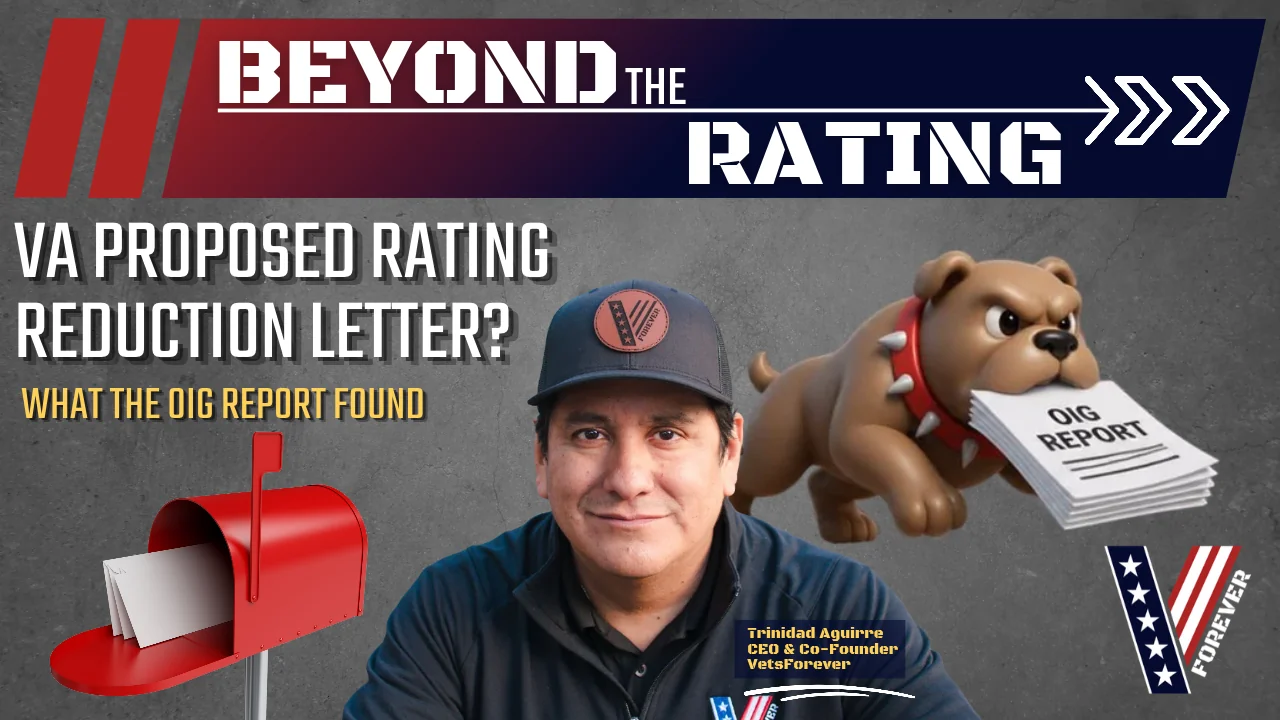
Every bill you built around your monthly VA payment now carries a question mark, because the letter in your hand says proposed reduction. The VA cannot lower or sever your rating and notify you after the fact. Federal regulation requires VA to give you written notice and a real opportunity to respond first, under 38 C.F.R. § 3.103, before that decision becomes final. In this episode of Beyond the Rating, VetsForever CEO and Navy veteran Trinidad Aguirre breaks down a new VA Office of Inspector General report that reviewed exactly these cases, and what the report found should change how closely you read your own letter.

Watch: “Beyond the Rating | What the VA’s Own Watchdog Found”

- 0:00: Intro

- 1:10: What the report focused on

- 1:40: Your due process rights

- 2:45: What the Inspector General found

- 5:06: How to review your proposed reduction letter

- 6:19: What you can control

What Counts as an Adverse Action

VA calls it an adverse action any time it takes away something you already have. That covers two different outcomes. A reduction lowers the rating on a condition VA already rated, so your monthly payment goes down. A severance goes further: VA decides the condition is no longer service connected at all, and the payment for it stops.

VA proposes these actions for one of three reasons. VA believes your condition improved. You missed a required VA exam. Or VA decided an earlier rating decision contained what it calls a clear and unmistakable error, shortened to CUE, meaning VA believes it got the facts or the law wrong the first time and that error changed the outcome, under 38 C.F.R. § 3.105.

Your Due Process Rights Under 38 C.F.R. § 3.103

Before VA can act on a proposed reduction or severance, federal regulation requires it to give you real due process first. In practice, that means:

- You get written notice before VA acts, usually called a proposed rating decision or a due process letter.

- You have 60 days from that notice to submit evidence showing why the action should not go forward.

- You can request a hearing to present that evidence or talk through the proposal.

- You have the right to representation.

- Once VA makes its final decision, it has to tell you in writing.

That 60-day window is the one stretch of time where you can put evidence in front of VA before the change takes effect. When you get one of these letters, note the date and keep it somewhere you will see it.

What the VA’s Inspector General Found

The VA Office of Inspector General reviewed proposed reductions and severances that closed in 2024, a total of 27,100 cases. It estimated that 9,300 of those cases, about 34 percent, contained at least one error.

Where the Letters Went Wrong

Four separate error categories show up in the report, but one is the one you can actually catch yourself: the due process letter itself. In an estimated 4,000 cases, the letter had the wrong reason, the wrong dates, or left out your rights entirely. That is the category that matters most to you right now, because it is the one piece of the file you already have in hand.

The report documents one heart condition rated at 100 percent, proposed for reduction to 10 percent over a CUE. The due process letter sent out instead stated the reason was improvement. Reading that letter, you would have gathered the wrong evidence to respond with. Per the report, the underpayment on that file ran roughly $26,600 across 2024 and 2025, with an ongoing monthly underpayment of about $2,200 until the error gets corrected.

The report also found about 2,900 cases where VA used the wrong effective date for the change, sometimes a month or more off in either direction, and a separate 2,900 or so cases where VA did not correctly update the rating history. That history matters later, since it can affect how much back pay you receive if VA later grants something else covering the same period.

In about 1,000 cases, VA proposed a reduction and then never finished it. The file closed early with no final decision ever issued.

Across these errors, the Inspector General estimated at least $16.9 million in improper payments for cases closed in 2024, plus roughly $964,000 in ongoing monthly improper payments until VA resolves them. That number runs in both directions: some payments were too low, some were too high. If yours turns out to be an overpayment, expect VA to come after that money later regardless of how the letter was worded.

VA agreed with every recommendation in the report: a standardized due process letter, a second level of review on CUE decisions, and a new internal report built specifically to catch reductions that were proposed but never finished.

What To Check in Your Own Letter

Pull out your letter and read it against these questions:

- Does it clearly state the reason VA wants to make the change, and does that reason match the rating decision attached to it?

- Does it show the proposed new rating, the new payment amount, and the date the change would take effect?

- Does it tell you whether you might end up with an overpayment?

- Does it explain your right to submit evidence, request a hearing, and have representation?

VA’s own procedure requires all of this in the letter. When one of these is wrong or missing, VA is supposed to send a corrected letter and start the 60-day response period over again from that corrected letter.

A mistake in your letter does not automatically mean the proposed action is wrong, and a corrected letter does not automatically mean the action is right either. What decides the outcome is the evidence about your condition, not the letter’s wording. That is why the 60-day window matters more than how the letter is written.

VetsForever is a veteran-founded organization. We provide legal representation through VA-accredited representatives.

If VA Already Reduced or Severed Your Rating

If you received a proposed reduction or severance letter and want someone to go through it with you, you can request a case review from a VA-accredited representative. If VA already reduced your rating or severed a condition within the last year, VetsForever’s Readout can show you what is in your file and what the decision was based on, typically within 5 to 10 business days.

The Readout provides a summary of findings from your C-file and does not constitute legal advice or claims preparation.

VetsForever’s Readout is an informational product. Results may vary. Veterans are encouraged to consult with a VA-accredited representative or attorney before taking action on their claim. If a veteran subsequently engages VetsForever’s full representation service, $500 of The Readout cost will be credited against the attorney fees on the first invoice VetsForever earns on any past-due benefits (back pay) recovered through that representation, as set forth in VetsForever’s standard fee agreement.

The credit applies only to earned attorney fees; if no back pay is recovered, no attorney fee is charged and the credit does not result in a payment to the veteran.

Frequently Asked Questions

What happens if you miss the 60-day window?

If 60 days pass with no evidence, hearing request, or response on file, VA can go ahead and make the proposed reduction or severance final, under 38 C.F.R. § 3.103. A late response is not automatically ignored, VA has discretion to consider it, but the clean, guaranteed path runs out at day 60. If you are already close to that date, get something in front of VA now rather than waiting to build a stronger case.

Do you need a VA-accredited representative to respond, or can you handle it yourself?

Nothing in 38 C.F.R. § 3.103 requires representation to submit evidence or request a hearing, you can respond on your own. A VA-accredited representative can review the letter against your file and gather the right evidence with you, which matters most when the letter cites a CUE or an exam finding you do not fully understand.

Do you get extra protection if you have held a rating for a long time?

Yes. Ratings held 5 years or more, 10 years or more, and 20 years or more each carry their own additional protection against reduction, under 38 C.F.R. § 3.344, § 3.957, and § 3.951(b) respectively. These are separate from, and stack on top of, the basic due process requirement under § 3.103.

What if VA proposed a reduction and then never finished it?

The Inspector General’s report found about 1,000 cases where VA proposed a reduction or severance and then closed the file without ever issuing a final decision. If that happened on your file, your rating should not have changed. Confirm your current rating and payment amount directly against your most recent award letter, and request a case review if anything looks off.

Can VA still collect an overpayment if its own letter had an error?

Yes. The report found errors ran in both directions, some payments were too low and some were too high. A wrong reason on the letter does not change what VA is owed back. You can dispute the amount or request a waiver, but that runs as a separate process from challenging the rating decision itself.

Ingest Status
Rejected
Dedupe hash
71da9bb7004c69c75c2a0ce0c1781156
Press Eligible Reason
JSON nicht lesbar - manuelle Pruefung noetig: Inhalt konnte nicht als JSON geparst werden
Source Name
VetsForever
Original Summary

<p>Every bill you built around your monthly VA payment now carries a question mark, because the letter in your hand says proposed reduction. The VA cannot lower or sever your rating and notify you after the fact. Federal regulation requires VA to give you written notice and a real opportunity to respond first, under 38 C.F.R. § 3.103, before that&#8230;</p>
<p>The post <a href="https://vetsforever.com/the-vas-own-watchdog-found-errors-in-a-third-of… VA&#8217;s Own Watchdog Found Errors in a Third of Rating Reduction Cases. Here Is What To Check In Your Letter.</a> appeared first on <a href="https://vetsforever.com">VetsForever</a>.</p&gt;

Image URL
https://vetsforever.com/wp-content/uploads/2026/10/S3-Bonus-Season-Opener.png
Source Node
Content Hash (SHA-256, erste 32 hex)
c24b886198ac5b8a5509cdbc128684ec
TDIU Explained: Getting Paid at 100% Without a 100% Rating
Image File
Original HTML

Total Disability based on Individual Unemployability (TDIU) lets the Department of Veterans Affairs (VA) pay you at the 100% rate when your service-connected conditions keep you from holding a substantially gainful job, even though your combined rating is lower. Under 38 C.F.R. § 4.16(a), the schedular bar is one service-connected disability rated 60% or more, or two or more disabilities with at least one rated 40% or more and a combined rating of 70% or more. A veteran rated 70% combined with one condition at 40% already clears that bar. Veterans below it can still be considered under § 4.16(b). As of December 1, 2025, the 100% rate for a veteran with no dependents is $3,938.58 a month, compared with $1,808.45 at 70%.

Alright, here’s the mission. A lot of veterans sitting at 70% or 80% have quietly stopped working, or are hanging on to a job by their fingernails, and many don’t realize the rating schedule has a second door to 100% pay. In our view, TDIU is one of the most overlooked benefits in the entire VA system. It isn’t a loophole. It’s written into the regulations, and it exists for exactly the veteran whose service-connected conditions have taken steady work off the table. The catch: TDIU claims are won or lost on employment evidence, and in our experience, it’s the evidence veterans most often overlook. Here’s the roadmap.

Do the TDIU math first

What ratings do you need to be considered for TDIU?

You need one service-connected disability rated 60% or more, or two or more service-connected disabilities with at least one rated 40% or more and enough additional disability to bring your combined rating to 70% or more. That’s the schedular standard in 38 C.F.R. § 4.16(a), and it’s the same test VA lays out on its Individual Unemployability page.

Run your own numbers right now. Pull up your latest rating decision and check two things: your combined rating and your single highest rating.

- One condition at 60% or more: For example, post-traumatic stress disorder (PTSD) rated 70% on its own. The percentage test is met.

- Combined 70% or more, with one condition at 40% or more: PTSD at 50% and a back condition at 40% combine to 70%. The percentage test is met.

- Combined 70% or more, but nothing rated 40%: Don’t stop reading. The “one disability” rules in the next section may still get you there.

- Below both lines: The extraschedular route under § 4.16(b) is still open, and we cover it below.

Does meeting the percentages mean VA will grant TDIU?

No. The percentages only get you through the gate. VA still has to find that your service-connected disabilities keep you from securing or following a substantially gainful occupation. Think of the math as your entry ticket and the employment evidence as the actual claim. A veteran can clear the numbers and still be denied if the file never shows VA why they can’t work.

How VA counts one disability

Can several smaller ratings count as one disability for TDIU?

Yes. For the TDIU percentage test only, § 4.16(a) treats certain groups of conditions as a single disability. That matters, because it means you can meet the 40% requirement without any one rating at 40%. The regulation lists five groupings:

- Extremities: disabilities of one or both upper extremities, or one or both lower extremities, including the bilateral factor if it applies.

- Common cause: disabilities resulting from a common etiology (the same underlying cause) or a single accident.

- One body system: disabilities affecting a single body system, such as orthopedic, digestive, respiratory, cardiovascular-renal, or neuropsychiatric.

- Combat injuries: multiple injuries incurred in action.

- Prisoner of war: multiple disabilities incurred as a prisoner of war.

What does that look like with real numbers?

Take a veteran with a low back condition at 30%, a right shoulder at 20%, migraines at 30%, and sleep apnea at 30%. No single rating is anywhere near 40%, so at a glance it looks like Path B is out. But the back and shoulder are both orthopedic. Combined under VA’s combined ratings math, 30% and 20% come out to 44%, which clears the 40% bar as one disability. All four ratings together combine to a 70% overall rating. That veteran meets the schedular test and may never have known it.

If VA’s combined ratings math has ever made you want to throw your laptop, you’re in good company. We break it down step by step in how VA combines disability ratings. Whether a grouping applies to you depends on how each condition was service-connected and rated, so it’s worth a line-by-line look at your rating decision.

What TDIU pays compared with your current rating

How much does TDIU pay?

TDIU pays at the same rate as a 100% rating. According to VA’s compensation rate tables, a veteran with no dependents receives $3,938.58 a month at 100% as of December 1, 2025. Here’s how that compares with two common ratings that can meet the schedular test:

- From 70%: $1,808.45 a month becomes $3,938.58, a difference of $2,130.13 a month, or $25,561.56 a year.

- From 60%: $1,435.02 a month becomes $3,938.58, a difference of $2,503.56 a month, or $30,042.72 a year.

Rates are higher with a spouse, children, or dependent parents. Compensation rates are typically adjusted each December 1 by the same percentage as the Social Security cost-of-living adjustment, and the December 1, 2026 rates had not been posted on VA.gov as of this writing.

Does TDIU change your actual rating?

No. Your combined rating stays where it is. VA’s Individual Unemployability page describes it as paying certain veterans “at the 100% rate” even though their service-connected disabilities aren’t rated totally disabling. You aren’t alone in this, either. The Government Accountability Office (GAO) counted about 330,000 veterans receiving Individual Unemployability in fiscal year 2013, in its 2015 report GAO-15-464.

Below the thresholds: extraschedular TDIU

Can you get TDIU if you don’t meet the percentages?

Yes, through 38 C.F.R. § 4.16(b). The regulation states VA’s policy that every veteran who can’t secure and follow a substantially gainful occupation because of service-connected disabilities should be rated totally disabled. When a veteran falls short of the § 4.16(a) percentages, rating boards should submit the case to the Director, Compensation Service, for extraschedular consideration. VA’s own page notes that veterans with lower ratings may qualify in some cases, such as when a condition causes frequent hospitalization.

Here’s a part that’s easy to miss. The regulation spells out what goes up the chain with that referral: a full statement of your service-connected disabilities, your employment history, your educational and vocational attainment, and other factors bearing on the issue. Your work history isn’t background noise in an extraschedular claim. It’s named in the rule.

Can the Board of Veterans’ Appeals grant extraschedular TDIU itself?

Not in the first instance. As one 2022 Board decision put it, “the Board cannot decide extraschedular TDIU claims in the first instance,” but it must decide whether the case should be referred, and failing to refer can be an error (Board decision A22003623). In plain terms, this route adds a step and takes longer. The file that reaches the Director is the file you built, so build it right the first time.

What substantially gainful employment means in practice

What does “substantially gainful employment” mean?

It means work that pays more than marginal income in a competitive setting, and that you have the physical and mental ability to do given your work history, education, skills, and training. The U.S. Court of Appeals for Veterans Claims laid this out in Ray v. Wilkie (2019), and Board decisions apply it routinely. As one Board decision summarizes Ray, the phrase “has two components: an economic one and a noneconomic one” (Board decision 21063139, 2021).

- Economic: Can you earn more than marginal income, outside a protected environment?

- Non-economic, history: What do your work history, education, skills, and training prepare you to do?

- Non-economic, physical: Can you handle the physical demands of that work, such as lifting, bending, sitting, standing, walking, climbing, grasping, typing, reaching, hearing, and seeing?

- Non-economic, mental: Can you handle its mental demands, such as memory, concentration, and adapting to change?

That last point matters for veterans with PTSD, depression, a traumatic brain injury (TBI), or chronic pain that wrecks sleep and focus. A desk job isn’t automatically “sedentary work you can do” if you can’t hold concentration through a shift. The question is whether you can do the work, not whether a hypothetical person could.

Can you work and still get TDIU?

Sometimes. Under § 4.16(a), “marginal employment shall not be considered substantially gainful employment.” Marginal employment generally exists when your earned annual income does not exceed the U.S. Census Bureau poverty threshold for one person. It can also exist, on a facts-found basis, when you work in a protected environment such as a family business or a sheltered workshop, even if you earn more.

The Board has described a family business as one where the employee is “hired or retained out of affection, loyalty, or familial or social ties rather than professional ability” (Board decision 22062812, 2022). VA’s adjudication manual, the M21-1, describes a protected environment as one “shielded in some respect from competition in the employment market,” and its examples include a veteran kept on despite substandard evaluations and a veteran working for a friend who can take time off when symptoms flare. So if your brother-in-law keeps you on payroll and lets you leave when your back locks up, tell VA exactly that. VA’s own page puts the short version plainly: odd jobs don’t count.

Does your age count against you?

No. 38 C.F.R. § 4.19 says “age may not be considered as a factor in evaluating service-connected disability,” and § 3.

Ingest Status
Rejected
Dedupe hash
150ddaab1cd0a0a4e5dd523f30d9d7f2
Press Eligible Reason
JSON nicht lesbar - manuelle Pruefung noetig: Inhalt konnte nicht als JSON geparst werden
Source Name
VetsForever
Original Summary

<p>TDIU in 2026: how VA pays the 100% rate without a 100% rating, the 60% and 40%/70% thresholds, "one disability" rules, and the job evidence a claim needs.</p>
<p>The post <a href="https://vetsforever.com/tdiu-100-percent-pay-without-100-rating/">TDIU Explained: Getting Paid at 100% Without a 100% Rating</a> appeared first on <a href="https://vetsforever.com">VetsForever</a>.</p&gt;

Image URL
https://vetsforever.com/wp-content/uploads/2026/10/tdiu-100-percent-pay-without-100-rating-featured-1024x572.png
Source Node
Content Hash (SHA-256, erste 32 hex)
ab57c44a9cbe9bc558165a65ccb79070
Futureview East 2026: What to Expect in Louisville
Image File
Original HTML

Futureview East 2026: What to Expect in Louisville

Futureview is back! And this time, Eagleview customers have TWO opportunities to attend, the first of which is Futureview East.

Futureview East 2026 will take place September 22–25, 2026, at the Louisville Marriott Downtown, bringing Eagleview users together for several days of training, product education, customer learning, and connection. The event is part of Eagleview’s reimagined Futureview experience, which now includes two flagship conferences: Futureview East in Louisville and Futureview West in Fort Worth, Texas, scheduled for April 12–15, 2027.

Designed for government, GIS, assessment, public safety, public works, and infrastructure professionals, Futureview East offers attendees an opportunity to explore new ways to use Eagleview imagery, software, and geospatial intelligence to support their work every day.

Whether your organization uses Eagleview to support property assessment, improve GIS workflows, inform emergency response, plan infrastructure projects, or create better visibility across departments, Futureview East is built to help you get more value from your investment.

A Conference Built Around Practical Learning

Futureview East is more than a traditional user conference. It is a working event designed to help customers learn, apply, and share.

Attendees can expect sessions focused on practical use cases, real-world workflows, and strategies to improve outcomes through better imagery and location-based intelligence. Eagleview’s March 2026 Futureview announcement described the event as a training and innovation summit focused on expert-led training, product deep dives, workflow innovation, networking, and customer and sponsor presentations.

That means attendees will have opportunities to:

- Learn directly from Eagleview experts

- Explore product capabilities and best practices

- Hear from peers facing similar operational challenges

- Discover new ways to apply imagery and geospatial data

- Connect with other public-sector professionals

- Bring practical ideas back to their organizations

- GET MORE OUT OF YOUR INVESTMENT

Why Louisville?

Futureview East will be held at the Louisville Marriott Downtown, giving attendees a central location for sessions, networking, and conference activities. Louisville offers a memorable setting for bringing customers together, while the downtown venue helps keep the conference experience convenient and connected.

For many attendees, Futureview East will also be the first opportunity in several years to reconnect with Eagleview experts and peers in person.

Who Should Attend?

Futureview East is designed for a broad range of Eagleview users and decision-makers, including:

- Assessment and appraisal professionals

- GIS leaders and analysts

- Public safety and emergency response teams

- Public works and infrastructure professionals

- IT and data leaders

- Department heads and agency executives

- Eagleview administrators and power users

- Customers looking to expand adoption across departments

The most successful attendees will be those who come ready to learn, ask questions, share ideas, and think about how imagery and geospatial intelligence can support more efficient, informed decision-making.

A Valuable Opportunity for Existing Ticket Holders

Many Eagleview customers already have Futureview tickets available through existing agreements. Futureview East is an important opportunity to put those tickets to use.

Customers with existing Futureview tickets are encouraged to review their options, confirm who from their organization should attend, and redeem their passes for the Louisville event.

Attending Futureview East can help organizations make the most of their Eagleview relationship by giving teams direct access to training, product knowledge, peer examples, and Eagleview expertise in one place.

Looking Ahead

Futureview East marks the next chapter of Eagleview’s customer conference experience. It brings together the best parts of past Futureview events—training, innovation, connection, and customer success—while creating a more flexible format for today’s users.

In 2023, Eagleview hosted its largest Futureview user conference to date, welcoming professionals from 45 states, two provinces, and the District of Columbia, with more than 50 sessions focused on customer insights, best practices, and hands-on learning. Futureview East 2026 builds on that momentum with a renewed focus on helping customers learn, connect, and innovate.

Ready to Attend Futureview East?

Customers with existing Futureview tickets can redeem their passes and register for Louisville here. Registration closes on July 15, 2026.

If Futureview West is preferred, registration opens September 1, 2026.

To check whether your organization has existing passes or to get your discount codes, contact your District Manager or reach out to events@marketing.eagleview.com.

Class (B2B/B2C)
B2B
Ingest Status
Rewritten
Dedupe hash
7c2042f7a23557e7e9bf13d2e91afd06
Press Eligible
Yes
Press Eligible Reason
Eagleview’s user conference focuses on geospatial products, training, and workflows for public-sector and infrastructure professionals.
Source Name
Eagleview
Original Summary

<p>Futureview East 2026 brings Eagleview customers together in Louisville for training, product education, peer learning, and practical strategies for getting more value from aerial imagery and geospatial intelligence.</p>
<p>The post <a href="https://www.eagleview.com/blog/futureview-east-2026-what-to-expect-in-l… East 2026: What to Expect in Louisville</a> appeared first on <a href="https://www.eagleview.com">Eagleview</a>.</p&gt;

Image URL
https://www.eagleview.com/wp-content/uploads/2026/06/EV_Futureview_blog_header_1_1_cropped.jpg
Source Node
Content Hash (SHA-256, erste 32 hex)
84acc422ce08c441a5835bcdd1eb424d
Gregory Robinson to Keynote Futureview East 2026
Image File
Original HTML

Gregory Robinson to Keynote Futureview East 2026

Eagleview is excited to announce that Gregory Robinson, former director of NASA’s James Webb Space Telescope Program, will keynote Futureview East 2026 in Louisville.

A 33-year NASA veteran, Gregory Robinson is widely recognized for his leadership of the James Webb Space Telescope Program, one of the most complex and ambitious space science missions ever undertaken. NASA announced in 2022 that Robinson had been named to the TIME100 list for his work leading the Webb program.

At Futureview East, Robinson will bring attendees a powerful message about leadership, innovation, resilience, and what it takes to guide complex missions through challenge and change.

Leadership Lessons from One of NASA's Greatest Achievements

The James Webb Space Telescope is often described as one of NASA’s greatest achievements of the 21st century. The Webb telescope is known around the world for its stunning images of deep space. Those images have helped scientists see farther, study more deeply, and ask new questions about the universe. They also serve as a powerful reminder that imagery can do more than show us what something looks like. It can reveal patterns, generate insight, and change how people understand complex environments.

Before its successful launch and deployment, though, the program faced intense scrutiny, including delays, cost challenges, and significant operational complexity.

Robinson is credited with helping turn around the Webb program and improving program efficiency while leading teams through one of the most high-stakes scientific missions in recent history.

His story is not just about space exploration; it is about what happens when leaders align people, processes, technology, and mission around a shared goal.

Why This Keynote Matters for Government and Geospatial Leaders

The James Webb Space Telescope captured the world’s attention with imagery that revealed the universe in extraordinary new detail. But Webb’s impact goes far beyond beautiful pictures.

Its images give scientists the ability to observe, measure, analyze, and better understand some of the most complex questions in space science. Beyond being an inspiration, that imagery is a source of data, insight, and discovery.

That idea has a powerful connection to the work Eagleview customers do every day.

While Eagleview customers are focused on communities here on Earth, they rely on imagery in a similar way: to see what is difficult to see from the ground, extract meaningful information, and make better decisions. High-resolution aerial imagery helps government teams understand properties, infrastructure, neighborhoods, public assets, and changing conditions with greater clarity.

For assessment teams, imagery can help validate property data, identify change, support remote review, and improve workflow efficiency. For GIS teams, it can strengthen maps, layers, and location-based analysis. For public safety and emergency management teams, imagery can support planning, situational awareness, and response. For public works and infrastructure teams, it can provide a clearer view of assets, conditions, and project needs.

In each case, the value of imagery comes from what it makes possible.

It helps teams move from observation to insight. From insight to action. From scattered information to more confident decisions.

Robinson’s keynote will offer Futureview East attendees a broader perspective on what it takes to lead complex, technology-enabled missions — and why better imagery, better data, and better collaboration can change the way teams understand and respond to the world around them.

A Keynote that Reflects the Spirit of Futureview

Futureview East is designed to help Eagleview customers learn, connect, and innovate. The conference brings together users, experts, partners, and industry leaders to explore how aerial imagery and geospatial intelligence can support better outcomes across government workflows.

Robinson’s keynote fits that mission.

His leadership of the James Webb Space Telescope Program is a story about vision, precision, teamwork, and the power of advanced imagery to expand understanding. For Futureview East attendees, it offers both inspiration and practical perspective: when organizations combine the right technology, the right data, and the right teams, they can solve complex problems and make better decisions.

Join Us in Louisville

Futureview East 2026 will take place September 22–25, 2026, at the Louisville Marriott Downtown. The event is part of Eagleview’s reimagined Futureview conference experience, which includes Futureview East in Louisville and Futureview West in Fort Worth.

Customers with existing Futureview tickets are encouraged to redeem their passes for Louisville and join us for this keynote experience, along with expert-led training, product education, customer sessions, and peer networking.

Don't miss Gregory Robinson at Futureview East 2026.

Customers with existing Futureview tickets can redeem their passes and register for Louisville or purchase additional passes here.

If your organization would rather attend Futureview West, registration opens September 1, 2026.

To check whether your organization has existing passes or to get your discount codes, contact your District Manager or reach out to events@marketing.eagleview.com.

Class (B2B/B2C)
B2B
Ingest Status
Rewritten
Dedupe hash
d23957578d1bfcacc835fe57f98d09a1
Press Eligible
Yes
Press Eligible Reason
Eagleview announces a business conference keynote relevant to government and geospatial industry professionals.
Source Name
Eagleview
Original Summary

<p>Gregory Robinson, former director of NASA’s James Webb Space Telescope Program and TIME100 honoree, will keynote Futureview East 2026 in Louisville.</p>
<p>The post <a href="https://www.eagleview.com/blog/gregory-robinson-to-keynote-futureview-e… Robinson to Keynote Futureview East 2026</a> appeared first on <a href="https://www.eagleview.com">Eagleview</a>.</p&gt;

Image URL
https://www.eagleview.com/wp-content/uploads/2026/06/Futureview-Keynote-OG-Image-Option-2.png
Source Node
Content Hash (SHA-256, erste 32 hex)
865d0a12f1fd23fb8acb8ddbc0bef999