ESMA analysis shows continued growth in cross-border investment services
Original HTML

ESMA analysis shows continued growth in cross-border investment services

Investor protection

14/10/2026

The European Securities and Markets Authority (ESMA), the EU’s financial markets regulator and supervisor, has completed its annual analysis of the cross-border provision of investment services, together with national competent authorities (NCAs).

The exercise collected data from investment firms across 30 jurisdictions in the EU/EEA and found that cross-border investment activity continued to grow significantly in 2025.

Key findings:

- A total of 379 financial firms provided cross-border services to retail clients.

- Approximately 15.5 million clients in the EU/EEA received investment services from firms located in other Member States, almost twice as many as in 2023.

- Compared to 2024:

- The number of firms increased by 2%.

- The number of retail clients rose by 47%.

- Complaints remained stable (decreased by -0.2%).

- Cyprus remained the primary location for firms providing cross-border investment services in the EU/EEA, accounting for 20% of passporting firms, followed by Luxembourg (14%) and Germany (12%).

- France, Spain, Germany and Italy are the main destinations for retail clients receiving cross-border services in other Member States.

These findings will support ESMA and the NCAs in monitoring cross-border investment services and understanding developments affecting retail investors across the EU/EEA.

Next steps

ESMA will carry out the next data collection in 2027.

Further information:

Iris Hude

Communications Officer

press@esma.europa.eu

Class (B2B/B2C)
B2B
Ingest Status
Rewritten
Dedupe hash
ce160eab391a84c6f8861da5b944ec4e
Press Eligible
Yes
Press Eligible Reason
Manuelle Prüfung nötig. Risiko: MEDIUM. Flags: ['numbers']. Stichprobe: False
Source Name
ESMA News
Original Summary

<span class="field field--name-title field--type-string field--label-hidden">ESMA analysis shows continued growth in cross-border investment services</span>

<span class="field field--name-created field--type-created field--label-hidden"><time class="datetime" datetime="2026-10-14T11:17:02+02:00" title="Wednesday, October 14, 2026 - 11:17">14 October 2026</time>
</span>

<div class="field field--name-field-news-section field--type-entity-reference field--label-hidden field__items">
<div class="field__item">Investor protection</div>
</div>

<div class="clearfix text-formatted field field--name-field-news-introduction field--type-text-long field--label-hidden field__item"><p class="text-align-justify"><span>The European Securities and Markets Authority (ESMA), the EU’s financial markets regulator and supervisor, has completed its </span><a href="https://www.esma.europa.eu/sites/default/files/2026-10/ESMA35-243228190…

Source Node
Content Hash (SHA-256, erste 32 hex)
907e1b1a9ed242c4ef737b3f856751cf
ESMA's third Sanctions Report highlights the need for greater convergence in enforcement
Image File
Original HTML

ESMA's third Sanctions Report highlights the need for greater convergence in enforcement

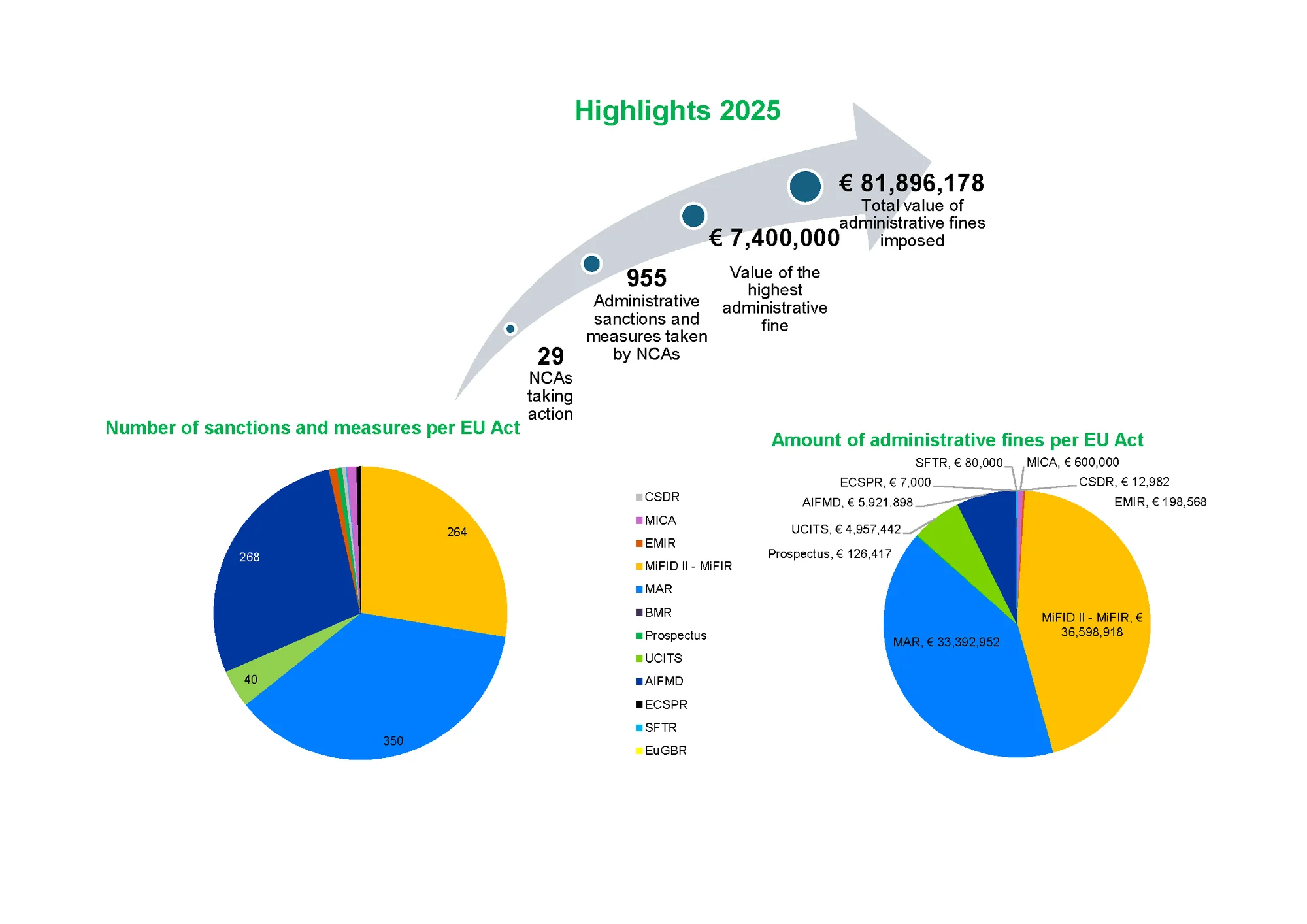
The European Securities and Markets Authority (ESMA), the EU's financial markets regulator and supervisor, published today its consolidated report on sanctions and measures imposed across the European Economic Area (EEA) in 2025, enhancing the transparency of sanctions data reported under EU financial acts within its remit.

In 2025, national authorities across the EEA imposed more than 950 administrative sanctions and measures, a stable number compared with the past two years. The aggregated value of administrative fines amounted to almost €82 million. The report also highlights an increased use of settlements.

As in previous years, activity remained focused mainly on breaches of the Market Abuse Regulation and the Markets in Financial Instruments Directive and Regulation. Enforcement activity remained concentrated in a small number of jurisdictions, with Germany, France and Spain accounting for two thirds of the total value of administrative fines across the EEA.

Need for stronger convergence

The report highlights significant differences in enforcement, including in the number and type of sanctions imposed, the level of fines and the use of settlement procedures. The findings point to a need for stronger convergence in enforcement, particularly where limited enforcement activity cannot be explained by market size.

Supervisory effectiveness ultimately depends on market participants’ compliance with the rules, and should not be measured solely by the number or value of the sanctions imposed in a Member State. Nevertheless, enforcement actions are an important component of the supervisory toolkit.

Next steps

Building on the findings of this report, ESMA will further continue to foster exchanges among national securities and markets authorities on the effective and consistent implementation of capital markets rules, including through case discussions. The objective is to ensure that similar breaches result in similar enforcement outcomes across the EU, irrespective of where they have been committed.

The underlying data are available in excel format. In addition, a snapshot of the report’s key findings is published here.

Further information:

Ana Dilaverakis

Communications Officer

press@esma.europa.eu

Class (B2B/B2C)
B2B
Ingest Status
Rewritten
Dedupe hash
5b6ed5043aaac4380a30527814ec96e5
Press Eligible
Yes
Press Eligible Reason
Manuelle Prüfung nötig. Risiko: MEDIUM. Flags: ['finance', 'numbers']. Stichprobe: False
Source Name
ESMA News
Original Summary

<span class="field field--name-title field--type-string field--label-hidden">ESMA's third Sanctions Report highlights the need for greater convergence in enforcement</span>

<span class="field field--name-created field--type-created field--label-hidden"><time class="datetime" datetime="2026-10-15T09:41:07+02:00" title="Thursday, October 15, 2026 - 09:41">15 October 2026</time>
</span>

<div class="field field--name-field-news-section field--type-entity-reference field--label-hidden field__items">
<div class="field__item">Market Abuse</div>
<div class="field__item">Supervisory convergence</div>
<div class="field__item">Transparency</div>
</div>

<div class="clearfix text-formatted field field--name-field-news-introduction field--type-text-long field--label-hidden field__item"><p class="text-align-justify"><span>The European Securities and Markets Authority (ESMA), the EU's financial markets regulator and superviso

Image URL
https://www.esma.europa.eu/sites/default/files/inline-images/Enforcement_snapshot.png
Source Node
Content Hash (SHA-256, erste 32 hex)
468b6cc230bae499e9f99c981b26c6ee
ESMA updates its manual on transparency with new guidance for OTC derivatives and tick-size regime
Original HTML

ESMA updates its manual on transparency with new guidance for OTC derivatives and tick-size regime

The European Securities and Markets Authority (ESMA), the EU regulator and supervisor, has updated its manual on transparency to provide further guidance on the identification of over-the-counter (OTC) derivatives subject to transparency requirements and to enhance supervisory convergence on the application of the tick-size regime.

The update also clarifies how the identifying reference data for OTC derivatives should be provided for transparency purposes, supporting greater consistency in the data reported to and published through the consolidated tape.

The manual finally includes several published Q&As on the tick size regime, as well as the addition of recommendations on the application of the tick-size regime, comprising when trading venues and national competent authorities may intervene in specific circumstances.

Next steps

With regard to the guidance on OTC identifying reference data, the updated manual should be considered a draft until the entry into force of the related technical standards (RTS 2 and RTS on CTP input/output data).

Further information:

Cristina Bonillo Olivares

Senior Communications Officer

press@esma.europa.eu

Class (B2B/B2C)
B2B
Ingest Status
Rewritten
Dedupe hash
a4aa3ef69f9bfad16b03b8f694a5a62c
Press Eligible
Yes
Press Eligible Reason
Regulatory guidance affecting transparency reporting and trading in OTC derivatives and securities markets.
Source Name
ESMA News
Original Summary

<span class="field field--name-title field--type-string field--label-hidden">ESMA updates its manual on transparency with new guidance for OTC derivatives and tick-size regime</span>

<span class="field field--name-created field--type-created field--label-hidden"><time class="datetime" datetime="2026-10-15T15:17:15+02:00" title="Thursday, October 15, 2026 - 15:17">15 October 2026</time>
</span>

<div class="field field--name-field-news-section field--type-entity-reference field--label-hidden field__items">
<div class="field__item">Trading</div>
</div>

<div class="clearfix text-formatted field field--name-field-news-introduction field--type-text-long field--label-hidden field__item"><p>The European Securities and Markets Authority (ESMA), the EU regulator and supervisor, has updated its <a href="https://www.esma.europa.eu/sites/default/files/2023-07/ESMA74-213416970… on transparency</a> to

Source Node
Content Hash (SHA-256, erste 32 hex)
e400cbfd0ead6fc691b077a9b09b35bb
One year to go for T+1 settlement: the regulatory framework is complete, now let’s make it happen
Original HTML

One year to go for T+1 settlement: the regulatory framework is complete, now let’s make it happen

The European Union (EU) will switch to T+1 settlement on 11 October 2027. Ahead of the transition, the European Securities and Markets Authority (ESMA), the EU’s financial markets regulator and supervisor, calls on market participants to finalise technical preparations, assess readiness across their entire ecosystems and begin testing as soon as possible throughout the trading and settlement chain.

With the publication of the RTS and ESMA Guidelines on standardised procedures and messaging protocols, the regulatory framework is now ready. The first deadline is for investment firms and their clients to comply with the new requirements on allocations and confirmations from 7 December 2026.

Verena Ross, ESMA’s chair, said:

“The transition to T+1 is one of the most impactful recent market structure initiatives. It will fundamentally improve the efficiency and international competitiveness of the EU markets. The date is known, the roadmap is clear, and, with the final piece of regulatory guidance published today, the framework is now in place for all players in the trading and settlement chain to prepare for 11 October 2027.

A successful transition is a shared effort by the industry and the public authorities. The focus now shifts to market participants to comply with the regulatory requirements, ready their systems and processes, and test their preparedness for the change, considering the recommendations of the EU T+1 Industry Committee.”

Delivering the final piece of regulatory work

ESMA’s revised guidelines on standardised procedures and messaging protocols clarify how market participants should meet the new requirements on allocations and confirmations introduced by the amended RTS on Settlement Discipline, in particular, as of 7 December 2026, the mandatory use of:

- electronic, standardised communication channels and international messaging standards; and

- machine-readable communication methods, except in cases of temporary technical disruptions.

Further information:

Cristina Bonillo Olivares

Senior Communications Officer

press@esma.europa.eu

Class (B2B/B2C)
B2B
Ingest Status
Rewritten
Dedupe hash
707c62e327b0343f7853b1c16a4def14
Press Eligible
Yes
Press Eligible Reason
Manuelle Prüfung nötig. Risiko: MEDIUM. Flags: ['finance']. Stichprobe: False
Source Name
ESMA News
Original Summary

<span class="field field--name-title field--type-string field--label-hidden">One year to go for T+1 settlement: the regulatory framework is complete, now let’s make it happen</span>

<span class="field field--name-created field--type-created field--label-hidden"><time class="datetime" datetime="2026-10-16T09:49:31+02:00" title="Friday, October 16, 2026 - 09:49">16 October 2026</time>
</span>

<div class="field field--name-field-news-section field--type-entity-reference field--label-hidden field__items">
<div class="field__item">Guidelines and Technical standards</div>
<div class="field__item">Post Trading</div>
<div class="field__item">Press Releases</div>
</div>

<div class="clearfix text-formatted field field--name-field-news-introduction field--type-text-long field--label-hidden field__item"><p class="text-align-justify"><span>The European Union (EU) will switch to T+1 settlement on 11 October 2027. Ahead of t

Source Node
Content Hash (SHA-256, erste 32 hex)
5afd558edd499a14680cd2b7856994ab
ESMA finalises the review of guidelines on the delay in disclosure of inside information
Original HTML

ESMA finalises the review of guidelines on the delay in disclosure of inside information

The European Securities and Markets Authority (ESMA), the EU’s financial markets regulator and supervisor, has updated and streamlined its Market Abuse Regulation (MAR) guidelines on the delay in the disclosure of inside information, completing the revised regulatory framework.

Under MAR, issuers are required to disclose as soon as possible the inside information concerning them, to ensure that investors are informed and to prevent insider dealing. In specific circumstances, issuers may delay public disclosure to avoid prejudicing their legitimate interests.

These guidelines help issuers in their decision to delay disclosure by providing a non-exhaustive list of legitimate interests that could justify such delay. Following a public consultation, ESMA has identified five additional legitimate interests for delaying disclosures, covering the following situations:

- where the issuer is requested not to disclose information by a public authority;

- where the issuer needs to collect additional information to enable a correct assessment of inside information by market participants;

- where the issuer may risk the loss of a business opportunity following the disclosure of sensitive commercial information;

- where the appointment of a member of the issuer’s governing body or a manager holding a key position could be jeopardised;

- where the disclosure of inside information concerning companies within the same group could cause a direct prejudice to the issuer and undermine the effectiveness of the delay applied by other company.

Since June 2026, issuers are no longer required to immediately disclose inside information related to protracted processes before their completion. As a result, and in line with its simplification and burden reduction objectives, ESMA has removed from the current guidelines the legitimate interests for delayed disclosure connected to these processes.

Next steps

The revised guidelines will become applicable from the date of their publication on ESMA’s website in the 24 official languages of the European Union.

Further information:

Cristina Bonillo Olivares

Senior Communications Officer

press@esma.europa.eu

Class (B2B/B2C)
B2B
Ingest Status
Rewritten
Dedupe hash
bf9fbcae5d886adf9bd573d960593933
Press Eligible
Yes
Press Eligible Reason
Updates regulatory guidelines affecting issuers and financial-market disclosure practices.
Source Name
ESMA News
Original Summary

<span class="field field--name-title field--type-string field--label-hidden">ESMA finalises the review of guidelines on the delay in disclosure of inside information</span>

<span class="field field--name-created field--type-created field--label-hidden"><time class="datetime" datetime="2026-10-16T12:21:13+02:00" title="Friday, October 16, 2026 - 12:21">16 October 2026</time>
</span>

<div class="field field--name-field-news-section field--type-entity-reference field--label-hidden field__items">
<div class="field__item">Guidelines and Technical standards</div>
<div class="field__item">Market Abuse</div>
<div class="field__item">Market Integrity</div>
<div class="field__item">Simplification and Burden Reduction</div>
</div>

<div class="clearfix text-formatted field field--name-field-news-introduction field--type-text-long field--label-hidden field__item"><p class="text-align-justify">The European Sec

Source Node
Content Hash (SHA-256, erste 32 hex)
759a8c5ad8c1b56e7d783a9155371814
New Q&As available
Original HTML

New Q&As available

CCP

Digital Finance and Innovation

16/10/2026

The European Securities and Markets Authority (ESMA), the EU's securities markets regulator, has published the following question and answer:

European crowdfunding service providers for business

Markets in Crypto-Assets Regulation (MiCA)

OTC derivatives, central counterparties and trade repositories (EMIR) - CCPs

- AAR 85% exemption (2936)

- AAR thresholds calculation (2937)

- AAR representativeness obligation (2938)

Class (B2B/B2C)
Ignore
Ingest Status
Rejected
Dedupe hash
536f37694ab9da863d50a4873e7d97a8
Press Eligible
No
Press Eligible Reason
Text too short (65 words. Min: 150)
Source Name
ESMA News
Original Summary

<span class="field field--name-title field--type-string field--label-hidden">New Q&amp;As available</span>

<span class="field field--name-created field--type-created field--label-hidden"><time class="datetime" datetime="2026-10-16T16:14:51+02:00" title="Friday, October 16, 2026 - 16:14">16 October 2026</time>
</span>

<div class="field field--name-field-news-section field--type-entity-reference field--label-hidden field__items">
<div class="field__item">CCP</div>
<div class="field__item">Digital Finance and Innovation</div>
</div>

<div class="clearfix text-formatted field field--name-field-news-introduction field--type-text-long field--label-hidden field__item"><div>
<div>
<div>
<p class="text-align-justify">The European Securities and Markets Authority (ESMA), the EU's securities markets regulator, has published the following question and answer:</p>
</div>
</div>
</div>
</div>

<div class="clearfix text-f

Source Node
Content Hash (SHA-256, erste 32 hex)
7677db80d8ee0ed1ef942861e63d7e39
ESMA specifies requirements to facilitate safe use of post-trade risk reduction services
Original HTML

ESMA specifies requirements to facilitate safe use of post-trade risk reduction services

The European Securities and Markets Authority (ESMA), the EU’s financial markets regulator and supervisor, has outlined the conditions that providers and users of post-trade risk reduction (PTRR) services need to meet for certain OTC derivative transactions to be exempt from the clearing obligation under EMIR 3. The new rules, published in its latest final report, also establish safeguards for the provision of these services and the monitoring of the use of the exemption.

With these new rules in place, the goal is to facilitate the use of PTRR services and ensure that the exemption is used under the conditions laid down in EMIR 3 and does not lead to the misuse of the clearing obligation.

The final report specifies the elements and requirements of PTRR services, including the information to be provided to participants, how exercises are carried out, the controls that providers should have in place, record-keeping and how the exemption will be monitored.

PTRR services help market participants manage their derivatives portfolios and reduce risks, thereby contributing to safer and more resilient derivatives markets.

The final rules build on existing market practices and aim to avoid introducing additional requirements where existing rules already meet the relevant objectives, in line with ESMA’s simplification and burden reduction objectives.

Next steps

The draft Regulatory Technical Standards will now be submitted to the European Commission for endorsement, in line with the standard review process.

Further information:

Cristina Bonillo Olivares

Senior Communications Officer

press@esma.europa.eu

Tayfun Yilmaz

Communications Officer

press@esma.europa.eu

Class (B2B/B2C)
B2B
Ingest Status
Rewritten
Dedupe hash
e1a8b9e2d516cf68928e8c2e4d48df3e
Press Eligible
Yes
Press Eligible Reason
Financial-market rules for derivatives risk-reduction services are relevant to industry professionals.
Source Name
ESMA News
Original Summary

<span class="field field--name-title field--type-string field--label-hidden">ESMA specifies requirements to facilitate safe use of post-trade risk reduction services</span>

<span class="field field--name-created field--type-created field--label-hidden"><time class="datetime" datetime="2026-10-20T14:34:51+02:00" title="Tuesday, October 20, 2026 - 14:34">20 October 2026</time>
</span>

<div class="field field--name-field-news-section field--type-entity-reference field--label-hidden field__items">
<div class="field__item">Guidelines and Technical standards</div>
<div class="field__item">Post Trading</div>
</div>

<div class="clearfix text-formatted field field--name-field-news-introduction field--type-text-long field--label-hidden field__item"><p class="text-align-justify">The European Securities and Markets Authority (ESMA), the EU’s financial markets regulator and supervisor, has outlined the conditions that providers and user

Source Node
Content Hash (SHA-256, erste 32 hex)
34c3706c8466e90bf8bcabde59a7a268
ESMA streamlines several Q&As as part of simplification efforts
Original HTML

ESMA streamlines several Q&As as part of simplification efforts

The European Securities and Markets Authority (ESMA), the EU regulator and supervisor, has updated its Questions and Answers (Q&As) on market structure under MiFID II, the Market Abuse Regulation (MAR) and the Short Selling Regulation (SSR), removing outdated, duplicative and no longer relevant guidance as part of its Simplification and Burden Reduction (SBR) initiative.

The exercise focused on identifying Q&As that are no longer relevant due to legislative amendments that are reflected in established market practices, or that are covered by other ESMA guidance. As a result, several Q&As have been withdrawn or amended, including instances where the same issues are addressed in other ESMA publications such as supervisory briefings and opinions.

The goal of the initiative is to reduce unnecessary complexity, remove obsolete guidance and ensure that ESMA's Q&As remain relevant, proportionate and consistent with the current legislative framework.

Stakeholders are encouraged to refer to the updated set of Q&As together with any other ESMA guidance for the most comprehensive interpretation of the applicable rules.

Further information:

Cristina Bonillo Olivares

Senior Communications Officer

press@esma.europa.eu

Tayfun Yilmaz

Communications Officer

press@esma.europa.eu

Class (B2B/B2C)
B2B
Ingest Status
Rewritten
Dedupe hash
518bbda7d9ac3e6b291e129dd6ae6e79
Press Eligible
Yes
Press Eligible Reason
Regulatory update affecting financial markets and industry professionals.
Source Name
ESMA News
Original Summary

<span class="field field--name-title field--type-string field--label-hidden">ESMA streamlines several Q&amp;As as part of simplification efforts</span>

<span class="field field--name-created field--type-created field--label-hidden"><time class="datetime" datetime="2026-10-22T16:51:53+02:00" title="Thursday, October 22, 2026 - 16:51">22 October 2026</time>
</span>

<div class="field field--name-field-news-section field--type-entity-reference field--label-hidden field__items">
<div class="field__item">Market Abuse</div>
<div class="field__item">MiFID - Secondary Markets</div>
<div class="field__item">Short Selling</div>
<div class="field__item">Simplification and Burden Reduction</div>
</div>

<div class="clearfix text-formatted field field--name-field-news-introduction field--type-text-long field--label-hidden field__item"><p class="text-align-justify"><span>The European Securities and Markets Autho

Source Node
Content Hash (SHA-256, erste 32 hex)
0afcd44af69dd32132946a43304b3d0a
What Are the VA’s 5, 10, and 20-Year Protection Rules?
Image File
Original HTML

Federal law limits how and when the VA can reduce a disability rating, and the limits get stronger the longer a rating or service connection has already been in place. Three regulations govern it, 38 C.F.R. § 3.344, § 3.957, and § 3.951(b), known as the 5-year, 10-year, and 20-year rules. VetsForever breaks down what each one actually protects and what to do if a reduction letter shows up.

You’ve been rated at 70% for eleven years. The number hasn’t moved, your condition hasn’t gotten easier, and you stopped opening VA mail with any dread a long time ago. Then an envelope shows up with the words “proposed reduction,” and every bill tied to that check suddenly feels temporary again.

Trinidad Aguirre, CEO and Co-Founder of VetsForever, walks through the 5-year, 10-year, and 20-year rating protection rules on this episode of Beyond the Rating, the federal regulations that decide when the VA can and can’t touch a rating that’s already been in place for years.

What Is the 5-Year Rule for VA Disability Ratings?

Under 38 C.F.R. § 3.344, once a rating has been in place for five years or more, the VA can’t reduce it off a single good exam. It needs sustained, documented improvement: a pattern shown across more than one exam, under the ordinary conditions of daily life, the kind of evidence a single appointment can’t produce on its own.

If you have a decent day at a C&P exam and the examiner notes some improvement, that alone isn’t enough to support a reduction. The VA is still allowed to schedule reexaminations on a rating protected under this rule, and a re-exam notice by itself is not a reduction notice. But if you skip the exam, or walk in without preparing, that appointment can become the first data point in a reduction case. Knowing the difference between the two notices is most of what matters.

What Is the 10-Year Rule for VA Service Connection?

Once service connection has been in effect for ten years or more, 38 C.F.R. § 3.957 stops the VA from severing that connection outright, except for fraud or a showing that your service didn’t meet the character-of-discharge requirement. After ten years, the VA cannot go back and say your condition was never related to your service. That question is closed.

What this rule doesn’t do is protect the percentage. A veteran with ten years of protected service connection can still see their rating reduced, sometimes sharply. The connection stays; the number can still move. A veteran can be fully protected from severance under the 10-year rule and still get a reduction letter the same year.

What Is the 20-Year Rule for VA Disability Ratings?

38 C.F.R. § 3.951(b) sets a floor. Once a rating has been continuously at or above a given level for twenty years or more, the VA cannot reduce you below that level, short of fraud. If you’ve held 70% for two decades, 70% is where you stay at minimum. That floor is set by federal regulation, and the VA has no discretion to go below it.

Stack the 10-year and 20-year rules together and a veteran with two decades in the system is protected two ways at once: a locked service connection and a rating floor under it.

Why Does Your VA Effective Date Matter?

Every one of these clocks starts on your effective date, which is when your original claim was filed. It has nothing to do with when the VA got around to approving it. If it’s been more than five years since that date, the 5-year rule is already active. Past ten, the 10-year rule applies. Past twenty, you have a permanent floor. Veterans who filed years ago sometimes have one or more of these protections in force right now without realizing it.

What Should You Do If You Get a Proposed Reduction Letter?

38 C.F.R. § 3.105(e) spells out what you’re owed once a reduction is proposed but before anything is final. You get 60 days to submit evidence showing your rating should stay where it is, and a separate right to request a predetermination hearing within 30 days. Request that hearing on time and your payments continue at the current rate until a final decision is made. Miss both windows, and the proposed reduction becomes final.

If you’ve received a proposed reduction, the response window is short and the rules above have to be applied correctly to matter.

VetsForever’s VA-accredited representatives know when the 5, 10, and 20-year protections apply to a given case and how to build a response around them. If you haven’t received a letter, a case review can still tell you exactly where you stand, how long your rating has been in place, which protections are already active, and what to watch for.

Got a reduction letter, or think one of these protections might already apply to your rating? A case review will tell you exactly where you stand. Get a case review

Watch the Conversation

Chapter Timestamps

0:00 — Intro: what the 5, 10, and 20-year rules protect

1:26 — The 5-Year Rule for VA Disability Ratings

2:19 — The 10-Year Rule for VA Service Connection

2:54 — The 20-Year Rule for VA Disability Ratings

3:51 — Why Your VA Effective Date Matters

4:23 — What to Do If You Get a Proposed Reduction Letter

5:30 — How VetsForever Can Serve

Frequently Asked Questions

If you request a predetermination hearing within the 30-day window, does that guarantee the reduction won’t happen?

No. Requesting the hearing on time keeps your payments at the current rate and gets you a chance to present your case in person, but the VA can still finalize the reduction afterward if the evidence presented doesn’t support keeping your rating where it is.

If your rating goes up after years at a lower level, does the 20-year floor move up to the new number?

Not automatically. Under 38 C.F.R. § 3.951(b), the floor is whichever level you’ve held continuously for 20 years or more. A higher rating you’ve only held for, say, five years, hasn’t earned its own 20-year floor yet. The VA could still reduce you back down to the older, lower level that’s actually been in place two decades.

Do the 5, 10, and 20-year rules protect your combined rating, or each condition separately?

Each one applies to a specific service-connected disability’s own rating or service connection. Your overall combined percentage isn’t what’s being measured. A veteran with multiple conditions could have one rating fully protected under the 20-year rule and another, more recently rated, condition with no protection yet at all.

Do you need a 100% rating for any of these protections to apply?

No. All three rules key off how long a rating or service connection has been in place. The percentage itself doesn’t factor into it. A 30% rating held for twenty years gets the same floor protection as a 100% rating held for twenty years.

Can the VA reduce your rating while a predetermination hearing request is pending?

No. Once you request the hearing within the 30-day window, your payments continue at the current rate until a final decision is issued. The reduction cannot take effect while that hearing is pending.

Does a scheduled reexamination mean the VA is reducing your rating?

No. A reexamination notice and a reduction notice are two different things. The VA can schedule a re-exam on a protected rating without proposing a reduction; the reduction process only starts if a separate proposed reduction letter goes out under 38 C.F.R. § 3.105(e).

What counts as “sustained improvement” under the 5-year rule?

Under 38 C.F.R. § 3.344, it means documented improvement shown across more than one exam, evaluated under the ordinary conditions of daily life, not just work or a single clinical setting. One good day at a C&P exam doesn’t meet that standard on its own.

Keep Reading on VetsForever

What GI Bill education benefits are available to veterans: the five VA education programs and how they compare. /what-gi-bill-education-benefits-are-available-to-veterans/

How to prepare for a complex VA disability claim: what to check in your file before you file. /how-to-prepare-for-a-complex-va-disability-claim/

You served your time to earn that rating. If the VA is trying to take it, get a VA-accredited representative in your corner. Get started

About VetsForever

VetsForever is a veteran-founded organization. We provide legal representation through VA-accredited representatives for VA disability claims, appeals, and military discharge upgrades. Our VA-accredited representatives have direct VBMS access to your VA file. Serving veterans nationwide. Not YouTube experts. Not unaccredited third parties. Real accredited representatives who served.

Class (B2B/B2C)
B2C
Ingest Status
Rewritten
Dedupe hash
8ae5d8ea37dc497403620c959228d9ee
Press Eligible
Yes
Press Eligible Reason
Manuelle Prüfung nötig. Risiko: MEDIUM. Flags: ['legal']. Stichprobe: False
Source Name
VetsForever
Original Summary

<p>Federal law limits how and when the VA can reduce a disability rating, and the limits get stronger the longer a rating or service connection has already been in place. Three regulations govern it, 38 C.F.R. § 3.344, § 3.957, and § 3.951(b), known as the 5-year, 10-year, and 20-year rules. VetsForever breaks down what each one actually protects and&#8230;</p>
<p>The post <a href="https://vetsforever.com/what-are-the-vas-5-10-and-20-year-protection-ru… Are the VA&#8217;s 5, 10, and 20-Year Protection Rules?</a> appeared first on <a href="https://vetsforever.com">VetsForever</a>.</p&gt;

Image URL
https://vetsforever.com/wp-content/uploads/2026/08/va-protection-rules-header.png
Source Node
Content Hash (SHA-256, erste 32 hex)
1b5e0e3f2b52753d8f38c0151156862a
What Does a VA C-File Review Actually Show You?
Image File
Original HTML

A C-file review means having someone who knows what to look for read your VA claims file front to back, not just skim the decision letter. In this post, we walk through what that review actually turns up: missed evidence, exam results that don’t match a decision, and conditions that were claimed but never rated. VetsForever’s VA-accredited representatives run these reviews daily, and the short version is this: most veterans have never seen a page of their own file, and that’s usually where a denial traces back to.

If you want the full breakdown of what’s inside a C-file itself, see “What’s in Your VA C-File?” This post picks up from there and focuses on what a trained review finds once someone actually reads it.

The VA built your rating on a file you’ve likely never seen. Hundreds of pages, sometimes thousands. Exams, treatment notes, decisions: every word behind the percentage you live with each month. If you’ve been denied, or you’ve moved a claim on your own for years without traction, the file is usually where the answer sits.

What Is a C-File?

Your C-file, short for claims file, is the VA’s complete record on you. It holds every rating decision, every Compensation and Pension (C&P) exam, your service treatment records, private medical evidence, and the VA’s own notes behind each decision.

Most veterans picture a thin folder. The real one runs hundreds of pages, sometimes thousands. Everything the VA knows about your claim lives in it. So does everything they used to rate you.

What’s Actually in Your C-File?

Picture the thickest personnel file you ever saw at your last duty station. Now double it, then let it sit for a few years. That’s a light day for a C-file. Here’s what’s actually stacked inside:

- Every rating decision and the reasoning behind it

- C&P exam results

- Your service treatment records

- Private medical records you or your doctors submitted

- Nexus letters connecting a condition to your service

- VA internal notes and correspondence

- The full history of what you’ve claimed and when

It stacks up over years, one form at a time. Most veterans have never seen it laid out in one place, and nobody at the VA is in a hurry to hand you a tour.

What Does the VA Use to Decide Your Rating?

Your file. Only your file.

When a rater sets your percentage, they work from what’s in your C-file: the exams, the evidence, the history. Under 38 C.F.R. § 3.159, the VA has a duty to assist you in developing your claim and gathering relevant evidence. But the VA rates what’s in front of it, not what should be there. If something is missing, recorded wrong, or never developed, your rating reflects that gap.

Beyond the Rating: Inside Your VA C-File

In this episode of Beyond the Rating, Trinidad Aguirre opens a real C-file on camera and walks through what’s inside it: the exams, the decisions, and the evidence the VA used to set a rating. He covers why most veterans never see their own file, and how a full read can turn up a nexus letter that got overlooked or an exam result that doesn’t match the decision it produced. The episode closes on how VetsForever’s The Readout puts a VA-accredited representative on your file, so you know what’s there before your next move.

00:07 Intro

00:54 Welcome back to Beyond the Rating

01:10 Your C-file is your evidence vault

02:44 The missing nexus letter problem

04:10 How old ratings can come back to help you

05:53 What the VA sees and what you see

07:08 C-file first, claim second

08:02 The Readout

09:19 Closing

VetsForever is a veteran-founded organization. We provide legal representation through VA-accredited representatives for VA disability claims, appeals, and military discharge upgrades. Our VA-accredited representative has direct VBMS access to your VA file. Serving veterans nationwide.

What Gets Missed in a C-File?

- A nexus letter your doctor wrote, sitting in the file, that a denial never mentions

- A knee rated at 10% on a C&P exam that describes a 30% limitation

- A C&P exam the file never marked attended, so the rater decided without it

- A condition you raised years ago that the VA acknowledged and then never rated

Sometimes it’s how something got recorded. Sometimes it’s what never made it in. Either way, what’s missing keeps costing you, decision after decision.

Can You See Your Own C-File?

Yes, and it’s not a favor. Under 38 C.F.R. § 1.577(a), you have the right to review your own record and get a copy of it. Veterans exercise that right by filing VA Form 20-10206, the Freedom of Information Act (FOIA) or Privacy Act request form. Two things to know before you file it.

First, the wait. Processing time depends on the size of your file and the VA’s workload, and it can run several months.

Second, reading it. When your file shows up, you’re looking at hundreds of pages of exams, decisions, and medical records on your own. Knowing what’s in a file and knowing what it means are two different jobs.

Key Terms Every Veteran Should Know

This isn’t jargon for its own sake. These are the six terms you need before you request your file or read a decision letter, so nobody can bury you in acronyms.

- C-file (claims file): The VA’s complete record on your disability claim — every rating decision, exam, and note used to decide what you’re paid.

- C&P exam (Compensation and Pension exam): The medical exam the VA orders to evaluate a claimed condition.

- Nexus letter: A statement from a doctor connecting your condition to your service.

- Rating decision: The VA’s official document explaining what it granted, denied, and why, and the percentage assigned.

- VBMS: The VA’s electronic records system, where your C-file lives.

- VA-accredited representative: Someone who has met the federal standard to represent veterans before the VA, with authorized access to your file.

Frequently Asked Questions

Q: What is a VA C-file?

A: A C-file, or claims file, is the VA’s complete record on your disability claim: every rating decision, C&P exam, treatment record, and note the VA used to decide your rating.

Q: What’s actually in my C-file?

A: Rating decisions, C&P exam results, service treatment records, private medical evidence, nexus letters, VA internal notes, and your full claim history.

Q: How do I request a copy of my C-file?

A: File VA Form 20-10206, the Freedom of Information Act (FOIA) or Privacy Act request form, online, by fax, or by mail to the VA’s Evidence Intake Center.

Q: Why does my C-file matter for my appeal?

A: It shows exactly what evidence the VA used to reach a decision, so you can spot errors, gaps, or evidence that never made it into the file.

Q: Is my C-file the same as my medical records?

A: No. It includes your medical records but also your service records, rating decisions, correspondence, and every other document tied to your claim.

Q: How does a VA-accredited representative use my C-file?

A: A VA-accredited representative reviews the complete file for missing evidence, exam results that don’t match a decision, and conditions that were claimed but never rated, then lays out what’s there before you file again.

Two Ways to See What’s in Your File

Request it yourself under VA Form 20-10206 and read it alone once it arrives. Or have a VA-accredited representative pull it, read it front to back, and lay out what’s there, what’s missing, and what may have been overlooked. That’s what VetsForever built The Readout to do. Serving veterans through every stage of their VA claims journey.
Class (B2B/B2C)
B2C
Ingest Status
Rewritten
Dedupe hash
ef6c0abcaced929b87c56476e5135a8e
Press Eligible
Yes
Press Eligible Reason
Veteran-focused informational content about VA claims files, with promotion of a related review service.
Source Name
VetsForever
Original Summary

<p>A C-file review means having someone who knows what to look for read your VA claims file front to back, not just skim the decision letter. In this post, we walk through what that review actually turns up: missed evidence, exam results that don&#8217;t match a decision, and conditions that were claimed but never rated. VetsForever&#8217;s VA-accredited representatives run these&#8230;</p>
<p>The post <a href="https://vetsforever.com/what-does-a-va-c-file-review-actually-show-you/… Does a VA C-File Review Actually Show You?</a> appeared first on <a href="https://vetsforever.com">VetsForever</a>.</p&gt;

Image URL
https://vetsforever.com/wp-content/uploads/2026/08/iStock-2282376326.jpg
Source Node
Content Hash (SHA-256, erste 32 hex)
c78d015a0b32b82a599a94deb555369b