Startup Spotlight: Dust’s Multi-Model AI Platform
Image File
Original HTML

Welcome to Snowflake's Startup Spotlight, where we ask startup founders about the problems they're solving, the products they're building and the lessons they've learned during their startup journey. In this edition, meet Dust's Co-Founder and CTO, Stanislas Polu, and learn how the company is building a collaborative AI platform to reduce the distance between your data and the decisions your teams are making.

What inspires you as a founder?

I'm inspired by technical shifts that force us to question old assumptions. Large language models have made intelligence abundant, but abundance creates a new problem: How does a company use changing sources of intelligence without giving up control of what makes it unique? As AI spreads across individual tools and vendors, the company's context, agents and ways of working can become fragmented. I want to build the layer that lets organizations absorb constant progress while keeping those assets and choices their own.

Explain Dust in a single sentence.

Dust is the collaborative AI platform that rewires the way companies work and enables them to control the intelligence they use and own the data they generate.

What problem does Dust solve? How did you identify that issue?

Companies are gaining access to more intelligence, but they risk losing control over it. Much of workplace AI is still adopted by one person, assistant or model at a time. That creates three forms of dependency: reliance on a single model provider, loss of control over the data and traces generated by agents, and limited visibility into costs and behavior.

The traces matter. They capture how work was completed: the instructions, context, model and tool choices, outputs and human feedback. Over time, that record may become one of the company's most valuable AI assets, helping it evaluate workflows and develop systems tailored to how it actually operates. Companies shouldn't give that asset away by default.

My co-founder, Gabriel Hubert, and I had seen the growing pains of coordination while working at Stripe, as it grew from roughly 150 people into a much larger organization. Information gets lost, decisions become harder to trace and teams stop sharing the same context. When LLMs became capable enough for serious work, our hypothesis was that companies didn't need another model. They needed a shared layer between humans, company data, existing systems and the available models.

Dust is that layer. It lets teams work collaboratively with AI, switch among supported frontier and open source models, and govern the context, agents and traces their work generates. What one person builds can become a reusable company capability without becoming dependent on a single source of intelligence.

What’s the coolest thing your company is doing with data?

We're helping companies turn agentic traces into an asset they can understand, improve and retain.

The data required to do a job rarely lives in one place. A single question can require warehouse data from Snowflake, account context from a CRM and qualitative information from Slack, Notion or call notes. But the result is only part of the value. The trace around it shows which context, instructions, models, tools and human decisions produced the work.

Dust brings those elements into a shared company system. An AI operator can study what works to improve an agent or skill and make it reusable by colleagues. As the company changes models or providers, it keeps the accumulated context and learning around its workflows. In the future, that corpus could also help companies evaluate or train models for their specific work. The model may change, but the intelligence the organization builds around it should remain its own.

How does Snowflake fit into the Dust stack? What role does it play?

Snowflake is a connected source of structured business data that Dust agents can work with. Organizations can connect Snowflake to Dust so teams can query relevant warehouse data in natural language and combine it with context from other company systems.

That matters because useful business questions often cross system boundaries. Snowflake can remain the structured data foundation and source of truth, while Dust helps humans and agents use that data as part of broader work.

This is an important part of company-owned AI. A company should be able to keep Snowflake as its source of truth, apply the relevant permissions and control how that context is used by its agents, rather than rebuilding its data strategy around an AI vendor.

How does Snowflake enable you to push the envelope in your line of business?

Snowflake makes structured data usable beyond the data team. Paired with Dust, a business user can ask a question in natural language, use relevant warehouse data alongside other company context and turn the result into a repeatable workflow rather than a one-off analysis.

This is the direction we care about: reducing the distance between a company's data and the decisions or actions it should inform, without weakening the company's control over that data. Access and control are not opposites. Data teams can encode trusted access and business logic, while more colleagues gain a practical way to use them.

As a founder and innovator, what is your take on the rapidly changing AI landscape, and how will it change what Dust is able to do?

The mistake is to treat AI as a race with one permanent winner. Models will keep changing in capability, cost, latency and specialization. Companies should not have to predict the winner or rebuild their operating layer whenever the frontier moves.

Dust is multimodel by design. Organizations can choose among supported frontier and open source models and update those choices as the landscape changes, without rebuilding their company context and workflows. This is what sovereignty means to us in practice: not doing everything locally or rejecting external providers, but staying in control when a provider, price, policy or model changes.

Companies will rent intelligence from many sources. The durable asset is what they build around it: how the organization works, what it knows, what it has decided and where human judgment matters. That layer should belong to the company, not to whichever model happens to be leading today.

The next shift is from individuals prompting assistants to companies coordinating digital teams of humans and agents. Our principle today is simple: Agents propose; humans dispose.

What’s the most valuable piece of advice you got about how to run a startup?

Before presenting a research paper early in my career, I worried that I didn't have enough authority to defend the work. My adviser reminded me that I had spent more time on that specific problem than almost anyone and should trust the depth of the work.

That advice has stayed with me as a founder. Deep focus can create its own doubt, because if a solution becomes obvious to you, you assume it must be obvious to everyone. However, often it's not the case. You should remain open to being wrong, but you should also respect the insight that comes from sustained attention to a real problem, then keep testing it with users.

What’s a lesson you learned the hard way?

Don't fall in love with a technology before understanding whether it can support a large and important market.

At TOTEMS, the company Gabriel and I founded before Dust, we were fascinated by what the technology could do. We did not ask early enough how large the business could become if everything worked. With Dust, we have tried to make a few consequential bets, test them quickly and avoid optimizing something that is still insignificant in the market.

That lesson shaped one of our early principles: "No product-market fit, no GPUs." We could have focused on training models, but it would've been a seductive distraction. We chose the product layer where customers had a concrete problem and where their usage could teach us what to build next.

When you envision the future of your industry, where do you see Dust?

AI will become less like a collection of applications that individuals open and more like a workforce that companies coordinate. Access to intelligence will not be scarce. The scarce resource will be the organizational ability to direct it, without becoming dependent on one provider's models, interface or roadmap.

I see Dust as the shared system where companies build and govern their own AI: their context, agents, skills, model choices and the ways humans and agents work together. Successful ways of working should become reusable across the organization and remain valuable when the underlying models change.

The goal is not for every company to own a foundation model. It's for every company to own its AI capital, including the soft and hard skills, the learnings, know-how, workflows, traces and operations it builds with AI. Dust is building for that future.

Learn more about Dust at https://dust.tt/. If you're a startup building on Snowflake, check out the Snowflake for Startups program for info on how Snowflake can support your goals.


Class (B2B/B2C)
B2B
Ingest Status
Rewritten
Dedupe hash
4ee45f22cc3b642b7999d1a5e1cf22bf
Press Eligible
Yes
Press Eligible Reason
Startup interview about Dust’s enterprise collaborative AI platform and its integration with Snowflake.
Source Name
Snowflake Newsroom
Original Summary

Dust Co-Founder and CTO Stanislas Polu explains the vision behind Dust and how it helps companies own their AI by enabling control over agentic traces.

Image URL
https://www.snowflake.com/content/dam/snowflake-site/blog/2026/10/startup-spotlight-dust.png
Source Node
Content Hash (SHA-256, erste 32 hex)
098c4cb520dcd4b38255f527d57ba515
Data Migration Tools: Meet the Snowflake AIM Application
Image File
Original HTML

Database migrations have always been one of those projects that everyone needs to happen and nobody volunteers to run. The tooling is fragmented and the risk tolerance is zero. Teams spend weeks stitching together data migration tools: extraction scripts, conversion tools, deployment pipelines and validation jobs — and then spend another few weeks wondering if they got it right.

We set out to change that with Snowflake AIM. It started as a skill inside the Snowflake CoCo CLI, then arrived in CoCo Desktop. As of Oct. 20, AIM has a surface entirely its own: the Snowflake AIM application, now in public preview.

With the AIM application, migration engineers have many new advantages:

- Zero setup, zero prerequisite knowledge: As long as you have the standard CoCo CLI and Snowflake CLI available, just open the app and start. No SCAI CLI to install, no IDE to configure, no terminal commands to memorize. Dependencies install themselves on the first run. You need to update the app? Just click on update directly from it.

- Guided end-to-end workflow: You don't need to know the right sequence of a migration. The application walks you through every stage — from connecting to your source database through validated deployment on Snowflake.

- Migration-focused UX: No distractions from unrelated IDE or development features. The entire interface is organized around the migration lifecycle. Everything you need is visible; nothing you don't need is in the way.

- Persistent project state: Close the app, come back days or weeks later. The agent picks up exactly where you left off. No reorientation tax, no lost progress, no "where were we?"

- Deterministic conversion with AI remediation: You get the reliability of our five-year-proven deterministic code conversion engine for the baseline, plus AI that fills in the gaps — explaining issues, suggesting fixes and generating tests. Every fix can become a reusable rule, and every rule can propagate across every similar object in the project, so the migration gets smarter as you work. That's how teams avoid fixing the same pattern 200 times.

- Automated testing and validation: Source-side baselines, two-sided comparison, automated fix loops. Data validation and code testing are handled as separate concerns so you always know what you're looking at.

- Multi-user collaboration: Multiple team members can work on the same project simultaneously without duplicating effort.

- Full CoCo power underneath: For advanced users, the entire agentic platform is accessible — custom rules, MCP tools, custom skills, deployment wave tuning. The guided path is a fast lane, not a cage.

- Broad platform coverage: SQL Server, Redshift, Oracle, Teradata, PostgreSQL out of the box, with Snowflake AIM supporting 15+ dialects and ETL conversion for SSIS and Informatica.

Same migration engine, new experience

Under the covers, the core engine is unchanged: It powers the same deterministic code conversion, dependency-aware deployment waves and advanced agentic test-fix loops — spanning both deterministic and AI-driven validation — that make a migration project smarter as it progresses. What changed is how you reach it.

The AIM application is a standalone desktop application built for migration projects and nothing else. You open it, point it at your source database, and a guided workflow carries you through each stage without an IDE to configure or a terminal to drive.

The CoCo CLI and CoCo Desktop remain excellent surfaces for AIM if you already work in them. The application is a purpose-built third option where the migration workflow sits front and center. With the AIM application, migration engineers always know what assistance to expect from the AIM agent, including a guided setup for each phase, clear visibility into the status of the migration project and precise indicators of where human judgment is needed to assist AI. An engineer driving a migration gets every stage laid out in order, with state tracked and the freedom to pause and resume. A DBA or data engineer who inherited the project without migration being their day job gets structure instead of a blank prompt. Migration engineers retain full control through the underlying agentic loop — customizing rules, writing fix patterns, reordering waves and building test cases. Meanwhile, project stakeholders get instant visibility into progress, object counts and validation results without digging through log files.

What the AIM application actually does

The application guides you through six stages of a migration to Snowflake:

- Connect: Set up a connection to your source database.

- Initialize: Create a local migration project with the scaffolding it needs.

- Register: Extract data definition language (DDL) and stored procedures from the source, or import existing .sql files.

- Convert: Translate source SQL to Snowflake SQL through the deterministic code conversion engine.

- Assess: Generate an interactive report covering complete end-to-end lineage and the migration plan assisted by multiple specialized reports.

- Migrate: Deploy the code, move the data and validate the result. This is where most of the work lives.

- Test-fix AI loop: AI-assisted remediation handles what the deterministic pass cannot. AIM generates test cases and synthetic data, runs the converted code to verify its accuracy, and AI fixes any issues.

Inside the migrate phase

Stages one through five set the table. Stage six covers four workstreams, each with its own logic, validation and fix loops. The agent coordinates all of them while keeping them distinct, because they could fail in different ways.

The validation and fix loop deserves a more in-depth discussion. In fact, testing is three problems, not one

Confirming that rows landed correctly is a different job from confirming that a stored procedure returns what it returned on the source, and both differ from confirming that converted ETL logic produces the same result. The application treats them separately.

Database code testing covers stored procedures, functions and views. The agent captures source-side baselines either from real query logs, if you have CSV logs of EXEC or CALL statements, or by generating test cases and synthetic data with AI. When it generates them, specialized subagents cover business logic paths, data-driven scenarios and edge cases such as NULLs, boundary values and type limits. The converted code then runs on Snowflake, and its output is compared against the baselines. A failure opens a fix loop: Diagnose the root cause, patch the converted SQL, redeploy and retest, repeating until the output matches or you choose to move on.

ETL testing confirms that converted dbt models or stored procedures produce equivalent results to the original SSIS packages or Informatica workflows. The agent claims each ETL code unit, runs it through a phase-based stabilization engine, applies fixes and iterates until the output is correct. Because ETL transformations chain together, it tracks dependencies between models so upstream fixes propagate before downstream units are retested.

Database DDL deployment

Tables, views, stored procedures, functions and sequences deploy wave by wave in dependency order. The assessment phase already mapped the relationships between objects and grouped them so prerequisites land before whatever depends on them. Each object deploys individually, and failures surface immediately. When a view can't compile because a function it depends on hasn't passed testing, the agent parks it and retries once the dependency clears, which means circular dependencies get untangled during assessment rather than by hand on a Friday night.

ETL pipeline migration

SSIS packages and Informatica workflows convert to a Snowflake-native target, either dbt projects on Snowflake or SQL stored procedures, depending on your operational preference and existing toolchain. Snowflake AIM parses control flows, data flows and transformation logic, then produces the equivalent in whichever target you choose. Where the deterministic pass cannot fully resolve a transformation, AI-assisted remediation explains what it could not convert, proposes a fix and applies it interactively. Converted ETL units then run through their own stabilization and testing cycle.

Report repointing

Downstream analytics assets, starting with Power BI reports, can be repointed at Snowflake. The agent handles connection strings, data source mappings and the validation that each report still renders correctly against migrated data. Moving the database and the pipelines only gets you so far if the reports your business users open every morning still query the old system.

Historic data migration

Moving data runs on an orchestrator and worker architecture. The orchestrator manages workflow metadata and tracks state, while workers connect to both source and Snowflake to move the data, running either locally or on Snowpark Container Services and scaling horizontally for large volumes.

Every run validates automatically at three levels. Schema comparison (L1) confirms that table structures in Snowflake match the source. Metric comparison (L2) checks row counts, sums and key aggregates. Row-level comparison (L3) is optional and exists for tables where exact equivalence matters.

Partition key selection, interval handling and other platform-specific data type mappings are configured through the agent, which walks you through the options that matter for your source and generates the configuration.

Built for projects that run for weeks

You can start and continue the project for weeks, and multiple users can share the migration state and work together. The agent reads your project state and picks up exactly where you left off, with the extraction, conversion and deployment record all intact. For a migration spanning hundreds of objects and several weeks, that's the difference between a managed project and a pile of sticky notes.

Class (B2B/B2C)
B2B
Ingest Status
Need Review
Dedupe hash
debc131e65dbeb247a2d0438e13f178b
Press Eligible
Yes
Press Eligible Reason
QA FAIL (need review): The target contains factual claims not supported by the source: (1) 'Deployment, ETL conversion and report repointing run in dependency order' – source only describes dependency-ordered waves for DDL deployment; ETL dependency tracking is for test propagation, and report repointing has no dependency-order claim. (2) The heading calls the converter 'five-year-old,' but the source says 'five-year-proven,' which is a claim of reliability over five years, not necessarily age. This makes the target partially inaccurate.
Source Name
Snowflake Newsroom
Original Summary

The Snowflake AIM application brings data migration tools into one guided desktop workflow: convert code, deploy in waves, move data and validate results.

Image URL
https://www.snowflake.com/content/dam/snowflake-site/blog/general-stock-images/04-general.jpg
Source Node
Generated Article_json
{"target_audience": "b2b", "is_medical": false, "ai_generated_title": "Snowflake Launches AIM App in Public Preview for Database Migrations", "body_html": "<p><strong>Global -- [CURRENT_DATE] --</strong> Snowflake has released the Snowflake AIM application in public preview as of Oct. 20, giving database migration projects a standalone desktop interface that covers SQL Server, Redshift, Oracle, Teradata and PostgreSQL out of the box.</p><p>AIM previously ran as a skill inside the Snowflake CoCo CLI and later in CoCo Desktop. The new application needs only the standard CoCo CLI and Snowflake CLI. Dependencies install on first run, and updates are triggered from within the app. AIM supports 15+ dialects and converts SSIS and Informatica ETL.</p><h5>Core engine stays unchanged, with a five-year-old deterministic converter</h5><p>The application reuses the existing deterministic code conversion engine, which Snowflake describes as proven over five years. AI remediation covers gaps by explaining issues, suggesting fixes and generating tests. Each fix can become a reusable rule applied across similar objects, which Snowflake says avoids fixing the same pattern 200 times.</p><h5>Guided workflow covers six stages plus an AI test-fix loop</h5><p>The stages are Connect, Initialize, Register, Convert, Assess and Migrate. A separate test-fix AI loop generates test cases and synthetic data, runs converted code and applies AI fixes. Assess produces an interactive report with end-to-end lineage and a migration plan. Project state persists, so users can pause for days or weeks and resume, and multiple team members can work on one project at the same time.</p><h5>Testing is split into three separate problems</h5><p>Database code testing covers stored procedures, functions and views. Baselines come from CSV query logs of EXEC or CALL statements, or from AI-generated test cases covering business logic paths, data-driven scenarios and edge cases such as NULLs, boundary values and type limits. Failures trigger a loop of diagnosis, patching, redeployment and retesting.</p><p>ETL testing checks that converted dbt models or stored procedures match the original SSIS or Informatica output. The agent tracks dependencies so upstream fixes propagate before downstream units are retested.</p><h5>Deployment, ETL conversion and report repointing run in dependency order</h5><p>Tables, views, stored procedures, functions and sequences deploy in waves based on dependencies mapped during assessment. If a view cannot compile because a function has not passed testing, the agent parks it and retries once the dependency clears.</p><p>SSIS packages and Informatica workflows convert to dbt projects on Snowflake or SQL stored procedures. Power BI reports can be repointed to Snowflake, with the agent handling connection strings and data source mappings and checking that each report still renders.</p><h5>Historic data moves through an orchestrator-worker architecture with three validation levels</h5><p>The orchestrator manages workflow metadata and state. Workers run locally or on Snowpark Container Services and scale horizontally for large volumes. Every run validates at schema level (L1) and metric level (L2), covering row counts, sums and key aggregates. Row-level comparison (L3) is optional for tables requiring exact equivalence.</p><p>Advanced users keep access to the full CoCo platform, including custom rules, MCP tools, custom skills and deployment wave tuning.</p>", "meta_description": "Snowflake's AIM desktop app enters public preview Oct. 20, guiding database migrations across 15+ dialects with deterministic conversion and AI test-fix loops.", "seo_keywords": "Snowflake AIM, database migration, public preview, SSIS, Informatica, dbt, Power BI, data validation, Snowpark Container Services, code conversion", "companies": ["Snowflake"], "industries": ["Information & Communication Technology (ICT)"], "markets_regions": [], "news_type": ["product_launch"], "products": ["Snowflake AIM"], "themes": ["digital_transformation", "ai_automation", "data_migration"], "events": [], "cta_text": "Learn more about the Snowflake AIM application public preview and supported migration sources", "learn_more": "", "fact_check": {"accuracy_score": 100, "legal_risk": "low", "corrections_made": ["Dateline city set to 'Global' because the source names no city", "Source describes 'six stages' but lists a seventh test-fix loop item; presented as six stages plus a separate AI test-fix loop", "Marketing claims attributed to Snowflake rather than stated as independent fact"], "recommendation": "publish"}}
Content Hash (SHA-256, erste 32 hex)
99ed26dafb5dba883acd3a57bcab04a8
Vivix Executable Digital Twin for Float Glass | Snowflake
Image File
Original HTML

Vivix is a Brazilian flat glass manufacturer whose products include glass and mirrors for the construction and furniture markets. In float-glass production, the furnace is one of the most critical assets — and one of the hardest to observe. At operating temperatures of approximately 1,550°C to 1,600°C in the furnace, teams have limited direct visibility into the interactions among combustion gases, molten glass and the furnace’s refractory walls. Understanding those conditions while production continues is essential to making informed decisions about energy use, asset life and glass quality.

To address that visibility challenge, Vivix is developing an executable digital twin (xDT) of its float-glass furnace in collaboration with Siemens, Snowflake and NVIDIA. The initiative brings together engineering simulations, observed furnace conditions and AI models to help teams estimate conditions they cannot measure directly and evaluate potential operating changes. Vivix is focusing initially on three connected areas: refractory health, combustion efficiency and glass-melting quality. By connecting physical shop-floor dynamics with cloud-scale AI analytics, Vivix brings physics and AI together to model, predict and optimize system behavior in near real time. This helps lower energy consumption, extend furnace lifespan and improve product quality.

Traditional physics simulations provide high-fidelity predictions but are computationally intensive, whereas standard AI models often lack an understanding of physics. The xDT architecture overcomes this trade-off by taking high-fidelity Siemens Simcenter multiphysics models, converting them via Simcenter reduced order modeling into lightweight, portable executables, and deploying them natively within Snowflake's AI Data Cloud. To achieve a high level of scalability, the Simcenter Executable Digital Twin Manager allows the management of the xDT lifecycle in a single solution. Snowflake’s role is to make the resulting engineering insights useful alongside Vivix’s operational data. Vivix brings IT and operational technology data, including physical sensor readings, together in a unified namespace in Snowflake. This gives engineering and operations teams a governed view of observed furnace conditions that they can use alongside predictions from the digital twin, rather than reviewing simulation results in isolation. This enables operations teams to access engineering-grade data in near real time.

NVIDIA PhysicsNeMo enables Vivix to build AI surrogate models that combine physics-driven causality with simulation and observed data, enabling real-time predictions. Engineering and operations teams can collaboratively review high-fidelity results with technologies built using NVIDIA Omniverse libraries. Deployed on Amazon Web Services (AWS) as the underlying cloud service provider, this hybrid solution functions as a continuous "virtual sensor." It allows teams to reconstruct complex and unmeasurable internal states in near real time, including volumetric heat distribution, gas velocity fields and thermal fluxes across refractory walls without needing constant connection to heavy simulation environments.

Across all furnace operations, this integrated approach unlocks targeted optimizations in three core domains:

- Refractory preservation and longevity: By fusing real-time thermocouple streams with refractory thermal profiling, the twin calculates localized wear rates and detects emerging hotspots hours in advance. This protects critical assets, minimizes thermal stress and extends furnace campaign life before requiring cold repairs.

- Combustion and energy efficiency: The airflow and thermal models dynamically evaluate burner power levels and heat distribution patterns. This enables precise setpoint optimization to stabilize combustion, lower natural gas consumption and reduce overall emissions.

- Glass melting and quality optimization: Modeling thermal gradients and fluid flow fields within the molten glass bath provides visibility into residence time distribution and melting completeness. This helps improve glass homogeneity and reduce defect rates in finished flat glass.

Based on a pilot project, Vivix expects to cut furnace energy consumption by 3%-5%, extend furnace lifespan by one year and shorten its data collection and analytics cycle by 80%.

Figure 1. AI physics predictions for glass melting and refractory wall conjugate heat transfer (model trained with NVIDIA PhysicsNeMo and visualized using NVIDIA Omniverse libraries).

Solution architecture

Figure 2. The solution architecture for the float furnace digital twin, developed by Snowflake and Siemens DISW. By combining physics-based modeling (Siemens SimCenter) with AI-driven analytics (Snowflake Cortex AI), this hybrid model can predict furnace behavior under new conditions and run virtual "what-if" simulations.

To make these insights immediately actionable on the shop floor, a Snowflake AI multiagent interface allows operators to interact with the digital twin using natural language. Engineers can ask direct questions regarding optimal air velocities, evaluate "what if" operational scenarios and receive root-cause diagnostics without risking the physical asset. Grounding AI in first-principles physics on top of Siemens, Snowflake, NVIDIA and AWS infrastructure gives Vivix a safer, highly predictive and sustainable foundation for glass manufacturing excellence by performing what-if simulations with the virtual twin instead of putting physical assets in unknown and potentially unsafe operating conditions.

Explore what’s possible: Learn how Snowflake helps manufacturers bring operational and engineering data together to support analytics and AI.

Class (B2B/B2C)
B2B
Ingest Status
Rewritten
Dedupe hash
5e7f1bdbf66cbfa2966463e324cddcda
Press Eligible
Yes
Press Eligible Reason
Manuelle Prüfung nötig. Risiko: MEDIUM. Flags: ['numbers']. Stichprobe: False
Source Name
Snowflake Newsroom
Original Summary

See how Vivix's executable digital twin, built with Siemens, Snowflake and NVIDIA, aims to cut furnace energy use 3%-5% and extend furnace life.

Image URL
https://www.snowflake.com/content/dam/snowflake-site/blog/manufacturing/01-manufacturing.jpg
Source Node
Content Hash (SHA-256, erste 32 hex)
c12cd3d169bf58b52a3d5bc944459d1f
How Brilliant Earth Drives Data Democratization | Snowflake
Original HTML

Every day, Brilliant Earth, a luxury fine jewelry and engagement ring company with a strong ecommerce footprint and a growing U.S. showroom network, automatically reprices its vast inventory of diamonds. This pricing model runs directly inside Snowflake — an automated capability that led Brilliant Earth to adopt Snowflake in the first place.

This successful automation raised the bar for the rest of the business. As Brilliant Earth expanded across channels, the appetite for insight grew faster than traditional reporting could deliver. Carefully built weekly data science reporting captured moments in time, but the team saw an opportunity in speed to delivery: What if decision-makers across the company had direct, self-serve access to the same trusted data?

“Brilliant Earth already had a highly capable data science team and well-governed data,” observed Natallia Drobau, Senior Solutions Advisor at Posit. “The opportunity was to extend that team’s reach, so their models and insights could power decisions across the entire business instead of flowing through a single reporting channel.”

Matthias Mueller, Senior Director of Analytics and Data Science at Brilliant Earth, saw that internal talent as the exact reason to change the company’s approach. "We have incredible talent at Brilliant Earth. Some of the best people I've ever worked with work here," Mueller said. "It was really an exercise in trying to bring people into the same governed ecosystem and the same platform to harness all of that talent."

To close the gap between data science and real-time execution, Brilliant Earth turned to Snowflake and Posit. Posit is the software company behind widely used open source data science tools such as RStudio, Shiny and Quarto, as well as Posit Team, an enterprise platform for building, publishing and sharing data science work in Python and R. Let’s explore how Brilliant Earth deployed Posit natively inside Snowflake to transform its central analytics function from a transactional reporting desk into a strategic builder of self-service data products.

Eliminating governance bottlenecks at the infrastructure level

In many retail enterprises, data democratization stalls because teams adopt their own isolated tools, resulting in conflicting reports and administrative nightmares for IT.

Brilliant Earth solved this governance dilemma by installing Posit Team as a Snowflake Native App running on Snowpark Container Services. Instead of maintaining a separate server with redundant security protocols requiring maintenance and oversight, the company integrated Posit directly into its Snowflake environment.

User provisioning is now entirely automated. An employee requests Posit access by clicking a tile in the IT ticketing system. The requester's manager and the analytics team approve it, and the system automatically assigns the user to the correct single sign-on (SSO) provider's group, which triggers provisioning of the correct Snowflake roles and Posit Connect account settings.

"The beautiful thing you get with deploying Posit inside the ecosystem of Snowflake is that the controls we implement in Snowflake still govern all of the access, all of the user roles, all of the tables someone can access," Mueller explained. "Posit Connect natively infers permission structures from Snowflake, so it allows our IT team to be in charge of permissions at a top-level, governed via our SSO provider," he noted, adding that this governance works seamlessly out of the box.

"Having deployed Posit on separate stand-alone servers at previous companies, moving to a native app inside Snowflake was a shift in architecture," Mueller noted. "But the seamless governance makes it an incredibly powerful system. I have not regretted deploying it this way for one minute, and I would absolutely do it like this again."

Moving from static PDFs to interactive scenario planning

Even before the transformation, Mueller’s data science team at Brilliant Earth used sophisticated data science models to optimize its investment choices. One such example is the company’s proprietary Bayesian marketing mix model (MMM). Before marrying Posit with Snowflake, these models were accessible mostly to the data science team itself; business leaders were provided with summary statistics, PowerPoint decks and other static recommendations.

To put the power of the MMM directly into the hands of decision-makers, Mueller’s data science team grounded the model in data from Snowflake and built an interactive Streamlit application hosted on Posit Connect on top of it. Today, Brilliant Earth's growth team can independently explore response curves, evaluate channel performance, set budgets, apply constraints such as channel saturation points and run custom scenario simulations complete with projected revenue and ROI metrics.

"The best domain expertise needed to actually run these scenarios lives with our business teams," Mueller noted. "By building this frontend interface, we aim to put the power directly into the hands of the decision-makers, allowing them to interact with the data model without being required to write code." The impact on the growth team has been profound, according to Mueller.

Modernizing operations for 100+ showroom managers

The next major test involved transitioning over 100 showroom operations users — responsible for tracking store-level performance — off a legacy BI platform. While the move generated significant cost savings by shedding old software licenses, driving adoption was also an opportunity to create a superior user experience.

"We're all creatures of habit," said Mueller. "Ultimately, it's about building something that someone perceives as an improvement over what they have."

Rather than simply re-creating familiar static tables, the analytics team wrapped the new Posit dashboards in querychat, a governed conversational interface. Instead of navigating through complex filters, a showroom manager can now submit a natural language prompt such as "I'm looking for the last 14 days of bookings performance for my showroom" and instantly retrieve a customized view.

Generating trusted narrative reports with AI

To replace manual weekly reporting without sacrificing mathematical accuracy, Brilliant Earth established a strict separation between quantitative calculation and text generation.

Python and R code compute the necessary metrics directly against Snowflake data. Only after the numbers are validated are they passed to an LLM’s API to summarize trends and write weekly reports in natural language.

"We use the LLM to summarize in prose, and it's really good at that. But I want mathematical functions to own the computation. What we put on Posit Connect is code-based, which means we can verify it; it’s repeatable, maintainable and reliable," Mueller said.

Accelerating rapid prototyping and disposable analytics

With AI-assisted coding and Posit running seamlessly inside Snowflake, custom application development has become incredibly fast. The team can now afford to build lightweight analytical tools designed for immediate, short-term needs.

"Having a Shiny dashboard, hosting it on Posit and connecting it to Snowflake is now so quick that I have really bought into the idea of generating disposable artifacts," Mueller explained. "In most cases, they explain the problem or analysis much better, and it is possible now to spin them out without having to spend hours and hours building them."

At Brilliant Earth, domain experts are actively prototyping their own solutions as well. By connecting frontier models such as Claude to Snowflake CoWork agents built on governed semantic layers, a merchandiser can prototype a custom report tailored to their specific metrics, such as carat weights and sell-through rates. If a prototype proves broadly valuable, the analytics team rebuilds it on validated Snowflake data and publishes it to Posit Connect as an enterprise-grade application.

Scaling governance across the enterprise

As Brilliant Earth looks to onboard its merchandising, digital and finance teams next, the goal is reinvention rather than replication as the company imagines its move into the next phase of business analytics.

"I don't want to rebuild an ever-increasing number of dashboards," Mueller stated. "I just want to figure out what someone would like to have, work with that stakeholder and then build those things as completely custom solutions instead. We're trying to build something we want to use two years from now."

The approach reflects a crucial lesson for modern retail data strategy. As Sem Sergunin, Retail and Consumer Goods Industry Lead at Snowflake, warned, deploying AI agents on raw, unprepared data only serves to "scale your mess." Brilliant Earth has avoided this trap by establishing governed data in Snowflake, giving data scientists a robust environment in Posit right next to that data and putting interactive tools directly into the hands of business experts.

See the full story

Watch the on-demand webinar "Inside Brilliant Earth's AI Transformation With Snowflake + Posit" to hear more from Matthias Mueller and Natallia Drobau about Brilliant Earth’s data transformation with Snowflake and Posit, and watch them demo a marketing mix scenario planner. To bring custom, governed analytics apps to your own business teams, explore the Posit Team Native App on Snowflake Marketplace, where you can get started with a 30-day free trial.

Class (B2B/B2C)
B2B
Ingest Status
Rewritten
Dedupe hash
a0f621947f795dd37174dbe529dfdc56
Press Eligible
Yes
Press Eligible Reason
Manuelle Prüfung nötig. Risiko: MEDIUM. Flags: ['numbers']. Stichprobe: True
Source Name
Snowflake Newsroom
Original Summary

See how Brilliant Earth runs Posit inside Snowflake to drive data democratization with governed, self-service analytics apps for business teams.

Image URL
https://www.snowflake.com/content/dam/snowflake-site/blog/retail/Blog-2-Snowflake-Intelligence-for-Retail-%20-Consumer-Goods_Blog4_AEM_1680x720.jpg
Source Node
Content Hash (SHA-256, erste 32 hex)
5d859d10775fc32c32836d0ef16228ea
Agentic Analytics: Building a Data Foundation for AI Agents
Image File
Original HTML

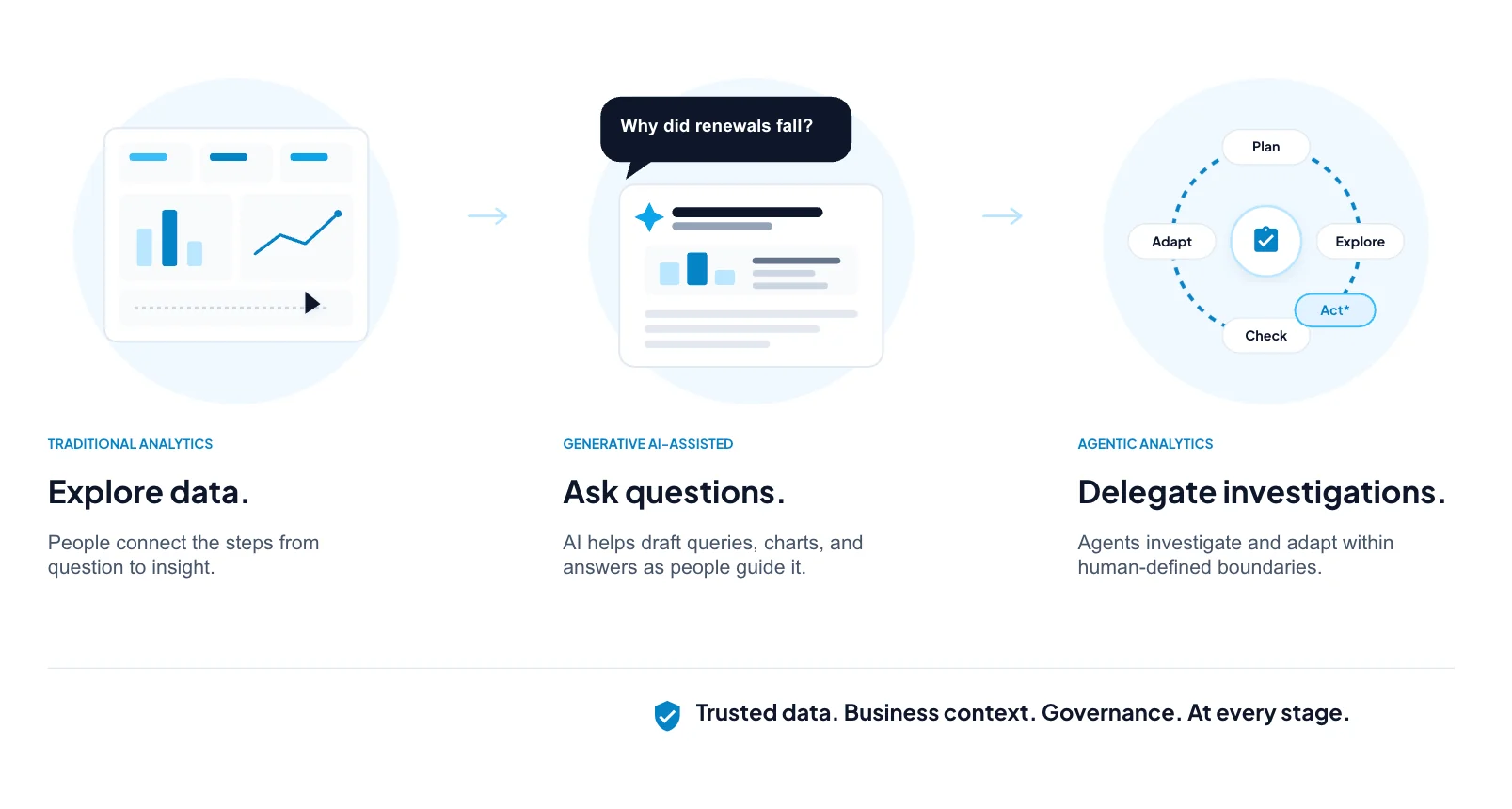
For decades enterprise analytics depended on people to drive every step. Then dashboards started showing what happened, and generative AI made it easier to summarize and explain. Now agentic analytics is the next shift: An AI agent investigates a business question by deciding what data to examine, learning from each result and choosing what to do next until it can provide an answer or take an approved action.

Consider a team investigating an increase in customer churn. An agent could compare customer segments, examine changes in product usage and investigate support issues within the affected accounts. If one explanation does not hold up, it can pursue another. It can then bring the findings and a recommended response into a retention workflow. The team delegates the investigation rather than directing every query.

That changes what the data platform must provide. The agent needs to know which sources and business definitions to trust. Each finding can lead to a different query, so analytical execution must support an investigation whose path is not known in advance. Access and action boundaries must hold throughout.

Snowflake brings these requirements together where enterprise data lives, providing business context to guide the investigation, query optimization and compute options to support its changing workload, and governed interfaces to carry outcomes into business workflows. This foundation supports agents built on Snowflake or connected from other platforms.

Most enterprises will not standardize on one agent platform

Sales, finance, engineering and support teams may each adopt different assistants and automation frameworks.

Requiring every agent to live inside one application stack would limit choice and often lead to unnecessary data movement. A more durable approach is to keep business context, analytical execution and governance close to the data while making them available through interoperable interfaces.

Standards and governed interfaces, including the Model Context Protocol (MCP), semantic views and SQL objects, can allow authorized agents to discover trusted context and analyze enterprise data without duplicating it into every AI platform.

Snowflake's platform pillars, wrapped in governance

Snowflake's approach to agentic analytics is built on three platform pillars: Ground, Analyze and Act. Agents must be able to ground their work in a trusted business context, analyze data at machine speed and act on an approved decision. Wrapped around all three is governance, which we call Assure. Here, Snowflake controls manage access to data, set limits on what agents can spend and record agent-driven queries and data access. As agents move from answering questions to initiating actions, a mistake can reach a business process and the customers it serves. Data access controls must therefore work alongside the permissions and approval rules configured in the business workflow. Snowflake applies its data controls, which are attached to the data, whether access comes from an agent built on Snowflake or connected from another platform. Each pillar helps this happen, as described below.

1. Ground: Provide machine-readable business context

Agents can access a table without knowing what its numbers mean, how the business defines revenue or whether the data is current and reliable.

An agentic analytics platform must have authoritative definitions of business entities, relationships and metrics, alongside information about data freshness and quality. Snowflake brings trusted data discovery, shared business definitions and relevant business knowledge together through Snowflake Horizon Context, semantic views and Snowflake Cortex Search. Verified queries give agents tested examples of how metrics should be answered, and certification tags point them to the tables the team trusts. Data Metric Functions monitor quality dimensions such as completeness and uniqueness, while Dynamic Tables refresh derived data toward a configured freshness target. These capabilities help teams assess whether the data is suitable for an agent's analysis.

In Ground, Assure works by keeping access policies attached to the data itself, so any agent or BI tool using a semantic view sees only what it is permitted to see.

2. Analyze: Gather evidence at machine scale

An agent's investigation changes as it learns. It may begin with a broad comparison, narrow to a customer segment, join another source and revisit an earlier finding. Supporting this work means more than handling additional queries. It requires efficient execution as query patterns change, with capacity for concurrent investigations.

Snowflake's compiler and optimizer plan how each query executes. On Gen 2 and Adaptive Warehouses, Snowflake Optima uses observed workloads to improve query planning and data access automatically, reducing the need for manual tuning. Eligible repeated queries can reuse persisted results rather than repeat the computation.

Different analytical steps also have different performance needs. Snowflake Interactive Analytics supports low-latency, high-concurrency execution for highly selective queries, while standard warehouses handle complex, compute-intensive analysis. As concurrency grows, multi-cluster warehouses add capacity within configured limits. Together, these capabilities help support agents' iterative workloads without requiring teams to anticipate every query in advance.

In Analyze, Assure allows configured policies to recognize agent-active sessions and restrict the data available to an agent, even when the user's role permits broader access. Resource monitors and budgets track agent compute spend and can trigger actions at thresholds you set, and statement timeouts stop runaway queries.

3. Act: Carry the decision into the business process

An agent's work has limited value if an approved outcome cannot reach the application or team responsible for carrying it out.

An agentic analytics platform must be able to persist that outcome or hand it off through governed interfaces, while leaving the existing business application in control of the process. Workflows can store approved outcomes and their supporting evidence in Snowflake, making them available to the systems that own the business process. In practice, the agent recommends a possible next step and shows its evidence. A person reviews it and decides whether it goes forward and whether the agent hands it off or they act on it themselves. Approved outcomes can reach the owning application through an MCP connector or a Snowflake table, and that application stays in control. Consequential actions go to a person for approval, while routine ones can run under rules people approved in advance.

In Act, Assure provides records of agent-driven queries and data access that teams can combine with workflow records to review the resulting action.

What sets Snowflake apart in agentic analytics

The value of agentic analytics lies in carrying a business question through investigation to a useful response with less manual coordination between steps.

Snowflake's advantage is connecting the capabilities that work requires. Shared business definitions guide the investigation. Automatic query optimization, result reuse and workload-appropriate compute support analytical execution. Workflows can persist outcomes and supporting evidence for the applications responsible for acting on them. Assure applies access controls, supports spending controls and records agent-driven data activity across that work. Agents built on Snowflake or connected from elsewhere can use this common foundation rather than assemble separate analytical foundations for each platform.

People set the goals, the definitions and the actions agents may take on their own. Agents apply that knowledge repeatedly and escalate consequential decisions through review workflows. The goal is more agent autonomy within boundaries people define.

Join us for Expedition to see the latest in agentic analytics.

Forward-looking statements

This article contains forward-looking statements, including about our future product offerings, and are not commitments to deliver any product offerings. Actual results and offerings may differ and are subject to known and unknown risk and uncertainties. See our latest 10-Q for more information.

Class (B2B/B2C)
B2B
Ingest Status
Rewritten
Dedupe hash
b80ebf9ef89dc670654442de6d42198a
Press Eligible
Yes
Press Eligible Reason
Enterprise analytics and AI agent capabilities for business users, centered on Snowflake's data platform.
Source Name
Snowflake Newsroom
Original Summary

Agentic analytics lets AI agents investigate business questions on their own. See how Snowflake grounds, runs and governs that work.

Image URL
https://www.snowflake.com/content/dam/snowflake-site/blog/drafts/agentic-analytics-data-foundation/three-analytics-approaches-traditional-analytics-with.png
Source Node
Content Hash (SHA-256, erste 32 hex)
42d03c675a9bd53ba4ee6c072b0af567
Public Sector Data Modernization for AI Readiness
Image File
Original HTML

Modernizing government technology is no small task. It requires navigating legacy systems, tight budgets and the high stakes of serving the public.

At this year's Snowflake Summit, leaders from Multnomah County, Oregon and the City and County of San Francisco shared how they've risen to that challenge and moved their organizations forward.

The real cost of delaying modernization efforts

Legacy data infrastructure is no longer viewed solely as an IT inconvenience. With federal mandates accelerating, AI adoption creating new competitive pressure, and constituents demanding faster, more responsive services, the cost of standing still has become impossible to ignore. It's seen for what it truly is: a mission delivery problem that impacts entire organizations across operational functions.

Public sector organizations that haven't modernized their data estate can't support the AI workloads that are becoming central to the ways government organizations serve their communities. The compounding issue is structural: Legacy systems create data silos that present a structural barrier to effective AI adoption.

As Snowflake’s Director of Migrations and Modernization Center of Excellence, Federico Zofaly framed it during the Summit panel discussion “AI-Powered Modernization: Oregon's Multnomah County Leverages SnowConvert AI”: "There is no AI strategy if you don't have a data strategy. You need to have your data in order before you can really build on top of that."

The government organizations that are making progress aren't waiting for a perfect budget cycle or a mandate. They're treating their data foundation as a mission-critical asset and moving their organizations forward accordingly.

How Multnomah County broke down data silos

Multnomah County, the state of Oregon's largest county and home to Portland, was running a decade-old SQL Server environment. It was spread across dozens of business intelligence workloads and was built by engineers who had long since left the organization. Documentation was sparse. Architecture was inconsistent. Costs were climbing.

The county needed to migrate to a modern data platform. It wanted to migrate quickly, not delaying for years on end as is often the case for public sector organizations—and indeed the team completed the migration in five months.1

Working with Snowflake's SnowConvert AI, the county used a hybrid migration approach that combined deterministic code conversion with AI-assisted handling of complex tasks. This included dynamic SQL, code fixing and automated test case generation instead of manual rewrites. The county reported results that included a shorter migration timeline, reduced future spend on legacy SQL server licensing costs and a standardized architecture that includes lines of business that were previously siloed, including health and human services, public safety and one of the largest library systems in the U.S.

Michael Hanna, Multnomah County's Senior Database Administrator, was direct about what made the migration work: "The amount of time that you spend preparing your data and preparing for the migration pays off multifold in the end."

3 lessons from Multnomah for organizations still using legacy tools

- Start earlier than you think you need to: Multnomah began its migration three months before one of its renewal agreements, which ended up not giving the county enough runway. The Multnomah team recommends starting migration efforts ideally a year or more before any licensing deadline.

- Don't migrate everything: Evaluate what to keep, archive or abandon. Right-sizing the workload streamlines the new environment and reduces the overall cost of the project.

- Allocate plenty of time for testing: Code conversion may take weeks. Validation and parallel-environment testing will take months. Plan accordingly.

How San Francisco is building a citywide data culture

City and County of San Francisco’s Chief Data Officer, Soumya Kalra, and her team are at an earlier stage in their modernization journey. The most pressing challenge Kalra is navigating is common in government: Departments have historically operated in isolation, each with their own systems, homegrown databases and definition of what "good data" looks like.

Her team’s focus isn't only on updating its technology stack. It’s also about implementing a cultural shift to make data insight a genuine part of how services are delivered.

"I really want us to get to this vision of data embedded within service delivery — how do we capture the right data along the way that gives executives across departments the opportunity to really iterate through their processes?"

Soumya Kalra

The goal is a citywide unified data platform that breaks down the departmental silos that have made cross-agency insight structurally impossible. But Kalra is clear on what needs to happen first: Before unifying data across the city, the team has to build the trust, shared standards and internal champions that make people want to participate.

That means involving stakeholders from across operational functions from the start, not only the IT department. For example, it involves designing for the analyst in the public health department who needs to answer a question, not only the engineer who built the pipeline. It also means accepting that change management, not technology, is what determines whether modernization endures.

City and County of San Francisco’s story is a useful counterweight to the migration timelines and technical benchmarks that dominate modernization conversations. Sometimes the most important work isn't the code conversion. It’s convincing an organization that a different way of working is worth the effort.

From technical debt to AI runway

The public sector organizations that succeed at modernizing share a common reframe: They stop treating migration as a one-time project and start viewing it as a shift in how data is managed as a strategic asset.

That means architecture decisions made today shouldn’t need to be rebuilt in three to five years. It means recognizing that a unified, governed data foundation isn't the end goal. It's the runway for everything that comes next, including cross-agency insights, predictive analytics and AI-powered service delivery that wasn't possible before.

The path forward follows a clear sequence:

- Modernize the foundation

- Unify the data estate

- Activate AI workloads

Organizations making progress have one trait in common

The organizations that are moving ahead have stopped treating their data foundation as a back-office concern and started treating it as a mission priority.

The tools to accelerate that journey, such as AI-assisted migration, automated testing and governed-data platforms, all exist now. The question is whether agencies have the runway and the foresight to use them.

Learn more about how you can securely collaborate and turn data into actionable insights, maximize resources with cloud efficiency and accelerate innovation with a trusted data foundation for AI.

1 Snowflake Summit Session MI201: “AI-Powered Modernization: Oregon's Multnomah County Leverages SnowConvert AI”

Class (B2B/B2C)
B2B
Ingest Status
Rewritten
Dedupe hash
0e499f96af434e356772e1ca0e7e737a
Press Eligible
Yes
Press Eligible Reason
Business technology article about public-sector data modernization and AI adoption, featuring Snowflake customer examples.
Source Name
Snowflake Newsroom
Original Summary

See how public sector data modernization helps agencies replace legacy systems, unify data and build a secure foundation for AI readiness.

Image URL
https://www.snowflake.com/content/dam/snowflake-site/blog/general-stock-images/52-general.jpg
Source Node
Content Hash (SHA-256, erste 32 hex)
2f55740df5c3cff23492770e200b5efd
How to Measure AI Value Beyond Adoption Metrics | Snowflake
Image File
Original HTML

Consider two organizations that each log 1,000 AI interactions in a week. In the first, most of those interactions are explanations and lookups. In the second, people are building data pipelines, investigating anomalies and running multistep workflows.

Most enterprise AI dashboards would score those two organizations identically. The first generation of AI developer metrics measured access and activity: how many people have a license, how many are active and how many prompts they send. But these metrics cannot tell you whether AI is driving meaningful work outcomes.

Answering that question means tracking what people use AI for and whether that is moving. Here is the framework we use to measure AI value and what we found when we applied it to two of our own teams.

A four-part framework for measuring AI value

1. Start with the work AI is doing

Asking an assistant to explain a SQL statement is a different request from asking an agent to build a pipeline or investigate a failure. Group the work the AI is doing into three levels:

- Foundational work: The AI explains code, answers questions and helps someone understand an unfamiliar concept.

- Applied development: The AI writes and modifies code, explores data, troubleshoots and builds reports or applications.

- Agentic work: This is a multistep process. The AI reasons across context, uses tools and helps finish an outcome instead of answering just one question.

This breakdown describes the work rather than the volume, which gives you something to check. If AI is creating real capacity, the hours saved should show up in the agentic level.

2. Measure adoption and fluency separately

The next question is whether higher-value usage has spread beyond just a few people. Two dimensions cover that:

- Adoption: This measures how broadly AI is used across the eligible population.

- AI fluency: This shows how sophisticated the work that people delegate to AI has become.

Together these dimensions describe four positions.

Figure 1: Measuring AI adoption and AI fluency

3. Use industry benchmarks for context

A number on its own is hard to act on. If 35% of your eligible developers actively use an AI coding agent, that figure alone will not tell you whether 35% is good. It depends on what comparable organizations are doing, and expectations vary by industry. A software company and a regulated insurer are not working from the same baseline.

Peer benchmarking gives you a relative view on both dimensions. Instead of reporting that adoption is 35%, it can tell you whether that puts you among the emerging, developing, proficient or leading organizations in your industry.

The same applies to fluency. One organization may have broad adoption but little agentic work. Another may have a handful of users doing sophisticated work that has not spread. Those two findings call for different responses.

4. Look at the gap between your best users and everyone else

Your most advanced users are the signal worth watching.

In most organizations, a few people find effective AI workflows before their colleagues do. They learn to hand over larger tasks, provide better context and combine tools. Treat those patterns as a roadmap, not a collection of anecdotes.

The practical question is how to move a behavior from one person to 100. Four tactics worked for us:

- Have power users teach, not just demo: A hands-on workshop led by someone on the team who already gets results beats a vendor training session. Watch for whether weekly usage holds a month later, not whether the room was full. A workshop that changes habits looks different from one that produces a spike.

- Turn their workflows into recipes and templates: When someone solves a problem well, have them write it down as something a colleague can run rather than read. The test is whether the next person executes it without asking the author a question.

- Run a regular show-and-tell: Provide a standing slot where people walk through a workflow they built, including the things that did not work. The failures travel better than the successes, because they tell everyone else which problems are worth attempting.

- Make the library findable: This is the step most teams skip. Once you have dozens of reusable workflows, discovery, rather than creation, becomes the constraint, and a library nobody can search is a library nobody reuses.

The aim is to move proven practice from a few people to many, and the mechanism matters more than the enthusiasm.

What to do with the answer

Measurement earns its keep when it points to an action instead of a status. There are three common positions, and each suggests a different course of action:

- Sophisticated but narrow: Early adopters use agents for advanced work, and most eligible people have not started. Remove access friction, share internal examples, and expand enablement.

- Broad but shallow: Many people use AI, mostly for explanations and simple code generation. Show them how to hand over larger tasks through examples, templates and hands-on training.

- Broad and sophisticated: More adoption is no longer the priority. Find the repeatable workflows, build reusable agents, and measure outcomes such as development velocity or operational efficiency.

The same metrics support different recommendations depending on where you sit.

Applying the framework to our own teams

We spent two quarters using this framework on Snowflake CoCo, our agentic AI development assistant, inside Snowflake. Two teams with very different work landed in a similar place, and in both cases the gains came from agentic workflows rather than foundational use.

Product data science: Automating a diagnostic runbook

Our product data science team runs thousands of data pipelines. In the first quarter of FY 27, those pipelines needed attention 960 times, which is normal at that scale. Each case took a skilled engineer about 30 minutes to diagnose. That works out to roughly 160 hours a month of expert time spent on diagnosis.

CoCo now performs that diagnosis. Across the Q1 and Q2, working alongside the team CoCo has:

- Improved more than 500 pipelines

- Generated more than 100 merged PRs

- Brought the time from incident to a tested and reviewable fix to under 16 minutes

- Reduced hundreds of daily wasted credits

Optimizing an expensive pipeline isis valuable and rarely urgent, so it is the work that waits indefinitely. An agent that proposes those changes as a matter of course does not need a quiet week to get to them.

The team had done the important work before CoCo was involved. They had a rigorous diagnostic runbook, written over hundreds of incidents and general enough to be useful in getting to the bottom of many different sorts of incidents.. That discipline is why incidents were resolved consistently. The runbook was already good enough to scale. What it needed was a way to run without waiting for someone to be available.

So the team gave the runbook to CoCo and had an alert trigger it instead of a keystroke. Same steps, same standard — but it ran on the incident's schedule instead of the team's.

That is the frontier-to-mainstream pattern in its most literal form. A method that lived with one team became a workflow that runs on its own. If a method is clear enough to onboard a new hire with, it is clear enough to hand off to AI. And if it currently lives in one expert's experience, writing it down is worthwhile on its own terms.

How review works

CoCo proposes and people decide. Every change arrives as a pull request that a named owner reviews and approves. Merging and deploying stay with the team.

That boundary is deliberate, and it moves to where the work sits. Reviewer attention becomes the thing to manage, and a team that produces more proposals than it can read has relocated its constraint rather than removed it. In exchange, the engineers moved 160 hours of diagnosis into the judgment call at the end, which is the part that needed them.

The practical lesson: Design the work so its output is always something a person can review. Review becomes the control, and that is what makes it straightforward to run against production pipelines.

Marketing: from 11.6% confident to 70% weekly use

The clearest evidence that this generalizes came from a part of the company with almost no engineers in it. Snowflake's marketing organization is nearly 600 people, most of them more comfortable with a campaign slogan than a SQL statement.

In February 2025, an internal survey of the North America marketing team found 11.6% felt very confident using AI in their role. When Snowflake CoCo arrived as a research preview late that year, eight North America marketers used it weekly.

By May 2026, weekly CoCo usage across the global marketing team had reached 70%. Separately, 93% said they use AI tools daily. The first is observed behavior and the second is self-reported, which is why we lead with the first.

What they built:

A motion graphics export pipeline that turned a full week of Summit work into 20 minutes.

A win-loss reporting app on CoCo and Streamlit that schedules interviews and generates the quarterly leadership deck. Three hours a month of candidate identification plus a week of deck work is now roughly 90% automated.

An inbound automation engine that handles 2,000 to 3,000 daily email replies to global campaigns with no human intervention, replacing a planned software purchase.

Marketers have since created more than 600 personal and project-level skills, and 100 to 200 have built their own from scratch. The median user runs seven skills a week.

Both dimensions moved. Adoption went from a small confident minority to 70% weekly use, and fluency went from asking questions to authoring workflows that run without their author present. A dashboard watching only adoption would have missed half of it.

That came from quarterly AI Days, regional hackathons, a newsletter and office hours, all peer-led.

Class (B2B/B2C)
B2B
Ingest Status
Rewritten
Dedupe hash
f7edda0430c63411f201a4a4893ed616
Press Eligible
Yes
Press Eligible Reason
Manuelle Prüfung nötig. Risiko: MEDIUM. Flags: ['numbers']. Stichprobe: False
Source Name
Snowflake Newsroom
Original Summary

Prompt counts and active users don't show whether AI is changing work. Use this four-part framework to measure AI adoption, fluency and real business impact.

Image URL
https://www.snowflake.com/content/dam/snowflake-site/blog/general-stock-images/30-general.jpg
Source Node
Content Hash (SHA-256, erste 32 hex)
3c65ab7572ac0d8b8a8ab28ad030052f
How Finance Cut Forecasting to Hours With AI
Image File
Original HTML

On Snowflake's sales finance team, we used to spend more than a week developing our monthly forecast. Today, it takes a few hours.

What changed was how much AI knows about our data before anyone types a question.

That knowledge also made our AI more efficient. Our analytics team built a profile that gives the AI standing context about our data, terminology and workflows. With it, Snowflake CoCo reaches an answer in less than half the steps, so each question costs less even as the team asks more of them.

This post covers the CoCo profile behind those results, why it makes each answer more efficient and how our analysts built 36 skills on top of it.

Key takeaways

- Snowflake's sales finance team cut its monthly forecast and variance analysis time from more than a week to a few hours.

- A CoCo profile cut the steps per answer from roughly 3.0 to 1.3, which lowers the cost of each question (Snowflake internal CoCo usage, February to May 2026, n = 44 finance users).

- Every answer traces back to a data source certified by the analytics team.

- The team built 36 skills in two months, and 87% of first adopters still use CoCo daily.

A weeklong forecast process now takes hours

The sales finance team runs more than 30 recurring analyses each month for Snowflake's sales leaders, covering the topline forecast, sales pipeline, commissions and business performance reporting. The forecast is the most involved of these, and it comes with a variance analysis that explains what's moved since the previous forecast. In the past, building the forecast meant reviewing pipeline deals, reading account notes in the CRM, comparing against historical trends and checking current field behavior. The work was split across several analysts, and because it took more than a week, it could only run once a month.

Using the topline forecast skill in CoCo, we now complete the same analysis in a few hours. That faster turnaround has changed the cadence. We now publish a midmonth update, so sales leaders see where the quarter is heading while there is still time to act. Any analyst can also rerun the skill to test a scenario.

"CoCo has truly become the first choice for all of our team's routine workflows and ad hoc analysis. Not only has it reduced turnaround times; it has unlocked the ability to process complex analysis. Any individual can use the skill to dive deeper and run scenario analysis."

Gayatri Kannan

Capable AI only helps when it knows your data

Our data changes daily, spread across dozens of certified sources and a CRM that reflects deals revised overnight.

Our first attempts were familiar to anyone who has pointed AI at real finance work. The AI was capable, but it didn't know our world. It would reference a related but incorrect data source or ask for clarification that an experienced analyst wouldn't need.

Both failures came from missing context: Every session, the AI had to infer things we knew but had never written down.

"When we first launched AI to the team, there were a lot of struggles with inconsistent and inaccurate results. It felt like we had to constantly remind a new hire about relevant terminology and data sources. Having a dedicated GTM Finance profile changed everything. The team is empowered to run complex analyses and rethink workflows themselves with minimal technical support and no governance concerns."

Gayatri Kannan

What a GTM Finance profile actually contains

Our partners on Snowflake's strategic finance analytics team built our CoCo profile for 'GTM Finance'.

A profile is standing context the AI reads before it answers anything, so nobody has to restate it in a prompt.

Without it, the AI would spend about three steps per session finding the right data source, resolving terminology and inferring what an experienced analyst already knows. With the profile in place, the first step of every conversation is already the work itself.

Memory scaling: Why a profile makes each answer more efficient

Memory scaling is the effect where an AI agent gets cheaper per unit of work as it accumulates context about its environment. It answers in fewer steps, and each step uses compute.

Across 44 finance users, those with a profile reached an answer in about 1.3 steps, compared with about 3 steps for those without one.

Two things make each answer more efficient. The profile cuts the number of steps, and steps drive cost: Without a profile, each extra step adds about 0.05 credits (roughly 10 cents), so a five-step session costs about three and a half times a one-step session. The profile also makes sessions cheaper at the same length. At every step count in the data, a session with the profile cost less than one without it.

Finance analysts now build their own AI skills

Once the foundation was in place, our analysts could build their own skills on top of it, without relying heavily on the analytics team.

A skill is a reusable workflow the AI recognizes and runs on request, and building one requires no technical background.

In two months the library grew from three starter skills to 36, and several Excel workbooks became shared skills the broader team could run. Three months after launch, 87% of first adopters were still using CoCo daily. Here's a selection of the skills we built.

The reason this works is ownership. The analyst who runs commission reconciliation 15 times a month understands that workflow better than anyone building it from the outside.

Our corporate FP&A team made the same argument when they wrote about who gets to build finance applications, and our skill library is what that shift looks like at scale.

Bookings BvA

Our corporate FP&A colleagues wrote about a similar build, their automated variance analysis workflow, including the AI-generated variance commentary and the governance model behind it. Bookings BvA applies the same idea to bookings: An analyst types "bookings bva" into CoCo, answers a few parameter prompts and has month-end variance across deal categories in minutes, including which opportunities slipped and why.

It is the clearest example of a skill that replaced a recurring cross-team assembly job.

Sales travel expense report

Travel is one of the largest controllable cost lines for a field sales team, and accountability requires regular visibility. The sales travel expense report skill determines the reporting window on its own; generates per-leader insights covering budget variance, out-of-policy spend and top spenders; and then drafts the email to each leader. Work that took hours across two teams now takes about 15 minutes, and any team member can run it, with more consistent insights than the manual version produced.

Keeping control when analysts build their own skills

Opening skill-building up to a team raises an obvious question for anyone accountable for the numbers: What happens to control when analysts write their own logic?

It is the same concern behind the trust and auditability requirements finance leaders bring to AI, and it has to be answered before any of the numbers above matter. Three things keep it in bounds:

- The analytics team certifies the source of truth: A technical source guide underpins the profile and defines which data sources to use and why. Follow-up questions and ad hoc analysis draw on those same sources, so answers stay consistent and traceable.

- The context layer is owned centrally: Analysts build on top of the profile; the analytics team defines the data sources and terminology underneath.

- Skills are shared and inspectable: A skill that runs commission reconciliation is visible to the team that depends on it, which is a stronger review position than a spreadsheet on one laptop.

How to replicate this on your team

Our approach applies beyond finance: Platform experts set the foundation and a functional team creates its own skills on top of it. Three steps get you there.

- Certify your sources first: Decide which sources are authoritative for each question your team answers, and write down why. If you skip this, then every downstream workflow inherits an unresolved question about which number is right.

- Encode terminology and output formats second: Definitions your team treats as obvious are exactly what the AI cannot infer. Capture them once, centrally.

- Then open skill-building to the team: The people closest to a workflow build the best version of it once the layer underneath them is trustworthy. If you reverse that, then you get fast workflows built on sources nobody agreed on.

This approach supports work well beyond recurring reporting. Our corporate FP&A team has done the same for long-range planning, asking questions of the plan in natural language.

Without standing context, every conversation starts from zero. What separates a team that has an AI tool from a team where AI is central to daily work is usually how much the AI knows about the work.

Learn more at Snowflake Expedition

Learn more about how finance teams are transforming how they work using Snowflake. Join us at Expedition, our global virtual event on Nov. 3-5, 2026.

Data: Snowflake internal CoCo usage, February to May 2026, comparing finance users with and without a profile (n = 44 users). 1 credit = US$2.

Class (B2B/B2C)
B2B
Ingest Status
Rewritten
Dedupe hash
ab06086f3b0a5a0dc375f9b81106f6c2
Press Eligible
Yes
Press Eligible Reason
Manuelle Prüfung nötig. Risiko: MEDIUM. Flags: ['finance', 'numbers']. Stichprobe: False
Source Name
Snowflake Newsroom
Original Summary

See how Snowflake's sales finance team used AI to cut its monthly forecast from more than a week to a few hours, and what it took to get there.

Image URL
https://www.snowflake.com/content/dam/snowflake-site/blog/general-stock-images/01-general.jpg
Source Node
Content Hash (SHA-256, erste 32 hex)
7e62641e993cad49bbd4d05f559ee981
ESMA sets out 2026 European Common Enforcement Priorities
Original HTML

ESMA sets out 2026 European Common Enforcement Priorities

The European Securities and Markets Authority (ESMA), the European financial markets regulator and supervisor, has outlined the European Common Enforcement Priorities (ECEP) for the 2026 annual financial reports of listed issuers.

The priorities identify the following areas of focus for issuers when preparing their annual financial reports:

- IFRS financial statements:

- Geopolitical risks and uncertainties

- Restructuring provisions and debt restructuring

- Sustainability statements under the European Sustainability Reporting Standards (ESRS):

- Continuing progress in applying materiality assessment

- Providing connected information on impacts, risks and opportunities (IROs), policies, actions and targets (PATs), and metrics

- European Single Electronic Format (ESEF) digital reporting:

- Common ESEF filing errors found in the statement of changes in equity

ESMA reaffirms its commitment to simplification and burden reduction, while maintaining a strong focus on investor protection and market stability. In this context, as in previous years, ESMA underlines the importance of materiality assessments when preparing and disclosing information to the market.

ESMA has also published the 31st extract from the FRWG (EECS) database of enforcement. The document contains seven decisions relating to the application of IFRS Accounting Standards and ESMA’s Guidelines on Alternative Performance Measures (APM Guidelines).

Next steps

Issuers, auditors, and supervisory bodies should apply these recommendations where relevant, taking into account their materiality and relevance for the issuer’s operations and reporting.

Further information:

Iris Hude

Communications Officer

press@esma.europa.eu

Class (B2B/B2C)
B2B
Ingest Status
Rewritten
Dedupe hash
112d0f397c0fa576fe3eb54e0644f961
Press Eligible
Yes
Press Eligible Reason
Financial reporting enforcement priorities for listed issuers, auditors, and supervisors.
Source Name
ESMA News
Original Summary

<span class="field field--name-title field--type-string field--label-hidden">ESMA sets out 2026 European Common Enforcement Priorities</span>

<span class="field field--name-created field--type-created field--label-hidden"><time class="datetime" datetime="2026-10-13T11:55:22+02:00" title="Tuesday, October 13, 2026 - 11:55">13 October 2026</time>
</span>

<div class="field field--name-field-news-section field--type-entity-reference field--label-hidden field__items">
<div class="field__item">Financial reporting</div>
<div class="field__item">Issuer disclosure</div>
</div>

<div class="clearfix text-formatted field field--name-field-news-introduction field--type-text-long field--label-hidden field__item"><p class="text-align-justify"><span>The European Securities and Markets Authority (ESMA), the European financial markets regulator and supervisor, has outlined the </span><a href="https://www.esma.europa.eu/sites/default/files/20

Source Node
Content Hash (SHA-256, erste 32 hex)
58efae9ad1fd48d4dc80df232da80b23
European Supervisory Authorities set priorities for 2027
Original HTML

European Supervisory Authorities set priorities for 2027

The Joint Committee of the European Supervisory Authorities (EBA, EIOPA and ESMA – the ESAs) published today its Annual Work Programme for 2027, setting out its priorities for addressing cross-sectoral risks and strengthening coordination across the European Union's financial sector.

In 2027, the Joint Committee will focus on areas where cooperation among the three ESAs is essential to support financial stability, consumer protection and effective supervision. Key priorities include digital operational resilience, technological innovation, sustainable finance, securitisation and cross-sectoral risk monitoring.

Under the Digital Operational Resilience Act (DORA), the ESAs will continue oversight activities relating to critical ICT third-party service providers and work towards strengthening the financial sector’s preparedness against cyber threats. The Joint Committee will also assess the implications of technological developments, including the growing use of artificial intelligence and other digital innovations.

Consumer protection will remain a central priority. The ESAs will continue their joint work on issues affecting retail consumers, helping them make informed financial decisions and promoting confidence in EU financial markets.

In sustainable finance, the Joint Committee will continue to support the consistent application of the EU's sustainability framework across sectors.

The programme reflects the Joint Committee's role in ensuring a coordinated supervisory response to cross-sectoral challenges and supporting a resilient, innovative and well-functioning financial system across the European Union. It also supports the European Commission's objectives to build an efficient Savings and Investment Union and advance a simplification agenda aimed at fostering more effective regulation and supervision while reducing unnecessary regulatory burdens.

Background

The Joint Committee is a forum established to strengthen cooperation between the European Banking Authority (EBA), the European Insurance and Occupational Pensions Authority (EIOPA) and the European Securities and Markets Authority (ESMA). It coordinates cross-sectoral supervisory work and promotes consistent supervisory practices across the EU.

Further information:

Tayfun Yilmaz

Communications Officer

press@esma.europa.eu

Class (B2B/B2C)
B2B
Ingest Status
Rewritten
Dedupe hash
7a39105ba01858369642f89338f24def
Press Eligible
Yes
Press Eligible Reason
Financial-sector supervisory priorities and regulatory coordination are relevant to industry professionals.
Source Name
ESMA News
Original Summary

<span class="field field--name-title field--type-string field--label-hidden">European Supervisory Authorities set priorities for 2027</span>

<span class="field field--name-created field--type-created field--label-hidden"><time class="datetime" datetime="2026-10-13T13:42:44+02:00" title="Tuesday, October 13, 2026 - 13:42">13 October 2026</time>
</span>

<div class="field field--name-field-news-section field--type-entity-reference field--label-hidden field__items">
<div class="field__item">Joint Committee</div>
</div>

<div class="clearfix text-formatted field field--name-field-news-introduction field--type-text-long field--label-hidden field__item"><p class="text-align-justify"><span>The Joint Committee of the European Supervisory Authorities (EBA, EIOPA and ESMA – the ESAs) published today its </span><a href="https://www.esma.europa.eu/sites/default/files/2026-10/JC_2026_21_-_Joi… Wor

Source Node
Content Hash (SHA-256, erste 32 hex)
aecd677b698fae98f17d225bd5a9e3fa