A Comprehensive Guide to Understanding Auto Dealer Co-op Programs
Image File
Original HTML

A Comprehensive Guide to Understanding Auto Dealer Co-op Programs

As a dealership, understanding and leveraging Auto Dealer Co-op Programs can provide significant benefits for both marketing and sales efforts. These programs, designed to encourage and support dealerships, can help you gain financial assistance for advertising and marketing, ensuring that your business can thrive in a competitive market. In this comprehensive guide, we’ll walk you through the basics, benefits, challenges, and financial aspects of Auto Dealer Co-op Programs. By the end, you’ll know exactly how to make these programs work for your dealership and why you should start taking advantage of them today.

Understanding the Fundamentals of Auto Dealer Co-op Programs

Before diving deep into the details, it’s essential to understand the basics of Auto Dealer Co-op Programs. In simple terms, a co-op program is a partnership between manufacturers and dealers. The manufacturer provides financial support to dealerships for marketing and advertising efforts that promote their products. This partnership can significantly reduce your advertising costs while improving your ability to reach potential customers. At COOPABLE, we make it easier for dealerships like yours to take full advantage of these programs with simple and clear processes.

Understanding the Purpose and Definition of Co-op Programs

So, what exactly is the purpose of a co-op program? The primary goal is to help dealerships promote their brand and products more effectively without bearing the full financial burden. Manufacturers understand the importance of local advertising and want to support dealerships in reaching their target audience.

Co-op programs allow dealers to access funds for various marketing efforts such as digital advertising, print media, radio ads, and even events. By participating in these programs, you not only reduce your costs but also boost your sales potential. Whether you’re looking to sell or trade in vehicles, these programs offer a financial incentive to help you attract customers and increase your profitability.

Key Players in Auto Dealer Co-op Programs

Several key players are involved in auto dealer co-op programs, each with distinct roles and responsibilities. The primary players are the manufacturer, the dealership, and sometimes a third-party marketing agency.

The Manufacturer

The manufacturer is the driving force behind the co-op program, providing funding and establishing guidelines. Their goal is to ensure dealerships have the financial support to promote their brand effectively. Manufacturers are highly invested in maintaining brand consistency and competitive positioning in the market. They help dealerships stay ahead of competitors by offering resources and incentives to boost sales through targeted marketing.

The Dealer

As a key player in the co-op program, the dealer is responsible for executing campaigns that align with the manufacturer’s objectives. Dealers are in direct competition with other dealerships, and co-op funds allow them to leverage marketing resources that can give them an edge. By using these funds strategically, dealers can target local markets, increase brand awareness, and stay competitive in a crowded landscape.

The Advertising Agency

Advertising agencies are essential in creating effective, high-impact campaigns that adhere to the manufacturer’s guidelines. They bring expertise in crafting innovative marketing strategies that give dealerships a competitive advantage. Agencies can also help dealerships differentiate themselves from others in the market by providing creative solutions, ensuring they stand out in an increasingly competitive industry.

The Customer

While customers aren’t directly involved in the co-op program, they are the ultimate focus of all marketing efforts. Effective campaigns funded through co-op programs help dealerships reach potential buyers and influence purchasing decisions. In a competitive environment, customers benefit from more targeted promotions and better deals, which ultimately drive sales and foster brand loyalty.

The Framework of Auto Dealer Co-op Programs

Standard Formats of Co-op Programs

Co-op programs can come in various formats, depending on the manufacturer and the specific requirements. However, most programs follow similar structures. These include:

- Fixed Funding Programs: Some manufacturers allocate a fixed amount of funds for marketing purposes. Dealers can claim a percentage of these funds, which are typically determined by the number of units sold or a sales target.

- Percentage-Based Programs: Other programs may reimburse dealerships based on a percentage of their sales. This means that the more vehicles you sell, the more funds you can claim for your marketing activities.

- Match Programs: In match programs, the manufacturer matches the dealership’s spending on advertising or marketing up to a set limit. For example, if you spend $1,000 on a digital ad campaign, the manufacturer will match your investment.

These formats provide flexibility and allow dealerships to tailor their marketing strategies while ensuring that they receive financial support from the manufacturer.

Understanding the Roles and Duties in Co-op Programs

To make the most of a co-op program, it’s crucial to understand the roles and duties involved. As a dealer, your responsibilities include:

- Creating and Implementing Marketing Campaigns: You will need to develop marketing strategies that align with the manufacturer’s guidelines. This includes choosing the right advertising channels and creating promotional materials.

- Submitting Claims for Reimbursement: Once you’ve spent the allocated funds on marketing, you must submit a claim for reimbursement. Ensure that all required documentation is provided, including receipts and proof of advertisement placement.

- Adhering to Branding and Advertising Guidelines: Manufacturers typically have specific rules about how their brand should be represented in advertising. Make sure you follow these guidelines to avoid complications in reimbursement.

For the manufacturer, their role is to provide financial support, approve campaigns, and ensure that the program is being used effectively. They may also offer guidance on how to best spend co-op funds for maximum impact.

Understanding the Financial Elements of Auto Dealer Co-op Programs

Financial Aspects of Auto Dealer Co-op Programs

Co-op programs are designed to ease the financial burden of marketing, but understanding the financial aspects is key to maximizing the benefits. The process generally involves receiving funding for qualifying marketing efforts and submitting for reimbursement. Here’s how it works:

- Funding Allocation: The manufacturer will either allocate a fixed amount of funds or determine your eligibility based on sales performance or a percentage of advertising spend.

- Reimbursement Process: After executing your campaign, you can submit documentation to the manufacturer for reimbursement. This typically includes invoices, ad placement proofs, and any other required evidence of spend.

- Deadlines and Limits: Be aware of deadlines and limits for reimbursement. Manufacturers may impose time restrictions on when you can submit claims, and there might be a cap on how much you can claim annually.

Funding and Reimbursement Processes

The process for claiming co-op funds usually involves submitting a claim through an online portal or by submitting paperwork. The manufacturer may require specific details about your marketing activities, including:

- Proof of Ad Placement: This could be a screenshot of a digital ad or a copy of a print ad.

- Receipts and Invoices: These documents confirm the amount spent and the service provider.

Once your claim is submitted and approved, the manufacturer will reimburse you, often within a set time frame. Understanding these processes ensures that you don’t miss out on any opportunities for reimbursement.

Understanding Profit Margins and Costs

It’s important to have a clear understanding of the profit margins and costs involved in running marketing campaigns with co-op funds. While the manufacturer will cover a portion of the costs, you should budget carefully to ensure that your overall marketing efforts are profitable.

Key Benefits of Co-op Program Participation

Participating in an auto dealer co-op program brings several key benefits:

- Reduced Advertising Costs: The most obvious benefit is the reduced cost of marketing. By utilizing co-op funds, you can significantly lower the financial burden of running ads, helping you stay competitive without overspending.

- Increased Exposure: Co-op programs give you the resources to run more advertising campaigns, which can increase your dealership’s visibility and attract more customers.

- Enhanced Marketing Opportunities: The program allows you to access advanced marketing tools and techniques that you may not have been able to afford otherwise. This can lead to higher sales and better customer engagement.

Opportunities and Advantages for Auto Dealers

For auto dealers, participating in co-op programs provides the chance to enhance their marketing strategies. By using the funds wisely, you can run targeted campaigns that resonate with your local market. Whether you’re looking to sell or trade in vehicles, these programs offer financial incentives that can increase your chances of success.

Opportunities and Advantages for Manufacturers

Manufacturers also benefit from co-op programs. By supporting dealerships, they ensure that their brand is consistently promoted across various regions. This fosters brand loyalty and helps maintain a strong presence in competitive markets.

Challenges Faced in Co-op Programs and Their Solutions

Like any business initiative, co-op programs come with their own set of challenges. However, understanding these obstacles and how to address them will help ensure that you make the most of the program.


Class (B2B/B2C)
B2B
Ingest Status
Rewritten
Dedupe hash
feb7b47bce3c04ac2a741b9ae06b602a
Press Eligible
Yes
Press Eligible Reason
Manuelle Prüfung nötig. Risiko: MEDIUM. Flags: ['finance', 'numbers']. Stichprobe: False
Source Name
COOPABLE
Original Summary

<p>In the ever-competitive automotive industry, co-op advertising programs present a golden opportunity for dealers to amplify their marketing efforts with financial backing from manufacturers (OEMs). Yet, a staggering 80% of these co-op advertising funds are utilized by merely 20% of the dealerships. </p>
<p>The post <a href="https://coopable.com/a-comprehensive-guide-to-understanding-auto-dealer… Comprehensive Guide to Understanding Auto Dealer Co-op Programs</a> appeared first on <a href="https://coopable.com">Coopable</a>.</p&gt;

Image URL
https://coopable.com/wp-content/uploads/2024/12/24309.jpg
Source Node
Content Hash (SHA-256, erste 32 hex)
295b6bd123911eca7d87e8030d89d0de
The Basics of Automotive Co-op Advertising
Image File
Original HTML

The Basics of Automotive Co-op Advertising

Co-op advertising is a marketing strategy in which two or more businesses share the cost of advertising. In the automotive industry, co-op advertising is often used by dealerships and manufacturers to promote new vehicles, special offers, and financing options.

There are many benefits to co-op advertising for both dealers and manufacturers. For dealers, co-op advertising can help to:

- Increase brand awareness

- Generate leads

- Drive sales

- Improve customer loyalty

For manufacturers, co-op advertising can help to:

- Build relationships with dealers

- Support dealer marketing efforts

- Increase sales of new vehicles

How Co-op Advertising Works

Co-op advertising typically works as follows:

- The manufacturer develops a set of rules and guidelines and provides documentation to dealers.

- The dealer chooses which campaigns to participate in and how much money to contribute.

- The manufacturer and dealer split the cost of the advertising campaign.

- The dealer runs the advertising campaign and tracks the results.

Tips for Successful Co-op Advertising

Here are a few tips for successful co-op advertising:

- Set clear goals and objectives. What do you hope to achieve with your co-op advertising campaign?

- Choose the right tactics. Not all co-op tactics are created equal. Choose campaigns that are relevant to your target audience and that are likely to drive results.

- Set a realistic budget. Co-op advertising can be a cost-effective way to market your dealership, but it’s important to set a realistic budget. Remember, you earned this money, so spend it wisely.

- Track your results. It’s important to track the results of your co-op advertising campaigns so that you can measure their effectiveness.

Navigating Co-op Advertising Challenges with COOPABLE

While co-op advertising offers significant benefits, it also presents challenges. These can include navigating complex manufacturer requirements, managing co-op funds and accruals, and tracking and reporting on campaign results.

That’s where COOPABLE comes in. Our platform is designed to streamline the co-op advertising process, making it easier for dealers and manufacturers to collaborate and achieve their marketing goals. We handle everything from co-op fund management to recommending vendor partners, so you can focus on what you do best: selling cars.

Conclusion

Co-op advertising can be a valuable marketing tool for automotive dealerships and manufacturers. By following these tips and partnering with COOPABLE to navigate the complexities, you can create successful co-op advertising campaigns that will help you to achieve your marketing goals.

Class (B2B/B2C)
B2B
Ingest Status
Rewritten
Dedupe hash
f75ba5223eb4e47e6db62fe2dac88b77
Press Eligible
Yes
Press Eligible Reason
Explains automotive co-op advertising for dealerships and manufacturers, with a related platform promotion.
Source Name
COOPABLE
Original Summary

<p>In the ever-competitive automotive industry, co-op advertising programs present a golden opportunity for dealers to amplify their marketing efforts with financial backing from manufacturers (OEMs). Yet, a staggering 80% of these co-op advertising funds are utilized by merely 20% of the dealerships. </p>
<p>The post <a href="https://coopable.com/the-basics-of-automotive-co-op-advertising/">The Basics of Automotive Co-op Advertising</a> appeared first on <a href="https://coopable.com">Coopable</a>.</p&gt;

Image URL
https://coopable.com/wp-content/uploads/2025/02/2425.jpg
Source Node
Content Hash (SHA-256, erste 32 hex)
80e19d4230440fa45fd2ba605ef03939
Maximizing Co-op Marketing Funds: Innovative Solutions for Car Dealerships
Image File
Original HTML

Maximizing Co-op Marketing Funds: Innovative Solutions for Car Dealerships

In the competitive world of automotive sales, car dealerships are constantly seeking effective ways to stand out and attract potential buyers. One of the most underutilized resources at their disposal is co-op marketing funds. These funds, provided by manufacturers, are designed to support dealerships in their marketing efforts. However, many dealerships struggle to fully leverage these funds. At COOPABLE, we believe in empowering dealerships to make the most of their co-op marketing opportunities. Here’s a look at the different types of solutions that can help dealerships maximize their co-op marketing funds.

- Digital Advertising Campaigns

In today’s digital age, online presence is crucial. Dealerships can use co-op funds to invest in digital advertising campaigns, including Google Ads, social media promotions, and display advertising. These platforms offer targeted advertising options, allowing dealerships to reach potential customers based on demographics, interests, and online behavior. By focusing on digital advertising, dealerships can increase their visibility and drive more traffic to their websites and showrooms.

- Search Engine Optimization (SEO)

SEO is a long-term strategy that can significantly enhance a dealership’s online visibility. By optimizing their website content for search engines, dealerships can improve their rankings on search engine results pages (SERPs). Co-op funds can be used to hire SEO experts or agencies to conduct keyword research, optimize website content, and build high-quality backlinks. This investment can lead to increased organic traffic and higher conversion rates over time.

- Video Marketing

Video content is a powerful tool for engaging potential customers. Dealerships can use co-op funds to create high-quality video content showcasing their vehicles, customer testimonials, and dealership events. Platforms like YouTube and social media channels are excellent for distributing video content. Videos not only capture attention but also help build trust and credibility with potential buyers.

- Email Marketing Campaigns

Email marketing remains one of the most effective ways to nurture leads and maintain customer relationships. Dealerships can use co-op funds to design and implement email marketing campaigns that highlight promotions, new arrivals, and special events. Personalized and targeted email campaigns can lead to higher open rates and increased customer engagement.

- Traditional Advertising

While digital marketing is essential, traditional advertising methods still hold value. Co-op funds can be allocated to print ads in local newspapers, radio spots, and television commercials. These channels can effectively reach local audiences and reinforce brand recognition within the community.

- Event Sponsorships and Community Involvement

Participating in local events and sponsoring community activities can enhance a dealership’s reputation and visibility. Co-op funds can be used to sponsor local sports teams, charity events, or community festivals. Such involvement not only boosts brand awareness but also fosters goodwill and strengthens community ties.

- Website Enhancements

A dealership’s website is often the first point of contact for potential customers. Investing co-op funds in website enhancements, such as improving user experience, adding virtual tours, or integrating live chat features, can significantly impact customer engagement and lead generation.

Conclusion

Co-op marketing funds offer car dealerships a valuable opportunity to enhance their marketing efforts and drive sales. By strategically investing in a mix of digital and traditional marketing solutions, dealerships can maximize the impact of these funds. At COOPABLE, we are committed to helping dealerships navigate the complexities of co-op marketing and achieve their business goals. By leveraging these innovative solutions, dealerships can not only increase their market presence but also build lasting relationships with their customers.

For more insights and strategies on maximizing co-op marketing funds, stay tuned to our blog at COOPABLE.com, or contact us at sales@coopable.com to get started maximizing your opportunities with co-op.

Class (B2B/B2C)
B2B
Ingest Status
Rewritten
Dedupe hash
e6f14b817b74bdbfd129a73fe46b94c0
Press Eligible
Yes
Press Eligible Reason
Provides marketing strategies for car dealerships and co-op advertising funds.
Source Name
COOPABLE
Original Summary

<p>In the ever-competitive automotive industry, co-op advertising programs present a golden opportunity for dealers to amplify their marketing efforts with financial backing from manufacturers (OEMs). Yet, a staggering 80% of these co-op advertising funds are utilized by merely 20% of the dealerships. </p>
<p>The post <a href="https://coopable.com/maximizing-co-op-marketing-funds-innovative-soluti… Co-op Marketing Funds: Innovative Solutions for Car Dealerships</a> appeared first on <a href="https://coopable.com">Coopable</a>.</p&gt;

Image URL
https://coopable.com/wp-content/uploads/2025/02/25570.jpg
Source Node
Content Hash (SHA-256, erste 32 hex)
e9af1f4dfc399609265ccd38b72c405f
Unlocking the Power of Dealership Co-op Funds: What Every Automotive Dealer Needs to Know
Image File
Original HTML

Introduction: The Hidden Goldmine of Automotive Co-op Programs

If you’re running an automotive dealership, you’ve likely heard of co-op advertising funds—those dollars your OEMs (think Hyundai, Mazda, or GM) set aside to help you market their brands. It’s a sweet deal on paper: you advertise, they reimburse. Yet every year, millions in dealership co-op funds go unclaimed. Why? The answer lies in the maze of rules, deadlines, and overlooked opportunities that make automotive co-op programs trickier than they seem. Let’s break it down and explore what’s at stake—and why understanding dealership co-op could be a game-changer for your bottom line.

What Are Dealership Co-op Funds, Really?

At its core, co-op advertising for dealerships is a partnership. OEMs like Subaru or Kia offer financial support to cover local marketing costs—everything from TV spots to digital campaigns. In return, they ensure their brand stays front and center. It’s a win-win, right? Well, not always. The reality is that automotive co-op programs vary wildly between manufacturers, and that complexity can leave dealers scratching their heads—or worse, missing out.

Take Mazda, for example. They’ve got multiple funds, like Retail Go To Market+ for digital efforts or separate pools for service ads. Subaru’s no different, splitting funds into several different categories. Each comes with its own deadlines and rules. Then there’s GM, mixing matching funds (where they match your spend) with non-matching funds for specific campaigns. Navigating this isn’t just about paperwork—it’s about knowing what’s on the table.

The Catch: Why Co-op Funds Slip Away

So why do dealerships leave co-op money unclaimed? It’s not laziness—it’s the hurdles. Deadlines are brutal—miss a cutoff by a day, and that reimbursement’s gone. Errors trip up claims too; a tiny logo tweak or missing receipt can sink you. But the real kicker? Missed opportunities. Many dealers don’t realize what qualifies for automotive co-op reimbursement.

Think about what you’re already paying for: tools like CRM software (DealerSocket, anyone?) or inventory management systems might be co-op eligible. Advertising’s even broader—beyond radio or billboards, Google Ads, social media boosts, or hosting a weekend sales event could count. Yet these often stay out-of-pocket expenses because the rules are buried—or dealers assume it’s not worth the hassle. One Hyundai store in New England learned this the hard way, missing $169,000 in co-op funds because they didn’t know it was there until the deadline passed.

The Turnkey Trap: A Common Misconception

Here’s where it gets interesting. Many OEM co-op programs—like GM’s in-Market Retail or Mazda’s RGTM+—push turnkey solutions. These are pre-approved vendors (think Dealer.com or Netsertive) promising seamless claims and quick reimbursements. It’s tempting—less legwork, right? But here’s the twist: you don’t have to use them. Dealership co-op reimbursement is still possible with your own vendors, as long as you follow the guidelines. The catch? It takes more effort to decode the rules and submit manually. That’s where the “turnkey trap” misleads dealers into thinking it’s the only path—when it’s just one option.

The Stakes: What’s Lost When Co-op Goes Unclaimed

When dealership co-op funds slip away, it’s not just a missed check—it’s a ripple effect. Your team’s time gets eaten up chasing fixes instead of selling cars. Revenue shrinks as marketing costs stay on your books. And growth? Those unclaimed dollars could’ve fueled more campaigns, drawing more customers through the door. That $169,000 loss for the Hyundai dealer wasn’t just a one-time hit—it was money they could’ve reinvested. Across the industry, these losses add up to millions, and every dealership feels the pinch differently.

Timing Is Everything in Automotive Co-op

Here’s a pro tip: timing matters. Many co-op programs reset quarterly—miss that, and there’s no rollover. Now might feel like it’s early, but it’s the perfect window to get ahead. Waiting until Q4, when sales spike and holidays loom, often buries co-op in the chaos. Smart dealers start noticing now, not scrambling later. It’s not about solving it today—it’s about knowing what’s coming.

Final Thoughts: Is Your Dealership Missing Out?

Dealership co-op funds are a powerful tool, but they’re not plug-and-play. From Mazda’s multiple funds to GM’s matching quirks, the automotive co-op landscape is a puzzle worth understanding. Are you leaving money on the table—whether it’s for tools, ads, or that next big event? At COOPABLE, we’ve seen these challenges up close, and we’re passionate about shedding light on them. The question isn’t just what’s available—it’s what’s possible for your dealership.

Class (B2B/B2C)
B2B
Ingest Status
Need Review
Dedupe hash
29cd2d329da6da645b81147b0ef7bf83
Press Eligible
Yes
Press Eligible Reason
QA FAIL (need review): TARGET adds an unsupported factual descriptor: 'COOPABLE, a co-op advisory firm.' The SOURCE never states that COOPABLE is an advisory firm. All other factual claims match.
Source Name
COOPABLE
Original Summary

<p>In the ever-competitive automotive industry, co-op advertising programs present a golden opportunity for dealers to amplify their marketing efforts with financial backing from manufacturers (OEMs). Yet, a staggering 80% of these co-op advertising funds are utilized by merely 20% of the dealerships. </p>
<p>The post <a href="https://coopable.com/unlocking-the-power-of-dealership-co-op-funds-what… the Power of Dealership Co-op Funds: What Every Automotive Dealer Needs to Know</a> appeared first on <a href="https://coopable.com">Coopable</a>.</p&gt;

Image URL
https://coopable.com/wp-content/uploads/2025/02/10348.jpg
Source Node
Generated Article_json
{"target_audience": "b2b", "is_medical": false, "ai_generated_title": "Hyundai Dealer Forfeits $169,000 as Co-op Ad Funds Go Unclaimed", "body_html": "<p><strong>New England -- [CURRENT_DATE] --</strong> A Hyundai dealership in New England missed $169,000 in OEM co-op advertising funds because it learned the money existed only after the claim deadline had passed, according to COOPABLE, a co-op advisory firm.</p><h5>Mazda, Subaru and GM run separate fund structures with their own deadlines</h5><p>Mazda operates multiple funds, including Retail Go To Market+ (RGTM+) for digital efforts and separate pools for service advertising. Subaru splits its funds into several categories. GM combines matching funds, where it matches dealer spend, with non-matching funds tied to specific campaigns. Each carries its own rules and cutoffs.</p><h5>One-day deadline misses and small claim errors void reimbursements</h5><p>Missing a cutoff by a single day forfeits the reimbursement. A minor logo change or a missing receipt can also sink a claim.</p><p>Eligibility is a second gap. CRM software such as DealerSocket and inventory management systems may qualify. So may Google Ads, social media boosts and weekend sales events. Many dealers carry these costs out of pocket because the rules are buried or the paperwork seems not worth the effort, COOPABLE says.</p><h5>Turnkey vendor programs are optional, not mandatory</h5><p>GM's in-Market Retail and Mazda's RGTM+ steer dealers toward pre-approved turnkey vendors such as Dealer.com and Netsertive, which promise streamlined claims and quick reimbursement. Dealers can still claim with their own vendors if they follow program guidelines. That route requires more effort to interpret the rules and submit claims manually.</p><h5>Quarterly resets leave no rollover for unused funds</h5><p>Many co-op programs reset quarterly, and unused funds do not roll over. Waiting until Q4, when sales spike and holiday campaigns crowd the calendar, often buries co-op claims in the rush.</p><p>COOPABLE says unclaimed co-op funds add up to millions of dollars across the industry each year. For individual dealers, the cost includes staff time spent fixing claims and marketing expenses that stay on the books instead of being reimbursed.</p>", "meta_description": "A New England Hyundai dealer lost $169,000 in unclaimed co-op funds. Mazda, Subaru and GM programs carry separate deadlines, rules and quarterly resets.", "seo_keywords": "dealership co-op funds, automotive co-op advertising, OEM co-op reimbursement, Hyundai, Mazda RGTM+, GM co-op, turnkey vendors, dealer marketing", "companies": ["COOPABLE", "Mazda", "GM"], "industries": ["Transportation & Mobility"], "markets_regions": [], "news_type": ["market_analysis"], "products": ["Retail Go To Market+"], "themes": ["marketing_spend", "regulatory_compliance"], "events": [], "cta_text": "Learn how dealerships can track OEM co-op program deadlines and eligible expenses", "learn_more": "", "fact_check": {"accuracy_score": 100, "legal_risk": "low", "corrections_made": ["Used source-city fallback 'New England' as the dealer location since no city was named", "Attributed industry-wide loss claim to COOPABLE", "Used [CURRENT_DATE] placeholder in dateline per critical rules"], "recommendation": "publish"}}
Content Hash (SHA-256, erste 32 hex)
d57e3339b18b01e58b80fa7fc1806bc9
Maximizing Your Dealership’s Potential: Why a Great Co-Op Partner Is Essential
Image File
Original HTML

In the competitive world of automotive dealerships, marketing budgets are often stretched thin.

Co-op programs offered by Original Equipment Manufacturers (OEMs) provide a lifeline, reimbursing a significant portion of advertising expenses and enabling dealerships to amplify their reach. However, the complexity of these programs—each with its own rules, deadlines, and requirements—can make them a challenge to manage. A great co-op partner can transform this challenge into an opportunity by focusing on three critical areas: optimization, utilization, and submission of co-op funds. As the experiences of our clients at COOPABLE demonstrate, the right partner can unlock the full potential of your dealership’s marketing dollars.

Optimization: Turning Co-Op Funds into Strategic Wins

Optimization is about more than just claiming co-op funds—it’s about using them strategically to achieve the best possible outcomes for your dealership. With multiple OEMs, each with distinct guidelines, it’s easy to miss opportunities to maximize your reimbursements. A great co-op partner brings expertise and strategic insight to the table, ensuring that every dollar is allocated effectively.

Marla R. Cardenas, Platform Director at Team Gillman, highlights this in her experience with COOPABLE: “COOPABLE keeps us informed on our balances and provides strategic recommendations to help us maximize every opportunity.” Marla’s experience shows how a proactive approach allows dealerships to plan campaigns that align with their goals while ensuring they’re getting the most out of their co-op funds. Instead of simply spending the money, a great partner helps you optimize it—turning it into a tool for growth.

For Chip Alvey, E-Commerce Director at Oxmoor Auto Group, this optimization translated into measurable results: “COOPABLE is the most effective ROI I have to optimize my reimbursable spend with my 9 different OEMs.” Managing nine different OEMs is no small feat, but with a partner that understands how to navigate each program, Chip was able to optimize his spend, ensuring that every campaign delivered maximum value. Optimization isn’t just about spending—it’s about spending wisely, and a great co-op partner makes that possible.

Utilization: Ensuring No Co-Op Dollar Goes to Waste

One of the biggest risks of co-op programs is leaving money on the table. Funds often come with expiration dates, and if they’re not used in time, they’re lost forever. A great co-op partner ensures full utilization of your co-op dollars, helping you avoid missed opportunities and making sure every available dollar is put to work for your dealership.

Chip captures this benefit perfectly: “COOPABLE collects, submits, and tracks my unique OEM COOP dollars so that I can optimize spend, and never have to explain why I left COOP dollars unused.” For dealerships, unclaimed funds can lead to tough conversations with stakeholders—why wasn’t the money used? Why was an opportunity missed? A great co-op partner takes that burden off your shoulders, ensuring that every dollar is utilized before it expires.

This focus on utilization is especially critical for dealerships managing multiple OEMs, where the risk of overlooking funds is higher. Marla emphasizes the broader impact: “This service is a valuable asset for dealerships of all sizes.” Whether you’re a small independent dealer or a large automotive group, a co-op partner ensures that no funds go to waste, allowing you to fully utilize your marketing budget to drive sales and growth.

Submission: Simplifying a Complex Process

The submission process for co-op claims can be a nightmare for dealerships. Each OEM has its own set of rules, documentation requirements, and deadlines, and a single mistake can result in a denied claim. A great co-op partner streamlines this process, handling the paperwork and ensuring that every submission is compliant and on time.

Jennifer Martel, Director of Marketing at McGovern Automotive Group, speaks to this directly: “Their expertise as the only company dedicated exclusively to this field shines through in their seamless handling of our programs, maximizing reimbursements while keeping everything compliant and stress-free.” By taking on the submission process, a great co-op partner removes the stress of navigating complex OEM guidelines, allowing dealerships to focus on what they do best—selling cars. Jennifer’s experience underscores how a specialized partner can make the submission process seamless.

Marla also highlights the expertise that makes this possible: “There is no one else in the dealership world who does what they do. Their deep understanding of each of our OEM programs, coupled with exceptional communication, truly sets them apart.” This deep knowledge ensures that submissions are handled with precision, reducing the risk of errors and ensuring that dealerships receive the reimbursements they’re entitled to. A great co-op partner doesn’t just submit claims—they submit them right the first time.

The Power of Partnership in Co-Op Management

What ties these three themes together—optimization, utilization, and submission—is the power of a true partnership. A great co-op partner doesn’t just provide a service; they work alongside you to understand your dealership’s unique needs and goals. Marla puts it best: “They genuinely embody the true meaning of a vendor partnership.” This collaborative approach ensures that your co-op funds are managed effectively, from start to finish.

For dealerships of all sizes, this partnership can be a game-changer. Jennifer sums it up well: “I’d recommend COOPABLE to any dealership looking to simplify and optimize their co-op process.” By focusing on optimization, utilization, and submission, a great co-op partner like COOPABLE ensures that your dealership isn’t just claiming funds—it’s using them to drive real results.

Don’t Let Co-Op Complexity Hold You Back

Co-op programs are a powerful tool for dealerships, but their complexity can be a barrier to success. A great co-op partner removes that barrier, helping you optimize your spend, utilize every dollar, and submit claims with confidence. With their expertise, strategic support, and commitment to partnership, they can transform your co-op program into a competitive advantage. Don’t let unclaimed funds or missed opportunities hold your dealership back—partner with a co-op expert and unlock the full potential of your marketing budget.

Ingest Status
Rejected
Dedupe hash
e462613fbd5e8dfb71bac48970033f2c
Press Eligible Reason
JSON nicht lesbar - manuelle Pruefung noetig: Inhalt konnte nicht als JSON geparst werden
Source Name
COOPABLE
Original Summary

<p>In the ever-competitive automotive industry, co-op advertising programs present a golden opportunity for dealers to amplify their marketing efforts with financial backing from manufacturers (OEMs). Yet, a staggering 80% of these co-op advertising funds are utilized by merely 20% of the dealerships. </p>
<p>The post <a href="https://coopable.com/maximizing-your-dealerships-potential-why-a-great-… Your Dealership’s Potential: Why a Great Co-Op Partner Is Essential</a> appeared first on <a href="https://coopable.com">Coopable</a>.</p&gt;

Image URL
https://coopable.com/wp-content/uploads/2025/04/17382.jpg
Source Node
Content Hash (SHA-256, erste 32 hex)
e5d74caf20501438a66faecebde71b4d
COOPABLE and Lotlinx Partner to Automate Manufacturer Co-Op Funding for Dealers in Order to Move the Metal
Image File
Original HTML

LEXINGTON, Ky., March 11, 2026 /PRNewswire/ — COOPABLE and Lotlinx today announced a new partnership that enables dealers to leverage COOPABLE’s service to apply eligible manufacturer co-op funds toward their Lotlinx solutions, helping get inventory in front of buyers faster and in turn accelerating vehicle sales.

Through the partnership, COOPABLE will fully manage co-op approvals, claim submissions, compliance documentation, and reimbursement tracking, eliminating the manual approvals, documentation gathering, and tracking typically required to access OEM co-op funds.

For dealers, the experience will feel turnkey. They will still be able to leverage Lotlinx’s state-of-the-art machine learning and data intelligence to predict and act on inventory risk through VIN-specific strategies, but they will not need to gather supporting documentation, submit proof of performance, or track reimbursement status. Approved funds will flow through standard OEM reimbursement channels, allowing dealers to activate Lotlinx campaigns while COOPABLE manages the compliance and submissions behind the scenes.

“The co-op process can be time-consuming and nuanced, especially across different OEM programs,” said Mark W. Baruth, CEO of COOPABLE. “Our partnership with Lotlinx removes that burden from the dealership. COOPABLE handles the approvals, submissions, and compliance on the dealer’s behalf.”

While Lotlinx already participates in turnkey co-op programs with select manufacturers, the partnership expands co-op accessibility to brands where dealers must manage documentation and submissions themselves. This is expected to be particularly meaningful for dealers who have had difficulty securing co-op approval for certain vendors under their OEM marketing guidelines. As a result of the partnership, all Lotlinx dealers will be able to use COOPABLE to submit VIN-specific digital spend.

“At Lotlinx, we’re focused on helping dealers move inventory efficiently,” said Kerri Wise, Chief Marketing Officer, Lotlinx. “Making co-op easier to access is a practical way to support our clients and remove friction from their VIN targeting efforts. Co-op dollars are available, and with this partnership, it makes it faster and easier for our clients than ever!”

The partnership went live on March 1, 2026, and COOPABLE is currently onboarding participating Lotlinx dealers.

About COOPABLE

COOPABLE is a Lexington, Kentucky-based co-op management company dedicated to helping dealerships uncover and claim their full manufacturer co-op marketing funds. COOPABLE is the industry’s only company focused on the optimization and utilization of co-op funds—they handle pre-approvals, claim submissions, compliance documentation, and reporting so dealer teams can focus on operations while maximizing available reimbursements.

About Lotlinx

Founded in 2012 and headquartered in Peterborough, New Hampshire, Lotlinx is the automotive industry’s leading VIN performance platform. Purpose-built for dealers, Lotlinx uses advanced AI and the industry’s most robust VIN and shopper behavior data to help dealers predict risk, optimize pricing and promotion, and improve merchandising – all at the individual vehicle level. By delivering real-time, VIN-specific insights and actions, Lotlinx empowers dealers and OEMS to take full control of their inventory and maximize profit, one VIN at a time. Learn more at www.lotlinx.com.

Media Contact:

Laurie Halter

Charisma! Communications

503-816-2474

409923@email4pr.com

Class (B2B/B2C)
B2B
Ingest Status
Rewritten
Dedupe hash
ed8c9db4a26f6787f2fb483ba2aac0c9
Press Eligible
Yes
Press Eligible Reason
Automotive companies announce a partnership to streamline manufacturer co-op funding for dealers.
Source Name
COOPABLE
Original Summary

<p>LEXINGTON, Ky.,&#160;March 11, 2026&#160;/PRNewswire/ &#8212;&#160;COOPABLE&#160;and&#160;Lotlinx&#160;today announced a new partnership that enables dealers to leverage COOPABLE&#8217;s service to apply eligible manufacturer co-op funds toward their Lotlinx solutions, helping get inventory in front of buyers faster and in turn accelerating vehicle sales. Through the partnership, COOPABLE will fully manage co-op approvals, claim submissions, compliance documentation, and reimbursement [&#8230;]</p>
<p>The post <a href="https://coopable.com/coopable-and-lotlinx-partner-to-automate-manufactu… and Lotlinx Partner to Automate Manufacturer Co-Op Funding for Dealers in Order to Move the Metal</a> appeared first on <a href="https://coopable.com">Coopable</a>.</p&gt;

Image URL
https://coopable.com/wp-content/uploads/2026/03/4110.jpg
Source Node
Content Hash (SHA-256, erste 32 hex)
368f597b794e88dd8d593962560d2467
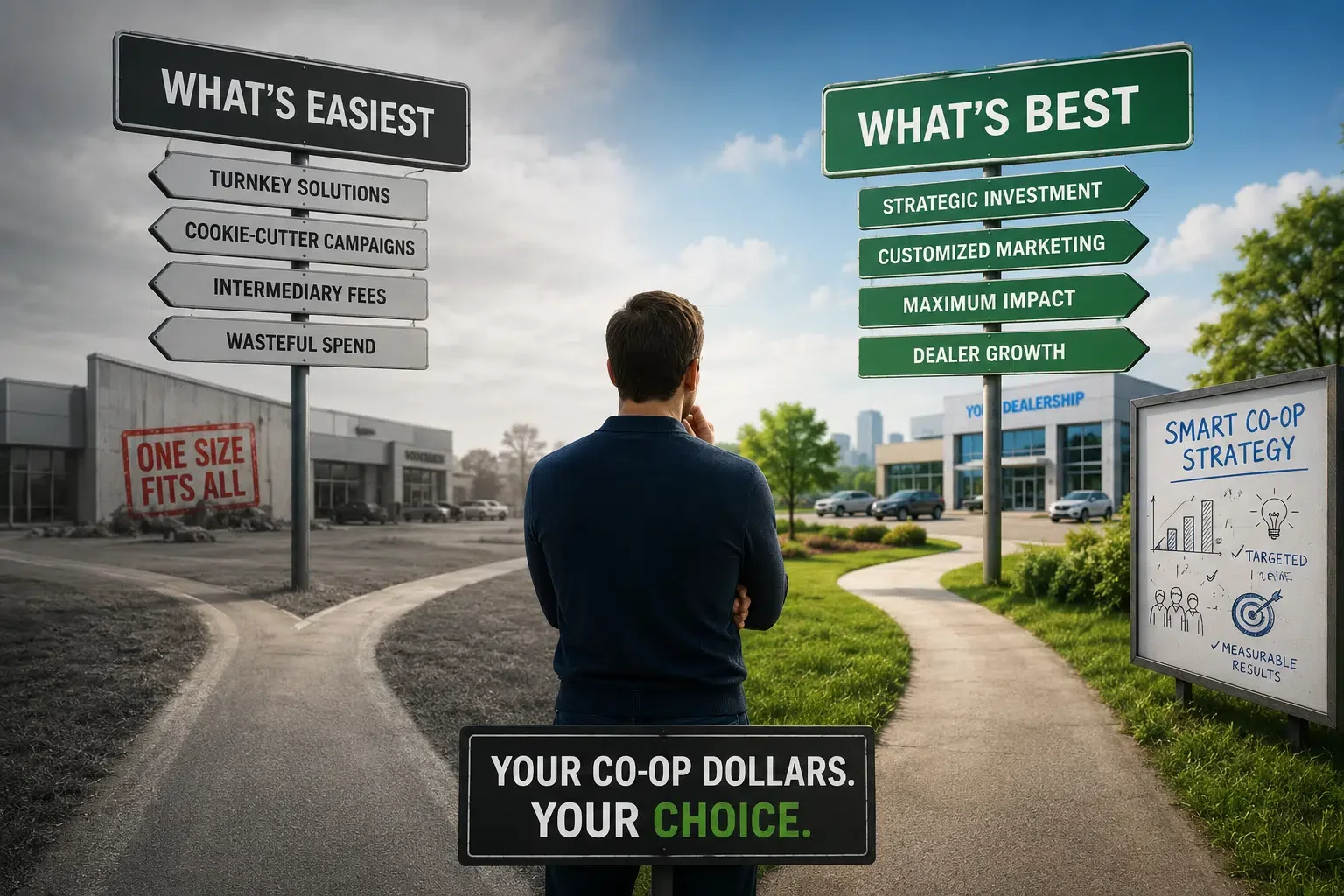
Are You Doing What’s Best With Your Co-Op Dollars, or Are You Doing What’s Easiest?
Image File
Original HTML

Imagine you’re a marketing director or a general manager at a dealership right now—many of you don’t have to imagine, because it’s your reality. You’re faced with a market that is dealing with a multitude of challenges, but what else is new?

Compressed margins, inventory challenges, highly competitive markets, consumer confidence, global economy, gas prices—it’s enough to make anybody question why they work in our business.

But wait! Help is on the way, and it’s in the form of Tier III Co-Op money. That’s right, OEM’s are dumping record amounts of money into the co-op funds in 2026, upwards of $13 billion dollars–with a “B.” Surely, this is going to help you sell cars, Mr. Dealer! All you have to do is sit down with your regional rep, figure out which approved vendor is worthy of your spend and BANG! The leads will just start rolling in!

If Only It Were That Easy

Unfortunately, it doesn’t work that way. Not at all. Here’s why.

- OEM reps are not co-op experts. I mean, they should be. But they aren’t. And it’s maddening. A lot of them don’t even really understand the various co-op portals, or how to read them. They aren’t equipped to advise dealers on marketing. But that’s not all.

- Many OEM reps are incentivized to promote certain solutions, and it has nothing to do with which vendors are the most effective–it has to do with which vendors are the most compliant. Most OEM’s reward the vendors who play by the rules the most, not the ones who have the best technology or provide the most leads. And that leads to…

- Cookie-Cutter solutions. In order to adhere to vendor compliance guidelines, the OEM program vendors have to play it safe—pushing the limits or getting creative can lead to getting kicked out of programs, which means they lose hundreds of potential clients overnight. No program vendor is willing to risk that, which is why your SEM strategy is nearly identical to the dealer down the street–and neither of you benefit as a result. You just get generic, blah marketing.

Friends, if that were the worst of it, then maybe we could survive. Unfortunately, it’s just the beginning of your problems.

You’re Wasting Money, and Nobody Is Willing to Admit It

You’re probably thinking, “Well, I’m spending $20,000 every month on Google, but it doesn’t seem to be as effective as it once was.”

Don’t worry, you’re not crazy. And you’re definitely not alone.

Unfortunately, being in an OEM vendor program isn’t free. Intermediary program managers (you know them by name, but I’m not trying to get sued) charge tremendous fees to vendors in order to participate in the programs that they manage. A 2025 COOPABLE study revealed that the average OEM program is taking 38 percent of dealer ad spend to cover program fees and vendor fees—and the vendors don’t have a choice!

Even if vendors want to give a better deal to their dealer partners, they can’t. Many programs mandate fees that are much higher than what those same vendors charge dealers outside of those programs. Ever wonder why the same vendor does better at OEM A Rooftop than at OEM B Rooftop? It’s likely because more of your budget is going to actual ad spend at OEM A because it’s not “in program.”

There IS a Better Way

Easy doesn’t mean good. Turnkey isn’t all it’s cracked up to be, and dealers have more choice than they think–co-op doesn’t HAVE to be spent with program vendors. Did you know that? Maybe not. And your OEM-approved vendors aren’t ever going to tell you that. Luckily, that’s what I’m here for. Follow these simple guidelines, and you’ll have more luck with your co-op than ever before.

- Every program is different. Some OEM’s have pretty locked down programs, especially when it comes to SEM. But many are more open than you think. Nearly every program will allow you to spend with vendors outside of program in at least a few categories–make sure to read every line of the guidelines, or hire experts to help you.

- A 2025 COOPABLE study showed that over 40% of dealers leave money on the table every month. Make sure that you know how much you’re earning, how much you’re spending, and where you might have opportunity to increase your spend.

- Get out of turnkey programs. I know, I know, it’s easy. It’s out of sight and out of mind. But you’re getting old tech, carbon copy strategies, and intermediaries leeching money out of your budgets. Look for new, exciting companies with new, exciting ideas and tech, and then work with co-op experts to figure out how you can get creative with your budgets.

And This Is Just the Tip of the Iceberg

If you want a consultation on how to make this happen at your dealership and start selling more cars because of co-op, please feel free to reach out to me at the link above. We’ll be happy to take a look at your dealership’s account and do a no-obligation review.

Mark Baruth

CEO, COOPABLE

Class (B2B/B2C)
B2B
Ingest Status
Need Review
Dedupe hash
5827d2c4cfa1e247dce72637fae0269a
Press Eligible
Yes
Press Eligible Reason
QA FAIL (need review): The target says automakers are spending 'up to $13 billion' on co-op funds, but the source explicitly says 'upwards of $13 billion' (more than $13 billion). This reverses the factual direction of the figure.
Source Name
COOPABLE
Original Summary

<p>Imagine you’re a marketing director or a general manager at a dealership right now—many of you don’t have to imagine, because it’s your reality. You’re faced with a market that is dealing with a multitude of challenges, but what else is new? Compressed margins, inventory challenges, highly competitive markets, consumer confidence, global economy, gas prices—it’s [&#8230;]</p>
<p>The post <a href="https://coopable.com/are-you-doing-whats-best-with-your-co-op-dollars-o… You Doing What’s Best With Your Co-Op Dollars, or Are You Doing What’s Easiest?</a> appeared first on <a href="https://coopable.com">Coopable</a>.</p&gt;

Image URL
https://coopable.com/wp-content/uploads/2026/07/ChatGPT-Image-Jul-30-2026-04_01_56-PM.png.webp
Source Node
Generated Article_json
{"target_audience": "b2b", "is_medical": false, "ai_generated_title": "OEM Co-Op Hits $13B in 2026, but Fees Take 38% of Dealer Spend", "body_html": "<p><strong>United States -- [CURRENT_DATE] --</strong> Automakers are putting a record of up to $13 billion into Tier III co-op advertising funds in 2026, but a 2025 COOPABLE study found that the average OEM program absorbs 38 percent of dealer ad spend in program and vendor fees.</p><p>COOPABLE CEO Mark Baruth argues that dealers are not capturing the value of that money. The study also found that more than 40 percent of dealers leave co-op funds unclaimed every month.</p><h5>Program fees take 38% of dealer ad spend</h5><p>According to Baruth, intermediary program managers charge vendors substantial fees to participate in OEM programs, and vendors cannot opt out. Many programs mandate fees well above what the same vendors charge dealers outside the program. A vendor can therefore deliver better results at one OEM's rooftop than another's because more of the budget reaches actual ad spend where the dealer is not &quot;in program.&quot;</p><p>Baruth cites a dealer spending $20,000 a month on Google who sees declining returns.</p><h5>Compliance incentives push vendors toward cookie-cutter campaigns</h5><p>Baruth says OEM reps often lack co-op expertise and struggle to read the various co-op portals. Many are also incentivized to promote the most compliant vendors, not the most effective ones.</p><p>Vendors that push limits risk removal from a program and the loss of hundreds of potential clients overnight. The result, Baruth says, is near-identical search engine marketing (SEM) strategies among competing dealers.</p><h5>Dealers can spend co-op funds outside approved vendor programs</h5><p>Baruth says co-op money does not have to go to program vendors. Programs vary, and some OEMs tightly restrict SEM. He says nearly every program allows out-of-program vendors in at least a few categories.</p><p>His recommendations for dealers:</p><ul><li>Read every line of program guidelines, or hire experts to do so.</li><li>Track co-op earned, spent and unused each month.</li><li>Move away from turnkey programs toward newer vendors and technology.</li></ul><p>COOPABLE offers a no-obligation review of dealership co-op accounts.</p>", "meta_description": "OEMs are pouring a record $13 billion into 2026 co-op funds, yet a COOPABLE study says program fees take 38% of dealer ad spend; 40% leave money unused.", "seo_keywords": "OEM co-op, Tier III co-op, dealer advertising, COOPABLE, automotive marketing, program fees, dealership ad spend, SEM, co-op funds 2026", "companies": ["COOPABLE"], "industries": ["Transportation & Mobility"], "markets_regions": ["United States"], "news_type": ["market_analysis"], "products": [], "themes": ["marketing_spend", "cost_efficiency"], "events": [], "cta_text": "Request a no-obligation review of your dealership's co-op account with COOPABLE", "learn_more": "", "fact_check": {"accuracy_score": 95, "legal_risk": "low", "corrections_made": ["Claims attributed to COOPABLE CEO Mark Baruth and a 2025 COOPABLE study, as the source is an opinion piece", "Source names no location; dateline and region set to United States, an inference from the US dealership co-op context", "Removed promotional and rhetorical language"], "recommendation": "publish"}}
Content Hash (SHA-256, erste 32 hex)
f19ad4cccbe5cdb87037f0178fb906b2
Enterprise Data Integration Platforms for Analysts
Image File
Original HTML

You moved inventory into a proper cloud warehouse a year ago. But every Monday, you still rebuild the fulfillment report by hand, in multiple spreadsheets, because the warehouse fixed where the data lives and left you to fix everything else.

Analytics used to belong to one small, specialized team. Now it belongs to anyone with a spreadsheet and a deadline. Gartner calls this shift out directly, framing the discipline as moving from “the domain of the few, to ubiquity,” while the people running it are asked to do far more as ownership spreads across the business.

So the real question isn’t which integration platform has the longest feature list. It’s which one works for the person opening it every Monday morning — no engineering degree required and no data engineer on call.

The decision this analyst faces

Most conversations about enterprise data integration are written for the team buying the infrastructure, not the person using it daily. IT evaluates platforms on throughput, scalability, and how well they fit an existing architecture. An analyst considers whether they can connect to the systems they already touch, blend that data into something usable, and trust the result without waiting on a ticket queue.

That gap between the buyer’s criteria and the user’s criteria is wider than most integration conversations acknowledge. The 2025 State of Data Analysts survey, published by Alteryx, found that despite near-universal adoption of AI tools, 76% of analysts still rely on manual, spreadsheet-based work for data preparation. This demonstrates a major usability gap between what’s been bought and what gets used day to day.

An analyst working across a CRM, an ERP system, and a handful of spreadsheets nobody has fully documented isn’t asking which platform is the most powerful. The evaluation question is narrower and more grounded: Does this platform meet them where they already work, or does it expect them to become a different kind of professional to use it?

Persona research on this group consistently surfaces the same objection to new tooling: Why learn a new platform when the spreadsheet already works well enough to get by? That objection deserves a real answer that properly addresses analysts’ daily pain points.

What to look for before you short-listing any vendor

Before comparing named products, it helps to fix the criteria that matter to an analyst, such as:

- A way in that does not require writing code, with room to add SQL or Python when a workflow genuinely calls for it

- Governed connections that IT can approve without a lengthy security review holding up the work

- Workflows a teammate can open, understand, and maintain, not a script only its original author can read

- A first working integration measured in hours or days, not a project plan sitting in a multi-month queue

That last criterion is worth a deeper dive. McKinsey’s 2025 State of AI survey found that 88% of organizations report regular AI use in at least one business function, yet nearly two-thirds haven’t scaled it enterprise-wide. The gap McKinsey describes sits squarely on data foundations and workflow design, not on model capability. An analyst who can only integrate data through a months-long IT project is, in effect, cut off from the same foundation that AI and advanced analytics both depend on to produce anything useful.

Comparing various approaches

Enterprise data integration for analysts generally falls into one of three categories. Each has a real place, and each carries a real cost that doesn’t always show up until months later.

None of these is universally correct, and deciding which route to go depends on who’s building it and who has to maintain it after they move to a different role. A team with a mature data engineering function and highly specialized transformation logic may be well served by a traditional ETL. An analyst working alone on a genuine one-off report might only need a spreadsheet. The category that tends to get overlooked in these conversations is the platform, largely because it was built more recently and doesn’t map cleanly onto either “IT tool” or “personal productivity tool.”

What this looks like against a real reconciliation problem

Consider the operations analyst from the opening. Every week, fulfillment numbers need reconciling across three sources. There’s the ERP system, a third-party warehouse feed, and a spreadsheet the returns team maintains on its own. The warehouse feed reports units in cases some weeks and in eaches other weeks, throwing off numerous fulfillment reports this year before anyone traced the pattern back to its source.

Under the manual approach, the analyst catches that kind of error only by rechecking totals against gut instinct, usually after the report has already gone out the door. Under a traditional IT-owned pipeline, fixing the case-versus-eaches logic means filing a change request and waiting for the next engineering sprint to open. Under a governed, low-code approach, the analyst can see the transformation logic directly, adjust the unit-conversion step themselves, and rerun the workflow the same day, while the fix stays visible to anyone else who opens the workflow later.

The difference isn’t only speed, though speed matters. That fix becomes something the whole team can see and rely on, instead of something that stays trapped in one person’s memory until the day they leave the team and take the knowledge with them.

Where the criteria point

A platform that satisfies those four criteria has a specific shape. It has to:

- Connect natively to the systems already in daily use, not just the systems an IT roadmap wants to standardize on eventually

- Work with cloud data platforms like Snowflake, Databricks, and BigQuery through query-in-place and pushdown processing, so data isn’t needlessly copied or moved before anyone can use it

- Offer a code-free workflow canvas for the analyst who has never written SQL, alongside code-friendly options for the analyst who has

Alteryx One is built around that shape. It connects to enterprise SaaS applications, relational databases, file storage, and existing ETL tools, and extends that connectivity to cloud data platforms without requiring data to move before it’s usable. Once the data is connected, the platform’s data preparation tools handle the blending, cleansing, and shaping work that used to happen in a separate spreadsheet step, with the transformation logic visible in the workflow itself instead of buried in a formula only its author understands.

Bringing IT into the conversation early

An analyst rarely gets to make this decision alone, and treating it as a solo choice is a common way evaluations stall out midway through. IT has its own list of requirements, and it usually starts with whether it can see and control what this new tool will do with data.

That question has a concrete answer worth having ready before the conversation starts. Role-based access controls, single sign-on through SAML or OAuth, audit logging, and data lineage tracking are the specific items an IT team will want to see. Alteryx publishes its current certifications and compliance documentation, including ISO 27001 and SOC 2 Type II status, through its Trust Center, alongside its broader approach to governance across the platform.

Bringing those specifics to the first conversation with IT, rather than waiting for the questions to surface later, tends to shorten the entire evaluation by weeks. It also reframes the conversation from a request for an exception to a joint decision, which matters when the analyst championing the platform is not the person with budget authority to approve it. Framing the pitch around what IT needs to see, rather than what the analyst wants to use, is usually the difference between a pilot that gets approved and one that stalls in a queue behind bigger projects.

Where a data integration platform doesn’t fit

A team with a mature data engineering function already maintaining custom pipelines in dbt, or a codebase of highly specialized transformation logic a visual canvas can’t represent cleanly, is often better served by staying with that approach rather than migrating for its own sake. The same holds for transformations so specialized that writing them directly in code will always read more clearly than representing them visually.

The approach outlined here fits best when the person building the integration is the same person who will use its output, and when that person’s time is better spent on the analysis itself than on re-litigating the same data cleanup every single reporting cycle.

Reinventing the way analysts work with data

None of this argues for replacing the data warehouse, the ERP system, or the infrastructure a company already invested in. It argues for closing the distance between that infrastructure and the person expected to make sense of it every week, without a ticket, a queue, or a six-week wait for someone else’s calendar to open up.

For an analyst, closing that distance does more than save a Monday morning. Done well, it reinvents the way they work with data altogether, turning a recurring, error-prone rebuild into something built once, understood by more than one person, and trusted the next time a number has to be defended in a meeting with people who weren’t in the room when it was calculated.

For a broader look at aligning these evaluation criteria with an existing modernization roadmap, the playbook on unifying a data architecture from Alteryx is a reasonable next stop. When the criteria above are ready to be tested against real data instead of a vendor’s demo environment, starting a free trial is the fastest way to find out whether the fit holds up under actual use.

Class (B2B/B2C)
B2B
Ingest Status
Rewritten
Dedupe hash
1817e66661c7b69c9df21fadfbe3381d
Press Eligible
Yes
Press Eligible Reason
Manuelle Prüfung nötig. Risiko: MEDIUM. Flags: ['numbers']. Stichprobe: False
Source Name
Alteryx, Inc.
Original Summary

You moved inventory into a proper cloud warehouse a year ago. But every Monday,&#8230;

Image URL
https://www.alteryx.com/wp-content/uploads/adobestock_1724983154-scaled-e1791227338894.jpeg
Source Node
Content Hash (SHA-256, erste 32 hex)
c215b40f0747fd71eae2bcf14dd580c4
The Single-Player Problem With Enterprise AI
Image File
Original HTML

AI’s nascence means the world is learning how to operationalize and scale a new technology in real time.

It’s exciting. But it’s also expensive.

Complex tasks have a certain token burn rate, and when building and running agents, these costs can quickly become unwieldy. Agents need to reason through complex business logic, make intelligent assumptions about context, read results, and decide the next best action, sometimes multiple times in a single instance.

Expensive one-off costs are not the main barrier to operationalization, though. The problem is what happens when attempting to run the same process, only to get a different answer each time.

While the token costs add up when restarting a process or refiguring important business logic, unpredictability is a nonstarter.

You cannot scale a business on randomness.

Business is not roulette

LLMs are probabilistic. They generate outputs from a probability distribution, which means the same request can produce different responses each time.

Some business tasks, like writing, don’t mind this variability. There are many ways to write a good email (and of course, many ways to write a bad email). As long as you have an effective email, AI will likely save you time.

Other tasks, however, require very specific answers.

Business-critical calculations, like those that get presented to auditors and board members, must be visible, understandable, repeatable, and auditable, what we refer to as VURA. Given the same inputs and business rules, they need to produce the same result every time. They must survive contact with reality, proving accurate under the highest levels of scrutiny.

Many business leaders I speak with are spending exorbitant amounts of time and money trying to turn something probabilistic into something deterministic, or in other words, turning something with high degrees of variance into something repeatable that will always give a certain output given the same input.

This isn’t impossible with LLMs. AI models can write code for deterministic tasks. The problem is that, for most business users, AI-generated code isn’t accessible. Finance leaders may understand the revenue-recognition rules better than anyone, but they often can’t validate a Python script.

Business users understand your business processes better than anyone else. They must be the ones to verify AI-driven processes. But if they can’t understand what’s happening, then you’re trying to operationalize a black box.

Why one-off AI solutions don’t scale

Imagine you want to build an AI agent to calculate revenue recognition for your finance team.

If you ask Gemini or Claude to look at your data from your enterprise systems, it can draw out high-level metrics in minutes. It may even write code to help you perform the right deterministic analytics. But if you show your finance leader what you built, they’re going to take a look at all the code on your laptop and ask you how it works.

You can walk them through your prompts, but if they can’t parse through Python and can’t understand the key logic steps, it’s impossible for them to trust this new function you’ve built, let alone operationalize it.

One option is to create a Git repository; put everything related to your new workflow in one place and share it with your finance team so they can verify the code and iterate on it. However, the chances that your finance team is suddenly going to start working in Git repositories and implement Git-based version control and reviews to verify your AI-generated Python scripts are low.

This is the single-player problem in enterprise AI: AI models can help you do incredible things, but if you’re not able to share those outputs with business experts who can verify the business logic and iterate on an AI-generated workflow, then the utility of whatever you built becomes a one-off artifact that’s difficult for the business to govern or scale.

Solving the single-player problem

Even if it’s not realistic to have your finance team start working with Git repositories, you can still share AI solutions in a central place for your business experts to review and iterate on.

Ask your AI model to build that solution as an Alteryx workflow instead of code. Business users can inspect the resulting workflow and see what’s happening at every step: what data was used, the logic that was applied, and the calculations performed, something no one can do with a Python script.

Then, every workflow becomes a shareable, verifiable artifact. Business users can review and see what’s happening. They can even have AI help them make tweaks to the workflow if changes are needed.

In addition, every Alteryx workflow can become a source of trusted business logic and an executable tool for AI.

If you have an Alteryx workflow called “Revenue Recognition,” you have a formalized, machine-readable record of how your company recognizes revenue. All of the relevant formulas and internal business logic are baked in.

Your AI agents can access these workflows to understand and use the business logic that defines how your company operates. You don’t need to burn tokens asking AI to refigure your business logic every time you want to calculate something.

Second, your workflows become “tools” for your AI models, executable functions that your AI models can call to perform specific actions. Whenever you need to calculate revenue recognition, you can simply ask your LLM to tap into that Alteryx workflow via MCP, right from your LLM interface.

Building a foundation of trust

Some tasks are perfect for probabilistic AI models. Others, like running important calculations and analytics, need to be done the same way, every time. Every business has standardized rules, logic, metrics, and calculations. Without these, you cannot scale.

By using Alteryx workflows for these calculations, you no longer need AI models to reinvent the calculations and business logic every time. The validated business rules live in the workflow, where they can be inspected, tested, governed, and reused. Every Alteryx workflow becomes a reusable business asset that powers your AI processes with trusted logic.

Suddenly, the black box is a whole lot clearer.

Class (B2B/B2C)
B2B
Ingest Status
Rewritten
Dedupe hash
51882fc2c65bf2dcdd7d9c50f3a65f2c
Press Eligible
Yes
Press Eligible Reason
Discusses scaling and governing enterprise AI workflows, with a business software solution.
Source Name
Alteryx, Inc.
Original Summary

AI’s nascence means the world is learning how to operationalize and scale a new&#8230;

Image URL
https://www.alteryx.com/wp-content/uploads/single-player-problem.jpeg
Source Node
Content Hash (SHA-256, erste 32 hex)
c6b67552c7dac9296c0d3590781b4931
Enterprise text analytics platforms: turning unstructured data into insights
Image File
Original HTML

Every enterprise sits on a pile of uncategorized text — ticket queues, contract terms, survey comments, and call transcripts to name a few. Reading through these by hand tops out at a few hundred rows, and a keyword filter misses the ticket that says the invoice math seems off instead of billing error.

A support queue that doubles in a quarter forces the question. A director asks for a breakdown by root cause, like billing confusion, shipping delays, or an integration bug that keeps showing up under different descriptions. Those categories live only as sentences buried in ticket bodies, so someone has to read enough of them to find the categories before anyone can start counting.

That work has a name: text analysis. There are three real ways to do it:

- Write custom code

- Buy a dedicated tool

- Add text mining to the workflow platform already handling everything else

The stakes are larger than one support queue, too. Unstructured sources like these make up an estimated 70% to 90% of the data organizations hold, according to Gartner analysts speaking at the Data & Analytics Summit in London this year. Most of what a company knows about its customers, contracts, and operations lives in exactly this kind of free text.

The decision to build, buy, or embed

Each path has its own pros and cons to consider:

- Build it. Hand the problem to a data scientist, or become one temporarily, and write code against an open-source NLP library. It’s flexible and tailored to the data at hand — right up until the person who wrote it moves to another team and the model becomes a file nobody can safely touch. This path also assumes a data scientist is available to hand the problem to, which is a bigger assumption than it sounds. In the World Economic Forum’s 2025 Future of Jobs Report, 63% of employers named skills gaps as the single biggest barrier to getting more value out of their data and AI investments. A specialized NLP hire is often the bottleneck a team is stuck waiting on.

- Buy a point solution. License a dedicated sentiment or text-analytics tool. It performs well on the use case it was built for, but it lives outside the rest of the analytic workflow. The categorized output has to be exported, re-joined, and re-explained to whoever owns the report downstream — a manual hop that gets rebuilt every cycle.

- Embed it. Run text mining as a step inside the same platform that already handles the blending, joins, and reporting, so a sentiment score or topic label becomes just another column feeding the same report as everything else.

All options carry tradeoffs, and the evidence on the build path is particularly discouraging. A widely reported MIT-affiliated study on enterprise AI deployment found that only a small share of custom-built enterprise AI tools ever reach production, largely because they’re built to impress in a demo rather than to keep running, unattended inside a workflow that absorbs staff turnover.

Test the approach with five criteria

Before comparing platforms, it helps to be explicit about what “good” looks like, regardless of which path a team takes:

- Accuracy on the language your team uses: Internal shorthand, industry jargon, and typos behave differently than the clean review text most product demos use.

- Repeatability without a standing request to the data team: Next quarter’s batch of tickets, comments, or contracts needs consistent, scheduled treatment without reopening a project.

- An audit trail: Someone will eventually ask how a sentiment score or topic label got assigned. “A model someone built two years ago” isn’t an answer IT or compliance can work with.

- Integration with the rest of the analytic workflow: A category label that lives in a separate export is a manual task away from the report it’s supposed to feed.

- A cost and tier fit that matches how the team already buys software: A specialized point tool is another line item, another vendor, and another login to provision and de-provision to handle.

Comparing the three paths against those bars

The three approaches trade capability for control in different places.

The table points to a single deciding factor: which approach is still running unsupervised, after the person who set it up has moved on to something else.

Inside a support ticket queue: pre-processing, sentiment, and topic detection

Picture the support team from the opening example, now trying to work through a backlog of open-ended ticket text without adding headcount. A workflow-embedded approach breaks the problem into steps an analyst can build and rerun without help:

First, raw ticket text gets tokenized and cleaned using a Text Pre-processing step that strips filler words and standardizes formatting. One detail worth knowing is that product documentation for this tool specifically warns against running it immediately upstream of sentiment scoring, since the cleanup step strips some of the exact words a sentiment model relies on to detect tone. The two tools solve different problems and, in this case, work best kept apart.

Sentiment scoring runs on the raw ticket text instead, using Sentiment Analysis to flag which tickets read as frustrated rather than merely descriptive — useful for triage, with the honest caveat that the tool currently analyzes English text only.

Meanwhile, Zero-shot Text Classification sorts tickets into categories the analyst defines on the spot — billing confusion, shipping delay, the recurring integration bug — without first collecting and labeling a training set. That’s the detail that matters most for a senior analyst without a dedicated data science team on call. There’s no model-training step standing between the question and the answer.

A Topic Modeling pass across the same batch catches something the predefined categories can’t — clusters of language nobody thought to name yet, including the complaint that hasn’t made it onto anyone’s list.

With an embedded approach inside Alteryx One Designer, text mining tools run as part of Alteryx Intelligence Suite as each step above produces a new column sitting next to the rest of the ticket data, ready to feed the same report that already tracks volume and resolution time. There’s no export, no manual rejoin, and no separate deliverable to remember to update.

Where the approach runs out of room

Someone mentions that a third of the support inbox comes in through the German site. The phrase “analyzes English text only,” easy to skim past in a tool’s documentation, now sets the actual scope of what this rollout covers this quarter. In Alteryx, Text Pre-processing, Text Classification, and Topic Modeling extend to French, German, Italian, Portuguese, and Spanish.

A team in this spot has three real options: cover categorization and topics everywhere and sentiment only where English applies, hold the German queue for a later phase, or route sentiment scoring for that language through a different process entirely. Each is a workable tradeoff, the kind that surfaces once a rollout touches real data instead of a demo.

A team asking for something else entirely — a model fine-tuned on millions of internal documents to make one narrow, high-stakes call — is solving a different problem than the one this covers. No amount of workflow tooling substitutes for a dedicated machine learning effort when that’s genuinely the ask. Most ticket queues, contract folders, and survey exports are recurring, moderate-scale problems that show up every quarter and need consistent treatment.

Start this week, not next quarter

Pull last week’s actual ticket export, run it through the steps above, and see what the categories look like by Friday — before the next quarter’s backlog makes the decision for you. Start a free 30-day trial of Alteryx One to try it against your own queue.

Class (B2B/B2C)
B2B
Ingest Status
Rewritten
Dedupe hash
f7abe2485716e605806ed382e3cc37c3
Press Eligible
Yes
Press Eligible Reason
Manuelle Prüfung nötig. Risiko: MEDIUM. Flags: ['numbers']. Stichprobe: False
Source Name
Alteryx, Inc.
Original Summary

Every enterprise sits on a pile of uncategorized text — ticket queues, contract terms,&#8230;

Image URL
https://www.alteryx.com/wp-content/uploads/adobestock_534477643-scaled-e1792000766281.jpeg
Source Node
Content Hash (SHA-256, erste 32 hex)
cb07697e0e58b1d3fabf333f002f1b0e