HIGHEST-GRADE GOLD ASSAY REPORTED TO DATE AT EASTSIDE; RESULTS SUPPORT EMERGING STRUCTURAL MODEL FOR HIGHER-GRADE GOLD MINERALIZATION
TONOPAH, Nev., Sept. 21, 2026 /PRNewswire/ -- A2Gold Corp. ("A2Gold" or the "Company") (TSXV: AUAU) (OTCQX: AUXXF) (FRA: RR7) is pleased to report assay results from diamond core drilling completed at the Castle Target, part of the Company's 100% owned, district-scale Eastside Gold-Silver Project in Esmeralda County, Nevada.
The program was designed to improve the Company's understanding of the geological and structural controls on gold mineralization at Castle and to test the potential for higher-grade mineralization within and beyond the current Castle mineral resource.
The results represent an important advancement in A2Gold's geological interpretation of Castle. In addition to the broad mineralized envelope that hosts the existing Castle resource, core drilling has identified discrete zones of higher-grade gold associated with interpreted structural corridors and favorable lithological contacts. These results provide the Company with a more focused geological framework for targeting higher-grade mineralization within and beyond the existing Castle resource, shifting the exploration emphasis toward structurally controlled higher-grade zones rather than simply targeting extensions of broad, lower-grade mineralization.
Highlights
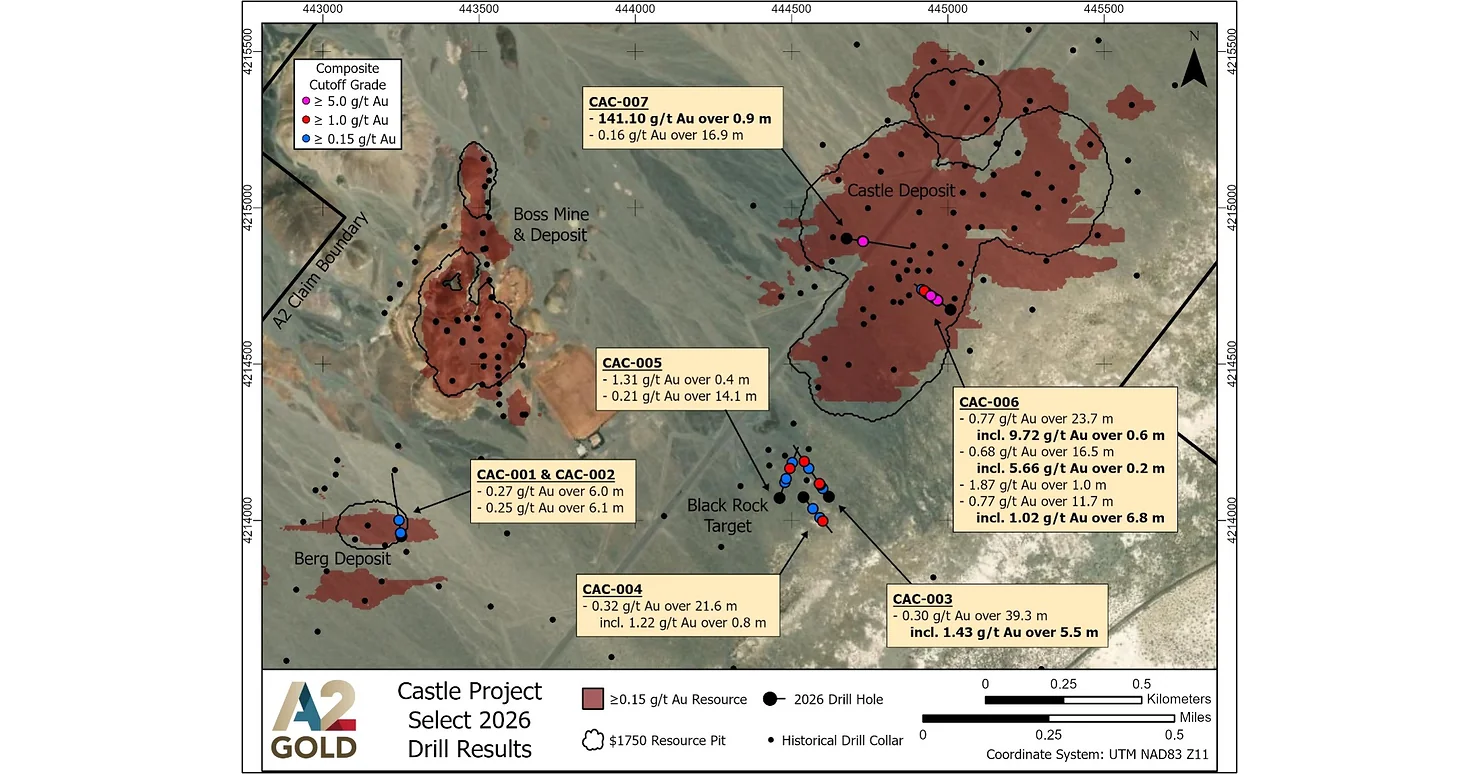
- CAC-007 intersected 141.10 g/t gold over 0.9 metres from 75.9 metres downhole, at approximately 53 metres vertical depth (Figure 1). This represents the highest-grade gold assay reported to date from the Eastside Project. The intercept occurs within the current Castle resource and is associated with an interpreted northeast-striking structural zone. The CAC-007 high-grade intercept occurs along the same broader northeast structural trend associated with previously reported high-grade surface channel samples at Black Rock, which include 10.50 g/t Au over 0.26 metres and 5.63 g/t Au over 0.28 metres. The approximately 400-metre corridor between Black Rock and the CAC-007 high-grade intercept remains incompletely tested and represents a priority target for follow-up drilling.
- CAC-006 intersected multiple high-grade gold intervals, including 9.72 g/t Au over 0.6 metres within a broader interval of 0.77 g/t Au over 23.7 metres, and 5.66 g/t Au over 0.2 metres within a broader interval of 0.68 g/t Au over 16.5 metres. These intervals occur near favorable lithological contacts within an interpreted northwest-trending structural corridor and provide additional evidence that higher-grade mineralization at Castle may be more extensive than previously recognized.
- The drilling supports an emerging geological model in which higher-grade gold mineralization may be controlled by northeast- and northwest-striking structures and favorable lithological/stratigraphic contacts, particularly where these features intersect.
- The 2026 core program also identified broad zones of silver mineralization that were not systematically characterized by historical drilling, including 13.3 g/t Ag over 19.5 metres inCAC-006 and 10.3 g/t Ag over 41.6 metres inCAC-003. These results indicate that silver may represent a more significant component of the Castle mineralized system than previously recognized.
Figure 1: Plan view map that shows core holes completed during this program and significant intercepts
Peter Gianulis, CEO of A2Gold, commented:
"These results are important because they begin to change the way we think about Castle. Castle has historically been viewed primarily as a large, near-surface, lower-grade mineralized system. Our current exploration strategy is increasingly focused on identifying the structural controls that may host materially higher-grade gold within that broader system.
The 141.10 g/t gold intercept in CAC-007 is the highest-grade assay reported to date at Eastside and occurs only approximately 53 metres vertically below surface. Importantly, we do not view the CAC-007 result in isolation. Together with the high-grade surface mineralization previously identified at Black Rock along the same broader structural trend, it provides us with a specific corridor to systematically test for continuity of higher-grade mineralization.
Our next objective is straightforward: follow these structures, test the intersections between structural corridors and favorable stratigraphy, and determine whether these high-grade occurrences form part of continuous vein or feeder systems. That will be an important focus of the next phase of drilling at Castle."
Castle Core Drilling Results
The current drill program was designed to improve understanding of the structural and stratigraphic controls on gold mineralization. The program targeted key structural orientations and stratigraphic contacts identified through historical drilling and recent geological interpretation, with the resulting core enabling detailed characterization of lithological contacts, structural features, alteration and veining and their relationship to gold mineralization.
CAC-007 – Shallow High-Grade Gold
Hole CAC-007 intersected 141.10 g/t gold over 0.9 metres beginning at 75.9 metres downhole, approximately 53 metres vertically below surface.
The high-grade interval occurs within a broader zone of lower-grade gold mineralization including 0.16 g/t gold over 16.9 metres and is associated with a fault interpreted to strike northeast-southwest and dip to the northwest. This structure juxtaposes Tertiary volcanic rocks against Paleozoic sedimentary basement rocks.
Results from CAC-007 support the Company's interpretation that higher-grade mineralization may be structurally controlled and associated with the interpreted northeast-trending corridor at Castle. This structural orientation can now be systematically tested along strike and down dip to assess the continuity and scale of the higher-grade mineralization.
CAC-006 – Structural and Stratigraphic Controls
Hole CAC-006 intersected 9.72 g/t gold over 0.6 metres beginning at 71.0 metres downhole within a broader interval of 0.77 g/t gold over 23.7 metres, and 5.66 g/t gold over 0.2 metres beginning at 110.2 metres downhole within a broader interval of 0.68 g/t gold over 16.5 metres.
The higher-grade intervals encountered in CAC-006 (Figure 2) occur within broader zones of gold mineralization near favorable lithological contacts within the volcanic sequence and in proximity to an interpreted northwest-striking, steeply dipping structural corridor.
Figure 2: Northeast-looking cross-section A-A' showing CAC-006, CAC-007, historical drill holes and gold intercepts in relation to the interpreted northwest-southeast structural corridor (parallel to this section) and favorable stratigraphic contacts.
Geological Significance and Exploration Potential
The 2026 core program has refined the Company's geological interpretation of the Castle mineralized system and identified three potential controls on higher-grade gold mineralization (Figures 2 & 3).
The first potential control is an interpreted northeast-striking, moderately northwest-dipping structural zone that juxtaposes Tertiary volcanic rocks and Paleozoic sedimentary basement rocks. CAC-007 tested this feature and returned the highest-grade gold assay reported to date at Eastside. High-grade vein samples previously collected and assayed from the Black Rock surface outcrop are also associated with this broader structural trend (Press Release dated June 3, 2026). The Company considers the corridor between Black Rock and CAC-007 and the projected extension of this structure to be a priority target for additional drilling.
The second potential control is an interpreted northwest-striking, steeply dipping structural corridor that transects the central Castle resource area. Offsets in lithology and mineralization observed in historical drilling, together with the distribution of the new higher-grade intervals, provide evidence that this corridor may influence the distribution of gold mineralization. Additional drilling will be required to establish its geometry and continuity.
The third potential control is favorable stratigraphy and lithological contacts within the overlying volcanic sequence and the contact with underlying Paleozoic basement. These contacts may have provided favorable pathways for hydrothermal fluids and sites for gold and silver deposition.
The Company's current interpretation is that higher-grade mineralization may preferentially occur where structural and stratigraphic controls intersect. The interpreted corridors extend through and beyond portions of the current Castle mineral resource, providing targets for additional drilling and potential resource expansion.
Figure 3: Plan map that shows the current Castle mineral resource, interpreted northeast- and northwest-striking structural corridors, and areas for potential resource expansion and follow-up drilling.
The 2026 core program has also identified broad zones of silver mineralization that were not systematically characterized by historical drilling, which predominantly reported only gold assays. Results include 13.3 g/t Ag over 19.5 metres in CAC-006 and 10.3 g/t Ag over 41.6 metres in CAC-003, indicating that silver may represent a more significant component of the Castle mineralized system than previously recognized. Systematic silver assaying in future drilling will improve understanding of silver distribution and its relationship to gold mineralization and provide additional data for consideration in future resource estimates.
Future drilling will build on these results and focus on infilling and extending the interpreted higher-grade trends within the current Castle resource, testing their projected extensions beyond the resource boundary, and evaluating their relationship to favorable stratigraphic contacts.