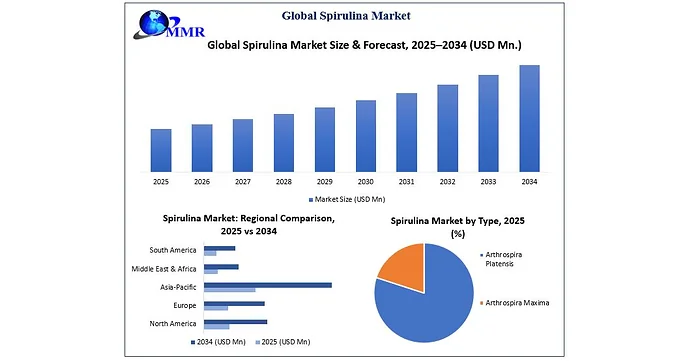
PUNE, India, Sept. 23, 2026 /PRNewswire/ -- Global Spirulina Market was valued at USD 651.35 Million in 2025 and is projected to expand at a 10.6% CAGR from 2026 to 2034, reaching USD 1612.91 Million by 2034, according to a new analysis by Maximize Market Research.
Global Spirulina Market
The Global Spirulina Market Report 2025 provides a detailed analysis of market trends, growth drivers, emerging cultivation technologies, product innovations, competitive developments, applications, and market forecasts through 2034. Spirulina is a nutrient-rich cyanobacteria and blue-green algae biomass widely used as a dietary supplement, functional food ingredient, plant-based protein source, natural food colorant, nutraceutical ingredient, animal feed, aquaculture feed, pharmaceutical ingredient, veterinary product, and cosmetic ingredient. The market covers Arthrospira Platensis and Arthrospira Maxima, along with spirulina powder, tablets and capsules, liquid formulations, granules, and gelling agents across food and beverages, nutraceuticals, animal and aquaculture feed, pharmaceutical, veterinary, cosmetic, and other applications.
The growing consumer focus on plant-based nutrition, sustainable protein, functional foods, clean-label ingredients, natural ingredients, and preventive wellness is supporting the increasing adoption of spirulina across food, beverage, nutraceutical, and dietary supplement applications. Spirulina's high protein content, nutritional profile, amino acids, minerals, antioxidants, and bioactive compounds are strengthening its position as a concentrated nutritional ingredient. At the same time, rising demand for natural blue food colorants and phycocyanin is creating additional commercial opportunities in beverages, confectionery, dairy, processed foods, and other clean-label product categories.
Advancements in spirulina cultivation, photobioreactor technology, controlled production systems, AI-enabled cultivation monitoring, automated biomass assessment, sustainable algae production, and high-value phycocyanin extraction are further transforming the industry. Increasing applications in aquaculture and animal nutrition, growing interest in spirulina-based functional foods and plant-based seafood alternatives, and expanding demand for organic and traceable algae ingredients are encouraging producers to diversify their product portfolios. These developments, combined with increasing R&D activity, advanced processing technologies, and investments in scalable spirulina production, are expected to strengthen the global spirulina market landscape.
Get Full PDF Sample Copy of Report: (Including Full TOC, List of Tables & Figures, Chart) @ https://www.maximizemarketresearch.com/request-sample/29894/
Global Spirulina Market gains momentum as plant-based nutrition, sustainable protein, natural food colorants, phycocyanin applications, and advanced algae cultivation accelerate industry innovation: Maximize Market Research unveils key insights.
Global Spirulina Market Size & Forecast
Global Spirulina Market Trends & Insights
- North America leads the Global Spirulina Market, driven by demand for dietary supplements, nutraceuticals, functional foods, and natural food colorants.
- Asia-Pacific is a high-growth region, supported by expanding spirulina cultivation, food processing, plant-based nutrition, and nutraceutical applications.
- Plant-based nutrition and sustainable protein demand are increasing spirulina adoption across functional foods, beverages, sports nutrition, and dietary supplements.
- Natural blue colorants and phycocyanin applications are expanding in beverages, confectionery, dairy, and clean-label food products.
- Advanced cultivation and photobioreactor technologies are improving spirulina production efficiency, quality control, scalability, and high-value extract production.
Rising Demand for Plant-Based Nutrition Drives Market Growth
The growing demand for plant-based protein, functional foods, dietary supplements, nutraceuticals, and clean-label ingredients is driving spirulina adoption. Its high protein content, amino acids, antioxidants, minerals, and nutritional value support applications across food and beverages, sports nutrition, and health products.
High Production and Processing Costs Restrain Market Growth
Controlled cultivation, harvesting, drying, quality testing, and contamination control increase spirulina production costs. Compared with conventional protein sources, these requirements can limit price competitiveness and wider adoption in cost-sensitive food and feed applications.
Natural Colorants and Aquaculture Applications Create Opportunities
Growing demand for natural blue food colorants, phycocyanin, sustainable protein, and nutrient-rich feed is creating new opportunities for spirulina producers. Expanding applications in beverages, confectionery, nutraceuticals, aquaculture, animal nutrition, cosmetics, and functional foods are supporting market diversification.
Quality Consistency and Contamination Risks Create Challenges
Variations in cultivation conditions, water quality, harvesting, drying, and processing can affect spirulina's nutritional composition and pigment concentration. Contamination risks and quality-control requirements remain important challenges for producers seeking consistent, scalable, and commercially reliable spirulina production.
Get Insightful Data on Regions, Market Segments, Customer Landscape, and Top Companies (Charts, Tables, Figures and More) https://www.maximizemarketresearch.com/request-sample/29894/
Global Spirulina Market Segmentation
The Global Spirulina Market is segmented by Type, Drug Formulation, Application, and Region. Increasing demand for plant-based nutrition, sustainable protein, functional foods, nutraceuticals, natural food colorants, phycocyanin, aquaculture feed, and clean-label ingredients, along with advances in spirulina cultivation and processing technologies, is supporting market development across these segments.
North America Leads the Spirulina Market While Asia Pacific Emerges as a High-Growth Region
North America held the largest share of the Global Spirulina Market in 2025, supported by strong demand for dietary supplements, nutraceuticals, functional foods, plant-based nutrition, natural food colorants, and clean-label ingredients. The United States represents a major market due to established health and wellness industries, increasing consumer awareness of sustainable protein, and growing applications of spirulina and phycocyanin in food, beverages, nutraceuticals, and natural color formulations. Canada and Mexico also contribute through expanding demand for natural nutritional ingredients and functional food products.
Europe represents an important market, supported by increasing demand for natural food colors, organic ingredients, clean-label products, functional foods, and nutraceuticals. The United Kingdom, France, Germany, Italy, Spain, and other European markets are witnessing growing interest in spirulina-based food and beverage products, dietary supplements, natural blue colorants, and high-value algae extracts. Growing consumer preference for minimally processed and naturally derived ingredients is further supporting market development.
Asia Pacific is expected to witness strong growth as spirulina cultivation, food processing, nutraceutical production, and plant-based nutrition continue to expand. China, South Korea, Japan, India, Indonesia, Taiwan, and other regional markets are important contributors, supported by established spirulina production, rising health awareness, increasing demand for protein-rich dietary supplements, and expanding applications in cosmetics, pharmaceuticals, animal nutrition, and aquaculture feed. Advances in photobioreactors, controlled cultivation, and automated algae production are also creating opportunities for scalable production.
Middle East & Africa is gradually developing as demand for nutritional supplements, functional foods, sustainable protein, and natural ingredients increases. South Africa, GCC countries, Egypt, Nigeria, and other regional markets are contributing to adoption as awareness of plant-based nutrition and health-focused products expands.
South America is supported by growing interest in nutraceuticals, functional foods, dietary supplements, natural ingredients, and sustainable nutrition. Brazil represents an important regional market, while Argentina and other South American countries are contributing as consumer awareness of spirulina-based nutritional products and plant-based ingredients continues to develop.
Leading Companies Strengthen the Spirulina Cultivation and Nutraceutical Landscape
Earthrise Nutritionals LLC, Cyanotech Corporation, DIC Corporation, Parry Nutraceuticals, Far East Bio-Tec Co., Ltd. (FEBICO), Fuqing King Dnarmsa Spirulina Co., Ltd., and Inner Mongolia Rejuve Biotech Co., Ltd. are among the prominent companies contributing to the global spirulina industry. Their activities across spirulina cultivation, biomass production, nutraceutical ingredients, dietary supplements, natural blue colorants, phycocyanin extraction, and algae-based applications are supporting product development and commercialization. Companies are also investing in advanced cultivation systems, sustainable production, high-value extracts, and expanded application areas.
Global Spirulina Market Competitive Landscape
The Global Spirulina Market is increasingly application-driven and technology-oriented, with companies focusing on spirulina cultivation, biomass processing, nutraceutical ingredients, dietary supplements, natural food colorants, phycocyanin, functional foods, animal and aquaculture feed, cosmetics, and pharmaceutical applications. Key players include Earthrise Nutritionals LLC, Cyanotech Corporation, DIC Corporation, Parry Nutraceuticals, Far East Bio-Tec Co., Ltd. (FEBICO), GNT Group, Roquette Frères, Givaudan, NOW Health Group, Inc.