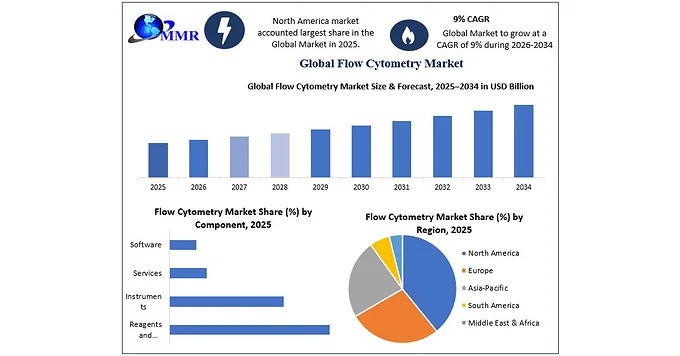
PUNE, India, Sept. 23, 2026 /PRNewswire/ -- The Global Flow Cytometry Market was valued at USD 5.13 Billion in 2025 and is projected to expand at a 9% CAGR from 2026 to 2034, reaching USD 11.14 Billion by 2034, according to a new analysis by Maximize Market Research.
Global Flow Cytometry Market
The Global Flow Cytometry Market Report 2025 provides a detailed analysis of market trends, growth drivers, technological advancements, clinical applications, research activities, product innovations, regulatory developments, competitive developments, applications, and market forecasts through 2034. The market covers Instruments, Reagents and Consumables, Software, and Services across Cell-based Flow Cytometry and Bead-based Flow Cytometry, with applications spanning academic and research institutes, hospitals and clinical testing laboratories, and pharmaceutical and biotechnology companies.
The growing adoption of flow cytometry in clinical diagnostics, oncology, immunology, cell biology, drug discovery, and life science research is supporting the expansion of the global flow cytometry market. Increasing demand for multiparameter cellular analysis, immunophenotyping, biomarker identification, cell-cycle analysis, and immune-cell characterization is strengthening the use of flow cytometry across research and clinical environments. Rising investments in biotechnology, pharmaceutical R&D, precision medicine, and cell-based research are further contributing to demand for advanced flow cytometry systems, reagents, consumables, and analytical software.
Advancements in spectral flow cytometry, high-parameter analysis, automated workflows, cell sorting, nanoscale particle analysis, and AI-enabled data interpretation are further transforming the flow cytometry landscape. Increasing research into cancer, immunotherapy, stem cells, cell and gene therapies, and single-cell analysis is creating new opportunities for market participants. Product launches, technological innovation, strategic collaborations, acquisitions, and expansion of clinical and research applications are expected to strengthen the global flow cytometry market through 2034.
Get Full PDF Sample Copy of Report: (Including Full TOC, List of Tables & Figures, Chart) @ https://www.maximizemarketresearch.com/request-sample/29653/
Global Flow Cytometry Market gains momentum as rising adoption in clinical diagnostics and life science research, increasing demand for multiparameter cell analysis, advances in spectral and high-parameter flow cytometry, automation, and expanding cell and gene therapy applications accelerate technological innovation: Maximize Market Research unveils key insights.
Global Flow Cytometry Market Size & Forecast
Global Flow Cytometry Market Trends & Insights
- North America leads the Global Flow Cytometry Market, supported by advanced healthcare infrastructure, strong biomedical research activity, established pharmaceutical and biotechnology industries, and extensive adoption of flow cytometry in clinical diagnostics and life science research.
- Asia-Pacific represents a high-growth region, driven by expanding pharmaceutical and biotechnology sectors, improving healthcare infrastructure, increasing biomedical research investments, and growing adoption of advanced cellular analysis technologies across China, Japan, India, and South Korea.
- Rising demand for multiparameter cellular analysis is increasing the adoption of flow cytometry across oncology, immunology, drug development, cell biology, and clinical diagnostics, particularly for immunophenotyping, biomarker identification, cell-cycle analysis, and immune-cell characterization.
- Spectral and high-parameter flow cytometry technologies are gaining importance, supported by the need for detailed analysis of complex and heterogeneous cell populations. Advances in automation, cell sorting, nanoscale particle analysis, and integrated data-analysis software are further expanding technology adoption.
- Clinical research and cell-based therapy development are accelerating market innovation, with increasing applications in cancer research, immunotherapy, stem-cell studies, and cell and gene therapy. Product launches, technological advancements, R&D investments, and development of automated analytical workflows are creating new opportunities for flow cytometry market participants.
Growing Adoption of Multiparameter Cellular Analysis Drives Market Growth
The increasing use of flow cytometry in clinical diagnostics, oncology, immunology, cancer research, drug discovery, cell biology, and life science research is driving market growth. Rising demand for immunophenotyping, biomarker identification, cell-cycle analysis, immune-cell characterization, and high-resolution cellular analysis is encouraging laboratories to adopt advanced flow cytometers. The expanding use of flow cytometry in pharmaceutical R&D, biotechnology research, immunotherapy, stem-cell studies, and cell-based research is further supporting demand for instruments, reagents, consumables, software, and services.
High Capital and Operating Costs Restrain Market Growth
The substantial investment required for advanced flow cytometry instruments, lasers, detectors, reagents, specialized software, maintenance, laboratory infrastructure, and technical support can restrict adoption, particularly among smaller hospitals, academic laboratories, and research facilities with limited budgets. The increasing complexity of high-parameter and spectral flow cytometry systems, together with recurring consumable and maintenance requirements, can further increase the overall cost of ownership and limit adoption in cost-sensitive markets.
Expansion of Spectral Flow Cytometry and Cell-Based Therapies Creates Opportunities
Advancements in spectral flow cytometry, high-parameter analysis, automated workflows, cell sorting, nanoscale particle analysis, and advanced data-analysis software are creating significant opportunities in the flow cytometry market. Growing applications in single-cell analysis, immunotherapy, cancer research, stem-cell studies, and cell and gene therapy are increasing demand for technologies capable of characterizing complex cell populations at greater resolution. The development of AI-enabled analysis, workflow automation, integrated software solutions, and application-specific platforms is further expanding opportunities for technology providers.
Shortage of Skilled Professionals and Complex Data Interpretation Create Challenges
The increasing complexity of multiparameter and high-dimensional flow cytometry datasets creates challenges related to panel design, compensation, quality control, instrument operation, data management, and interpretation. Laboratories require skilled professionals with expertise in flow cytometry instrumentation, fluorescence analysis, cell sorting, assay development, and computational data analysis. The shortage of trained personnel, together with the complexity of analyzing multidimensional cellular datasets and maintaining standardized workflows, can create operational challenges for clinical and research laboratories.
Get Insightful Data on Regions, Market Segments, Customer Landscape, and Top Companies (Charts, Tables, Figures and More) https://www.maximizemarketresearch.com/request-sample/29653/
Global Flow Cytometry Market Segmentation
The Global Flow Cytometry Market is segmented by Component, Technology, End Use, and Region. Increasing adoption of multiparameter cellular analysis, growing applications in clinical diagnostics and life science research, technological advancements in spectral and high-parameter flow cytometry, rising pharmaceutical and biotechnology R&D investments, and expanding applications in cell-based therapies are supporting market development across these segments.
North America Leads the Flow Cytometry Market While Asia Pacific Emerges as a High-Growth Region
North America held the largest share of the Global Flow Cytometry Market in 2025, supported by advanced healthcare infrastructure, strong biomedical research activity, established pharmaceutical and biotechnology industries, and widespread adoption of advanced cellular analysis technologies. The United States represents a major market due to substantial healthcare and life science investments, extensive clinical laboratory networks, strong oncology and immunology research, and increasing use of flow cytometry in clinical diagnostics, drug discovery, immunotherapy, and cell-based research. Canada and Mexico also contribute through improving laboratory infrastructure, expanding research capabilities, and growing adoption of advanced flow cytometry systems.
Europe represents an important market, supported by established healthcare systems, strong clinical and academic research networks, pharmaceutical and biotechnology activity, and increasing use of flow cytometry in diagnostic and research applications. The United Kingdom, France, Germany, Italy, Spain, Sweden, Austria, and other European markets are witnessing continued adoption of multiparameter flow cytometry, spectral flow cytometry, cell sorting, immunophenotyping, and advanced data-analysis technologies. Growing investments in precision medicine, immunology, cancer research, and cell-based therapies are further supporting regional market development.
Asia Pacific is expected to witness strong growth as pharmaceutical and biotechnology industries expand alongside improvements in healthcare infrastructure and biomedical research capabilities. China, South Korea, Japan, India, Australia, Indonesia, Malaysia, Vietnam, Taiwan, and other regional markets are contributing to market development. Rising investments in cancer research, drug development, immunology, cell biology, cell and gene therapies, and life science research, together with increasing adoption of high-parameter and automated flow cytometry systems, are creating opportunities across the region.