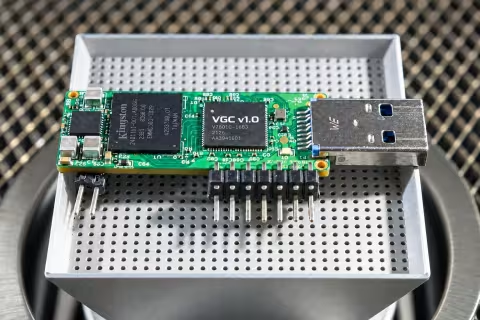
Hanoi – November 03, 2026 -- Vietnam's Government Cipher Committee and Viettel Group have unveiled VGC v1.0, a 28-nanometre security chip that runs a domestically developed cryptographic algorithm in silicon and performs encryption and decryption about 15 times faster than a software-only solution.
VGC v1.0 packs 300 million transistors into a 10 x 10 mm package
The chip is fabricated on a 28-nanometre CMOS process. Its first batch passed technical tests and received certification for socio-economic applications in the first quarter of 2026. Technical safeguards applied before fabrication are designed to reduce the risk of information leakage and reverse engineering.
The project targets data-exposure risks tied to imported chips. Embedding cryptographic functions in hardware is meant to give Vietnam more control over how the technologies protecting sensitive information are designed and verified.
Cipher Committee's M2 unit defined the algorithm while Viettel Semiconductor Center built the chip
M2 set the security requirements, developed the algorithm and defined the evaluation criteria. Viettel Semiconductor Center designed and implemented the silicon. The platform uses the open RISC-V instruction set architecture, so Vietnamese engineers can modify processor designs and reuse verification processes for future chip generations.
Secure USB drives for state agencies are the first deployment, with a 2-million-certificate system next
VGC v1.0 is already used in secure USB storage devices for Party, government and defence agencies. Planned uses include Vietnam's national digital signature certification system, which has more than two million certificates in circulation. Other candidate uses include financial data protection, connected cameras and sensors, and critical infrastructure in electricity, water, oil and gas, and telecommunications.
Products intended to protect state secrets would need further testing and certification under applicable standards.
Agreement covers volume production and multicore security chips
At the launch, the two parties signed an agreement covering volume production, multicore security chips, specialist workforce development and testing on real devices. Viettel is also building a semiconductor fabrication plant in Hoa Lac to extend domestic capability across chip design, manufacturing and packaging.
Lieutenant General Tao Duc Thang, Chairman and CEO of Viettel Group, said that starting later does not mean accepting dependence on others.