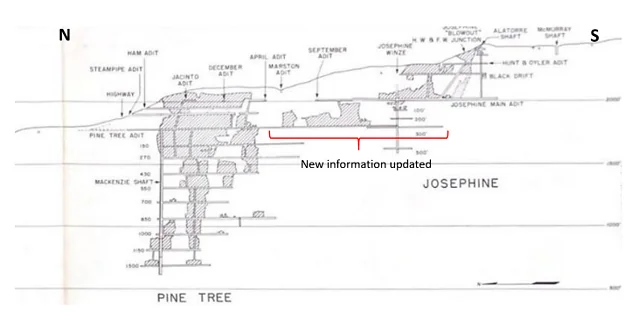
VANCOUVER, BC, Nov. 3, 2026 /PRNewswire/ -- Lode Gold Resources Inc. (TSXV: LOD) (OTCQB: LODFF) (FSE: X27) ("Lode Gold" or the "Company") announced today that it has identified structural patterns controlling gold grade distribution at the Pine TreeâJosephine Mine within its Fremont Gold Mine in Mariposa County, USA. The interpretation is based on the digitization, completed earlier this year for the 2026 Mineral Resource Estimate (MRE), of an extensive portion of the historical Pine Tree underground level containing channel samples collected in 1941, integrated with historical drilling results and the Company's geological interpretation of the Pine Tree and Josephine vein systems.
The integrated dataset indicates the presence of at least two higher-grade mineralization shoots along the Pine Tree vein, each approximately 50â60 metres long and associated with grades of approximately 4â6 g/t Au. These shoots occur in predictable structural positions relative to transverse normal faults. The adjacent Josephine vein was barely explored in this area during the historical underground operation, although a later drill hole intersected 43.02 g/t Au over 0.61 metres, approximately 26 metres from a crosscut developed to intersect the vein. The Company believes that understanding these structural relationships could help identify underexplored zones with potential for higher grades and additional gold content, including at depth.
Hashim Ahmed, Director and Chair of the Board of Lode Gold, commented: "The strategy pivot to bulk underground mining is central to a lower-cost operation. With the significant increase in the price of gold since the previous MRE, the cut-off grade has decreased to 0.82 g/t Au for economic extraction. This approach allows a greater proportion of the deposit, including lower-grade material, to be considered in the resource estimate."
Continuous Underground Sampling Reveals Structural Controls
The historical channel samples provide continuous sampling along exposed mineralized structures in the underground workings, allowing the Company to examine changes in the vein geometry and grade distribution in greater detail than would be possible from drill intersections alone. This dataset has revealed a recurring relationship between transverse normal faults and changes in the orientation of the Pine Tree and Josephine veins.
Where these faults intersect the vein systems, the veins bend, creating concave and convex segments associated with local openings and closures. The Company's interpretation indicates that higher-grade shoots along Pine Tree occur approximately 50â60 metres before the transverse faults, whereas along Josephine, higher-grade mineralization occurs in the metres following the faults. This contrasting spatial relationship provides a geological framework for predicting where higher-grade mineralization may occur along each vein.
Jon Hill, Director of the Board, Chair of the Technical Committee of Lode Gold, commented: "An important opportunity at Fremont is the ability to improve our understanding of gold grade distribution even within mineralized structures that have already been drilled. Systematic drilling on a regular grid provides valuable information, but it does not guarantee that localized higher-grade shoots will be intersected. Continuous underground channel samples allow us to examine how grades change along the veins and relate those changes to the underlying structural geometry. By recognizing these patterns, we can develop more targeted drilling strategies to test areas that may have been underexplored and assess the potential to increase both the grade and gold content of the deposit."
Historical drilling at Fremont was generally conducted on a systematic grid of approximately 30 by 30 metres (100 by 100 feet), rather than being specifically targeted at the structural positions now recognized as favourable for higher-grade mineralization. Consequently, drill holes may have intersected the veins without intersecting the higher-grade shoots, depending on their position relative to the structures. Where the systematic drill pattern did not intersect these localized zones, their potential contribution may not have been adequately represented in the geological interpretation or resource model.
Recognizing these patterns allows the Company to revisit known mineralized structures with a more predictive geological framework. Rather than relying solely on the regular spacing of historical drill holes, future drilling can be designed to test specific structural positions where the historical underground data indicate a greater potential for higher-grade mineralization.
Historical Drilling Demonstrates Higher-Grade Potential
Historical drilling provides supporting evidence for the interpretation of the Pine Tree and Josephine vein systems. Drill hole DD-15-045 intersected 43.02 g/t Au over 0.61 metres, from 314.25 to 314.86 metres downhole. The intersection was obtained approximately 26 metres from a crosscut developed to intersect the Josephine vein, demonstrating the presence of very high-grade gold mineralization in a structure that had seen limited historical underground exploration in this area.
Historical drilling along the Pine Tree vein also returned grades of approximately 6 g/t Au in several intervals:
These results are consistent with the grades recorded in the higher-grade shoots identified from the historical underground channel samples. Together, the underground sampling and drilling data support the interpretation that structural geometry plays an important role in the distribution of gold grades along both vein systems.
Implications for Resource Growth and Deeper Exploration
The significance of this work extends beyond the two higher-grade shoots identified along the historical Pine Tree level. By recognizing structural controls on grade distribution, Lode Gold aims to identify underexplored portions of known mineralized structures where historical drilling may not have adequately tested the most prospective locations.
The deeper portion of the area under consideration remains sparsely tested, with only two drill holes providing information in the relevant zone. The Josephine vein has had limited exploration by historical underground mining in this specific area, leaving its continuity and grade distribution insufficiently constrained.
The Company intends to use the structural interpretation to guide future infill drilling and evaluate whether the same patterns continue at depth. Such drilling will test whether additional higher-grade shoots occur in previously underexplored portions of the Pine Tree and Josephine veins and whether these zones could contribute to an increase in the grade and gold content represented in future resource evaluations. Any such increase would be subject to confirmation through drilling, geological modelling and a subsequent resource estimate.
Wendy T. Chan, CEO and Director of the Board, Lode Gold, commented: "An important aspect of Fremont's potential is that resource growth may not depend solely on discovering new mineralized areas or extending the known deposits at depth. A better understanding of how gold grades are distributed within the structures we already know could reveal opportunities to improve the grade and potentially increase the gold content captured in our resource models. We believe this represents an important opportunity to unlock additional value from the existing mineralized system as we continue to advance Fremont."
About Lode Gold
Lode Gold has key assets in United States and Canada.
Fremont Gold Mine (Fremont Gold Mining LLC) is a brownfield project in Mariposa, California with 43,000 m drilled, 10,000 underground channel samples, 14 adits and 2 shafts. Mining halted in 1942 due to the gold mining prohibition during WW II. It was mined at 10.7 g/t when price was gold was $35 per oz. PEA was completed (link) in 2023. The PEA was based on 1.16 Moz at 1.90 g/t Au within 19.0 Mt Indicated, and 2.02 MOz at 2.22 g/t Au within 28 Mt Inferred with a composite cut-off[1]. MRE (link) was updated in 2026; 89% of the ounces were left unmined if we compare historical production with our current Indicated Resource. Average true widths at 1 g/t cut off is 53m. Project sits on > 3,000 acres of 100% owned private and patented land which is designated as OZ, Trump Administration Opportunity Zone (Special Tax Incentives).
[1] 0.25 g/t for oxide, 0.45 g/t for open pit mineralization and 1.45 g/t for underground mineralization
Dingman Property is an orogenic deposit in Ontario, Canada with over 22,000 m drilled, with a 2013 PEA, MRE (link to report) : 376,000 oz at 0.94 g/t within 12.5 Mt measured and indicated and 47,000 oz at 0.71 g/t within 2.1 Mt Inferred.
Qualified Person
The technical information contained in this press release was reviewed and approved by Gary Wong, P.Eng., Vice President of Exploration of Lode Gold, designated as a qualified person under National Instrument 43-101.
The data presented in this news release relies on historical data from the 1941 mining operation and cannot been independently verified due to lack of underground access.
ON BEHALF OF THE COMPANY
Wendy T. Chan
CEO & Director
info@lode-gold.com
+1(604) 977-GOLD (4653)
Kevin Shum
Investor Relations
kevin@lode-gold.com
+1(604) 977-GOLD (4653)
Cautionary Statement Regarding Forward-Looking Information
Neither the TSX Venture Exchange nor its Regulation Services Provider (as that term is defined in the policies of the TSX Venture Exchange) accepts responsibility for the adequacy or accuracy of this release.
This news release includes "forward-looking statements" and "forward-looking information" within the meaning of Canadian securities legislation.