Wuppertal – November 03, 2026 -- Low water levels in 2026 will cost the German economy almost EUR 18 billion, according to expert estimates cited by the Wuppertal Institute, which argues that cutting climate and resource spending raises costs instead of saving money. The think tank's new policy paper, "Multiple Benefits: the underestimated return on sustainable solutions," was published ahead of the Bundestag's final budget vote on November 27.
Budget holes are increasing pressure to cut climate, environment and resource spending. The institute counters that sustainable measures also improve competitiveness, supply security and public health, and relieve public finances.
Henning Wilts, a member of the institute's executive board and co-author, said that skipping these benefits is shortsighted from both an ecological and an economic perspective.
Energy transition could cut EU fossil import bills by almost EUR 60 billion a year
Analyses cited in the paper show the EU could reduce annual import costs for oil, gas and coal by almost EUR 60 billion by 2030. The GreenTech sector employs about 3.4 million people in Germany, roughly three times the automotive industry's workforce. It generates about 9% of German gross value added and 8.4% of exports.
Circular economy could cut German raw material imports by up to 40%
Studies indicate German companies could forgo up to 40% of raw material imports through circular strategies. That would reduce exposure to critical raw materials, whose export is increasingly restricted by countries such as China. Industry estimates the additional value-creation potential at about EUR 700 billion by 2045.
Rail freight and natural flood protection lower public maintenance costs
A Federal Highway Research Institute study found that a single 40-tonne truck wears a road surface as much as several tens of thousands of passenger cars. Shifting freight to rail would therefore reduce road and bridge maintenance. For climate adaptation, nature-based solutions such as restored river floodplains are often more cost-efficient over the long term than technical measures. Green, unsealed urban surfaces protect against heat and heavy rain and can lower health-related costs for municipalities.
Authors call for multi-term funding, lump-sum budgets and simpler municipal applications
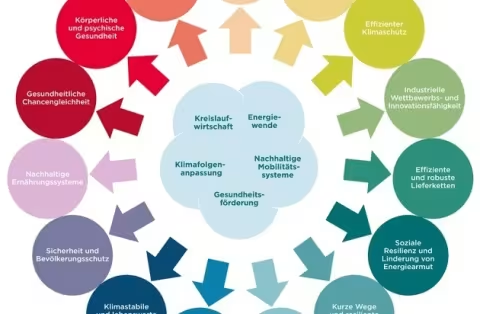
The paper covers five fields of action: energy transition, mobility, circular economy, climate adaptation and health. It names digitalization as an integrating factor that also strengthens Germany's innovation capacity. To accelerate delivery, the authors propose funding programs that remain reliable across several legislative terms and target integrated measures. They also recommend lump-sum investment budgets and simplified application procedures for municipalities.
Institute President Manfred Fischedick said the multiple-benefits focus does not weaken the urgency of climate and resource protection. He described it as a response to a debate increasingly dominated by short-term economic arguments.
The institute will discuss the topic on November 4 at the Scientific Wuppertal Sustainability Congress, co-organized with Sparkasse Wuppertal.