Frankfurt am Main – October 31, 2026 -- GrindingHub 2026 drew about 11,000 visitors and 462 exhibitors from 28 countries, with foreign participation above 50 percent, as grinding-technology suppliers pitched networked process chains to an industry facing falling output.
The show took place against declining production, weaker exports, rising energy and material costs and volatile sales markets. Exhibitors therefore stressed more productive and robust process chains over standalone machines. Sensors, measurement data and digital feedback are used for process monitoring and quality assurance. The 2024 edition already covered automation, digitalization, sustainability, coolant delivery and new grinding-tool concepts. In 2026 the emphasis moved to grinding as a connected process of machine, tool, sensors, metrology, data management, automation and service.
Wema Glauchau and GMN tie sensor and condition data to process control
Wema Glauchau showed the Wotan Dynamic Rest, a dynamic steady rest that actively compensates position deviations of long, compliant workpieces during machining. GMN presented Idea-4X, which makes spindle condition data usable for monitoring, service and process evaluation.
Artificial intelligence appeared mainly as an assistance and analysis tool. Examples included data-based machine and process diagnostics, automatic wear assessment, and systems supporting operation, maintenance and process planning. The source stresses that AI does not replace grinding process expertise. Its value lies in turning large data volumes from machine, tool, sensors and metrology into reliable process information.
Kellenberger splits its cylindrical grinding range between the K8 and the K10
Swiss manufacturer Kellenberger, based in Goldach, showed two machines for flexible production. The K8 is a standardized, cost-conscious CNC cylindrical grinder for entry-level use and small to medium series. It has a one-piece machine bed, friction-reducing coated V-flat guideways in the Z axis and high-resolution Fagor measuring systems. It has no loader interface.
The further-developed K10 targets greater flexibility. Its universal grinding head takes two external grinding wheels and a direct-driven high-frequency internal spindle with a maximum wheel speed of 60,000 min-1. It adds longer X and Z travel, an automatic B axis and a revised user interface. Structure-borne noise detection, semi-automatic balancing, quality measurement and grinding-time monitoring support guided operation, shorter setup times and process monitoring.
Emag targets humanoid robotics components with a process-chain approach
Emag, based in Salach, presented grinding as a precision step within a coordinated chain. Upstream manufacturing steps prepare parts so that only the necessary final stock removal remains for grinding. For high-precision functional components, the approach can reduce machining time, tool wear and process costs without compromising dimensional, form and surface quality.
Emag addressed the production of humanoid robotics components, such as gear, shaft, screw and actuator parts, where motion precision, noise behavior, load capacity and service life depend directly on manufacturing quality. Its machines for this field were the UG 400 for internal, external, non-round and face grinding in one clamping, the G 500 HL for profile and gear grinding, and the WPG 7 for automated external cylindrical grinding.
Emuge prints clamping sleeves via laser metal deposition for deformation-free workholding
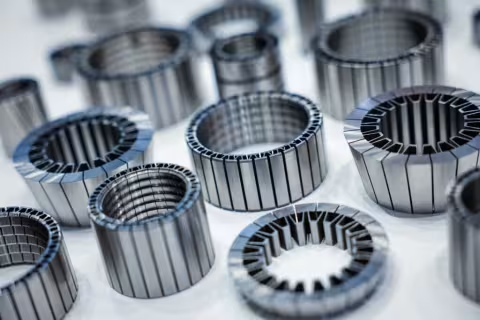
Emuge, based in Lauf an der Pegnitz, showed additively manufactured clamping sleeves for parts with varying geometries, hardness distortion or thin walls. The sleeves are made by laser metal deposition and include longitudinal meander-shaped clamping segments and honeycomb structures that conventional methods can realize only to a limited extent. FEM-supported design sets radial expansion for internal clamping or radial contraction for external clamping, which eliminates separate rubber elements. Grinding of the inner and outer surfaces creates the surface topography needed for precise clamping.