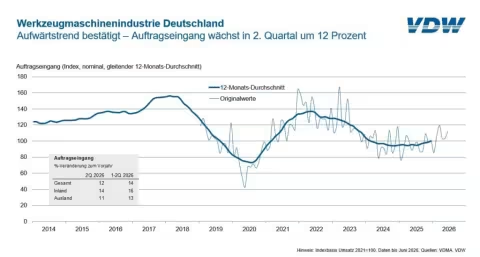
Frankfurt – October 31, 2026 -- Orders at German machine tool makers rose 12% year on year in the second quarter of 2026, following a 15% gain in the first quarter and bringing the first-half increase to 14%, according to the VDW (German Machine Tool Builders' Association). Domestic orders climbed 16% and foreign orders 13%.
Bernhard Geis, head of economics and statistics at the VDW, said the trough is behind the industry and the upward trend is consolidating. He cautioned against an all-clear, however. The recovery starts from a low base, and project business still contributes substantially to growth, so a broad-based demand recovery can only be claimed to a limited extent.
Aerospace and defense lift demand while automotive share falls to 23%
Demand varies sharply by customer industry. Aerospace and defense are the most dynamic segments, and the electronics and medical technology industries are also assessed positively. Metalworking and mechanical engineering remain difficult.
The automotive and supplier industry faces the biggest challenges. Its share of total German machine tool sales fell to 23% in 2025. Mechanical engineering remains the largest customer at 27%. The aerospace share rose five percentage points within two years to 11%.
Production falls 7% to about €5.9 billion in the first half
The order recovery has not yet reached factory floors. Second-quarter production was an estimated 6% below the prior-year level, and first-half output declined 7% to around €5.9 billion. The VDW expects the improved order situation to show up increasingly in production over the rest of the year.
US shipments rise 8% while exports to China drop 24%
Second-quarter exports were 4% below the prior year, a markedly smaller decline than in the first quarter. The US, the largest market, supported the sector with an 8% increase in first-half deliveries. Exports to China, the second-largest market, fell 24%, though companies report a stabilization and slight revival of Chinese demand. Amid intense price competition, the "Local for Local" principle is gaining importance for German manufacturers with local production.
German exports to Europe fell 6% in the first half. France grew 25% and moved up to third place among the most important markets. Poland and the Czech Republic also contributed positively. India continued to grow and is now the fourth-largest market.
Domestic sales fall 10% and consumption drops 6% despite higher orders
Domestic sales were 10% below the prior-year level in the first half. The ifo business climate and the purchasing managers' index point to improved sentiment in industry. Imports declined 2%, holding up better than domestic sales, with Japanese and South Korean manufacturers in particular increasing their sales in Germany. Total domestic consumption fell 6%, showing that weak investment in the German market has not been overcome.
Capacity utilization has stabilized at around 75%. In June, companies employed about 60,000 people, just over 6% fewer than a year earlier. Real production remains roughly one-third below the peak levels of earlier years.