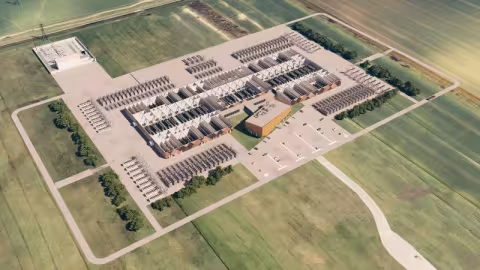
Berlin – October 31, 2026 -- Vertiv and NVIDIA modeled up to 30% more cumulative token output in the first 12 months at equal installed capacity. The gain comes from a combined design-and-deployment approach for AI factories, introduced at NVIDIA GTC Berlin. Polar Data Centers is applying the factory-built element to the first 41 MW phase of its multiphase AI data center at Herøya, Norway.
The pitch targets sequential engineering of power, cooling and facility systems, which Vertiv says creates complexity and potential delays. The new approach starts from pre-engineered reference architectures. These are configured to site requirements, virtually validated, then built as factory-made infrastructure.
Vertiv models a cut from 30 days to 3 days for design configuration and validation
The workflow combines the NVIDIA Vera Rubin DSX AI Factory reference design and the NVIDIA Omniverse DSX Blueprint with Vertiv SimReady power and cooling assets. It is integrated with Dassault Systèmes' 3DEXPERIENCE agentic platform. In the modeled scenario, the time from requirements to a validated AI factory solution falls from about 30 days to three, a 10x improvement.
Vertiv is also contributing SimReady OpenUSD assets of its power and cooling equipment to the SimReady Central Library on Hugging Face. Engineering teams can reuse the validated assets in AI factory digital twins.
Factory-built infrastructure halves modeled on-site deployment from 90 to 45 days
Vertiv's prefabricated solutions move more assembly, integration and testing off-site. They include Vertiv OneCore, a hybrid-built data center solution, and Vertiv SmartRun, a prefabricated overhead system for power distribution, liquid cooling, networking and containment. The modeled deployment period drops from roughly 90 days to 45, a reduction of up to 50%.
Combined, the two stages shrink from about 120 days to 48. That makes productive AI capacity available about 10 weeks sooner, according to the model.
Footnoted model counts 317 productive days against 245 in the first year
The 30% token-output claim rests on productive days in the 12 months after design kickoff: 317 versus 245 at equal installed capacity. The calculation compares a 3 + 45 day path with a 30 + 90 day conventional path. All three headline metrics are modeled, and Vertiv states that actual results will vary by project.
Polar Data Centers deploys Vertiv modules at 41 MW Herøya phase, scalable to 100 MW
Vertiv is supplying prefabricated power and thermal modules, SmartRun overhead infrastructure and Vertiv SmartMod to Polar. Vertiv Unify software supports the deployment. The Herøya campus is designed to scale to 100 MW and to deliver high-density, liquid-cooled capacity.
Polar CEO Andy Hayes said customers measure the company on how quickly capacity is ready. He described the model as a more disciplined, repeatable deployment approach that preserves customer flexibility.
Vertiv CEO Giordano Albertazzi framed the economics in output terms: "An AI factory earns its return in tokens." NVIDIA's Vladimir Troy, vice president of AI infrastructure, said the Omniverse DSX Blueprint lets partners such as Vertiv and Dassault Systèmes simulate systems together and resolve conflicts earlier.
Vertiv's Scott Armul presents the approach on Oct. 22 at booth #3055
Vertiv and NVIDIA will demonstrate how facility requirements inform infrastructure configuration, how power and cooling are virtually validated, and how factory-built infrastructure speeds physical deployment. Dassault Systèmes technology features in the demonstration. Chief Product and Technology Officer Scott Armul presents "Building the AI Factory: Converting Megawatts into Intelligence" on Oct. 22, 2026, from 4:00 to 4:15 p.m. CEST.