Quick summary: NRR remained flat for SaaS companies in recent years but mature AI teams are performing at a higher level. Here is what the 2026 Customer Success Leadership Study reveals about AI and NRR correlation, and how to develop your CS team’s AI maturity.
NRR has plateaued for SaaS organizations for the last three years, with reported numbers remaining flat from 2024 through 2026. But teams that are ahead on AI maturity tend to perform better. The majority of mature AI businesses report NRR of 100% or higher, while tactical AI teams are not as likely to perform at that level.
ChurnZero’s 2026 Customer Success Leadership Study polled nearly 600 CS and revenue leaders to learn about the current state of AI in SaaS. The numbers clearly show a correlation between mature AI and stronger NRR.
There are many possible explanations for why businesses with more developed, strategic AI tend to see higher NRR. But one thing is clear: developing AI for strategic customer success can enable your team to drive growth more efficiently.
NRR and AI maturity, by the numbers.
The study’s responses from CS and revenue leaders about AI maturity and NRR showed a clear trend:
- NRR has remained flat from 2024 to 2026
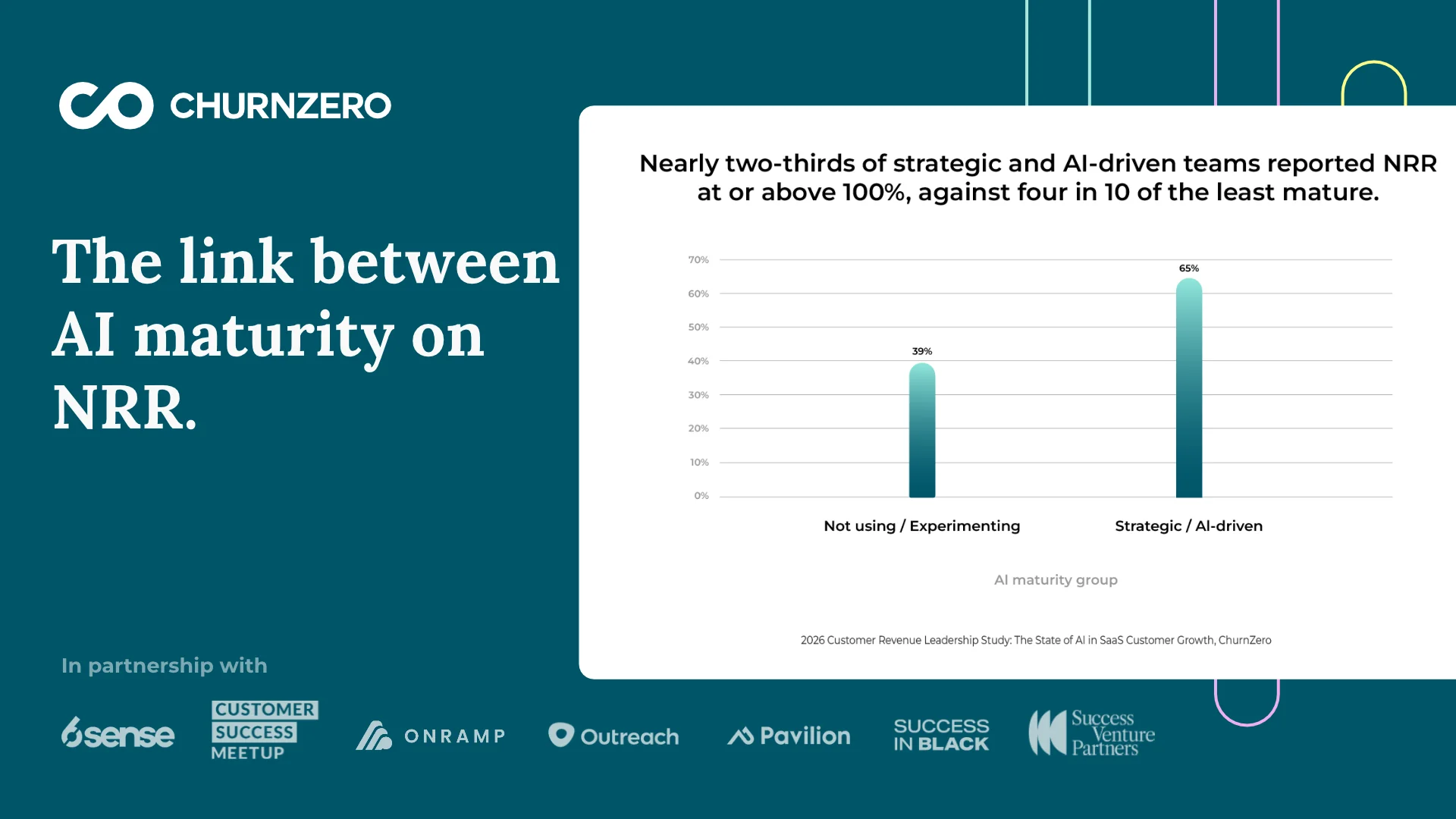
- ChurnZero compared how many teams report NRR of 100% or higher by AI maturity:
- Nearly two-thirds (65%) of strategic and AI-driven teams reported NRR of 100% or higher
- 39% of the least mature AI teams reported NRR of 100% or higher
This tells us that mature AI teams are much more likely to have a NRR of 100% or higher than teams that are further behind on AI use.
How to evolve your AI and enable customer success.
For CS teams, building more advanced AI usage can help CSMs drive growth and retention, the components of NRR. Here are some ways to grow your AI beyond tactical use and help your team mature strategically.
Redirect resources toward high-impact work.
For many teams, AI can take over tedious tasks like building presentations from scratch, writing emails from templates, and summarizing meeting notes. Now you can direct your CSMs toward more high-impact work that drives growth – checking in with customers, reviewing accounts for buying opportunities, or managing a larger book of business. Find out how much time your CSMs are saving with AI, and use that time wisely.
Train your CSMs for strategic work.
When you hand over administrative work to AI, CSMs can focus on more challenging, long-term value tasks: negotiating expansions, saving at-risk accounts, escalating issues, and growing the partnership between your business and the customer. Make sure to keep developing your team’s skills through training. For example, your CSMs should have the contextual understanding to identify customer pain points and the sales skills to promote renewals and expansions at the right time.
Let AI drive customer retention and growth.
If you’re already using AI to automate manual tasks, you can now look at ways it can help grow the business. For example, many CSPs now have signal detection AI agents that can evaluate customer data, flagging accounts you’re at risk of losing and identifying opportunities for expansion. CSMs can then direct more of their attention toward saving at-risk accounts and growing ones that are ready to buy.
Start measuring AI impact.
Even though most CS teams use AI, they often can’t measure its performance – according to the study, 63% of CS leaders have no consistent method to track AI impact. But if you don’t know how AI is affecting your team, you can’t strategically improve your processes and you may still rely on manual human interventions at every step (the study found that teams that don’t measure AI are four times more likely to require human approval for every recommendation).
List out the tasks you’re using AI to automate, and define the metric that determines success. Note how your team was performing before automation, then start tracking that metric and check in on a regular basis to see how your team is performing with AI. Now you have a framework to measure other AI workflows and automations as you go along. Eventually, you’ll be able to identify where it makes sense to invest more resources in AI automations.
Mature AI teams tend to see better NRR performance.
AI-leading organizations may have other factors driving better NRR performance, such as stronger data, advanced products and services, or better-funded CS teams with more resources. But the correlation is clear: while NRR has stayed flat across the industry, AI leaders are more likely to report NRR of 100% or higher.
To start closing that gap, reallocate the time that AI saves your CSMs toward work that drives retention and expansion. Let AI flag risks and buying signals, while training your team for strategic customer-facing work and measuring results so you can show the impact.