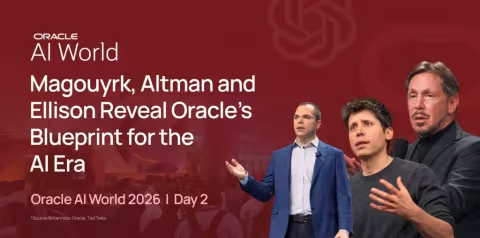
Las Vegas – October 29, 2026 -- More than 70% of Oracle's code is now written by AI, CEO Clay Magouyrk told attendees on Day 2 of Oracle AI World 2026, as the company paired the disclosure with security, chip and application announcements.
Oracle cuts support resolution from 3.5 hours to 16 minutes
Magouyrk presented internal results before announcing any product. Support requests that once took 3.5 hours now resolve in 16 minutes. Product ideas that previously took nine months to reach customers now take six weeks. Vulnerabilities are found and fixed ten times faster than six months ago.
Oracle launches AI Security Mesh and agent identities
Rob Clark, Oracle's SVP of security architecture, said AI-written code once pushed a malicious package toward production before safeguards caught it. Oracle responded with an autonomous loop that hunts for vulnerabilities around the clock and repairs them, sometimes with zero customer disruption. Oracle AI Security Mesh, built with OpenAI, packages that capability for customers.
Oracle Identity and Access Management adds biometric verification to confirm a real person stands behind critical approvals. It also adds dedicated identities for each AI agent.
OpenAI CEO Sam Altman advised companies starting their AI journey to put security ahead of productivity. Magouyrk added that AI is exposing decades of existing human errors rather than creating new weaknesses.
OCI adds Google TPU v8 alongside Nvidia, AMD and OpenAI silicon
Oracle is opening OCI to several chip families:
- Nvidia Vera Rubin systems are now shipping.
- Google TPU v8 chips are coming to OCI, placing Google's proprietary silicon in a rival's cloud.
- AMD MI455 rack-scale systems are joining Oracle's data centers.
- OpenAI Jalapeño, an inference processor co-designed with Broadcom, joins the lineup.
Pradeep Vincent, EVP of compute, said a single one-second stall in a 100,000-GPU cluster wastes roughly 28 GPU-hours. Oracle's Acceleron network therefore builds redundancy into every pathway. He also described batteries and supercapacitors that shield the electrical grid from sudden AI training surges.
Media Fabric enters limited availability ahead of early 2027 launch
Oracle's Media Fabric suite is already with key customers, with broader availability planned for early 2027. It combines four components: AI media models that generate images and video from trusted data, Creative Studio for AI-based production, Video Edge for uninterrupted live streams when bandwidth tightens, and Adaptive Media Platform, which tailors one broadcast to millions of individual viewers.
Oracle adds governed app-building tools for non-programmers
Oracle App Composer deploys employee-built apps under IT-approved security profiles. APEX Lang lets AI agents build on a foundation that enforces data rules automatically. Oracle AI Workspace, built with OpenAI, connects Oracle applications with Slack and Microsoft 365 through one conversational interface. AI ontologies in the AI Data Platform supply agents with business context.
Ellison pitches AI-built industry software, starting with healthcare
Larry Ellison rejected the so-called SaaS apocalypse, the idea that companies will drop packaged software and build everything themselves. He argued AI lets vendors finish applications for entire industries, removing decades of customization patchwork. Oracle chose healthcare first because of its complexity.
Oracle Health replaces menus with plain conversation. Its plug-in modules run beside existing hospital systems such as Epic without data migration. Insurance approvals collapse into a single exchange, and clinical trials open to patients beyond elite research hospitals.
Ellison also predicted that the majority of cancers could vanish within five to ten years, and named government, which he called dangerously underserved, as Oracle's next target sector.