General consumer scam victims report thoughts of suicide at more than triple the rate of traditional identity theft victims (80.5% vs. 24.5%).
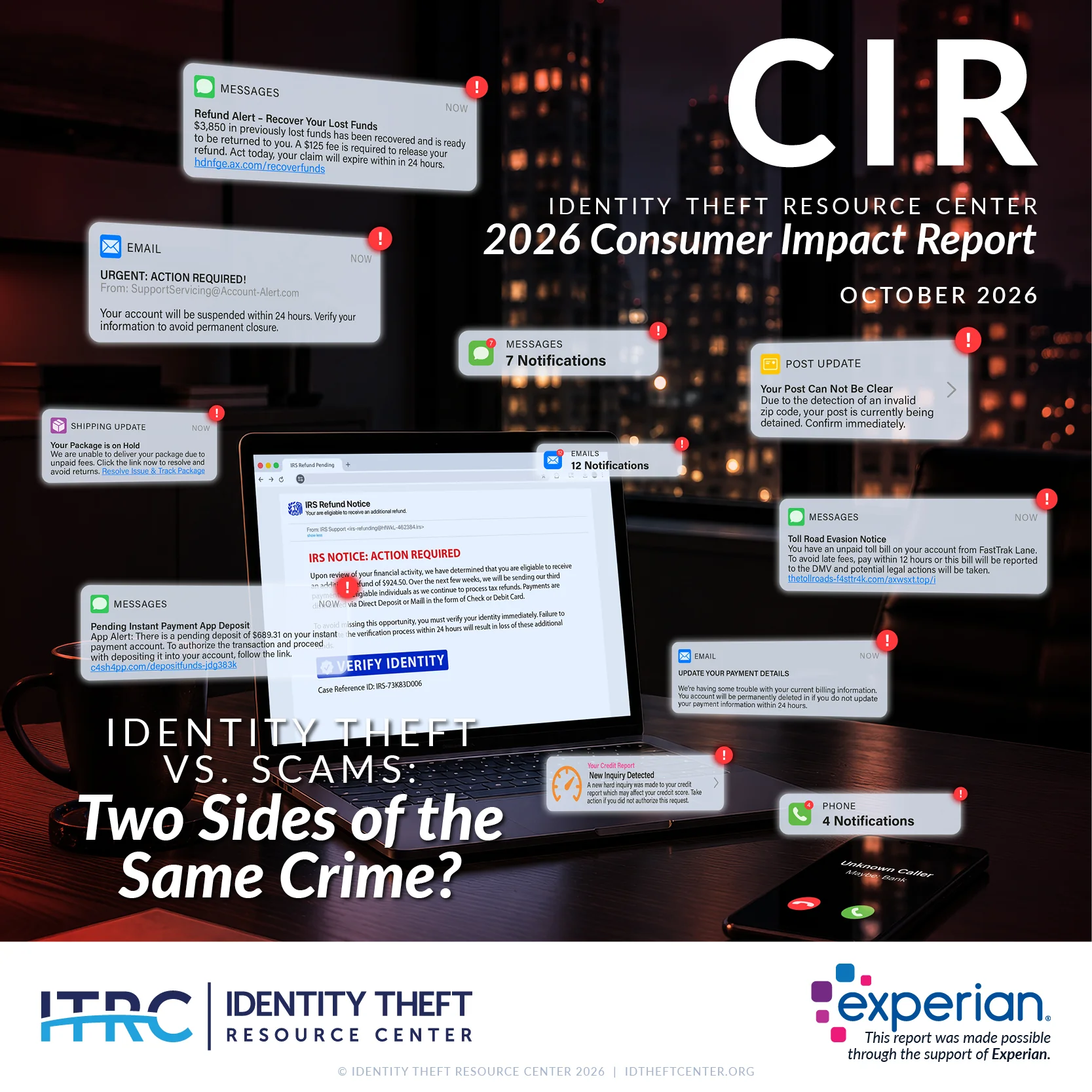
SAN DIEGO, Oct. 28, 2026 /PRNewswire/ -- Scams are having a major impact on people's lives in the United States, triggering acute emotional crises, life-changing financial losses and secondary revictimization, according to findings from the Identity Theft Resource Center's® 2026 Consumer Impact Report, released today and supported by Experian. The report goes beyond the basic financial implications of identity crimes and explores the lost opportunities as well as the emotional and physical impacts experienced by victims resulting from the crimes.
For the 2026 Consumer Impact Report, the ITRC, a nationally recognized nonprofit organization established to prevent and reduce the impact of identity theft, scams and fraud, surveyed 197 victims who contacted the ITRC and 1,111 general consumers (including 798 self-reported identity theft, fraud and scam victims). The findings reveal that scams function as an acute trauma characterized by manipulation and internalized guilt, while traditional identity theft operates as a chronic burden defined by institutional red tape, externalized anger and prolonged remediation timelines.
Download the ITRC 2026 Consumer Impact Report
Across 14 core financial, physical and emotional impact indicators, general consumer scam victims experienced an average adverse impact rate of 33.7%, compared to 17.3% among traditional identity theft victims. The mental health toll is especially stark: 80.5% of general consumer scam victims reported experiencing suicidal ideation following the crime, compared to 24.5% of traditional identity theft victims. In contrast, suicidal ideation dropped to 15.1% among scam victims who sought free assistance from the ITRC, demonstrating that specialized intervention alters outcomes. (If you or someone you know is experiencing overwhelming emotional distress or thoughts of suicide, call or text the Suicide and Crisis Lifeline at 988.)
"This year's survey makes it clear that scam victimization and traditional identity crimes are not two versions of the same injury," said Eva Velasquez, CEO of the ITRC. "Scams act as an acute trauma, while traditional identity theft acts as a chronic burden. Support for victims is as crucial now as it has ever been. Behind these numbers are real people enduring devastating trauma and shame. Lawmakers, companies and technology leaders cannot treat this as business as usual. We must replace institutional indifference with compassion, urgent action and a unified defense that meets this crisis head-on. And when prevention fails, recovery services must be available to victims."
"This report is a powerful reminder that identity theft and scams can erode trust and leave lasting emotional consequences that extend beyond financial loss," said Kathleen Peters, Chief Innovation Officer, Identity and Fraud at Experian. "Protecting consumers requires collaboration across the ecosystem and a shared commitment to helping victims recover from fraud with confidence."
Other key findings from the ITRC 2026 Consumer Impact Report include:
- Acute Shame vs. Externalized Anger: Since scammers weaponize social engineering, 87% of general consumer scam victims agreed the crime was partly their own fault. Self-blame remained high even among ITRC scam victims at 42.4%, compared to just 15.8% of traditional identity theft victims. Conversely, traditional identity theft was associated with higher rates of externalized anger among both general consumers (50.3% vs. 26.7%) and ITRC victims (76% vs. 65.6%).
- The "Revictimization Spiral" and the Power of Intervention: Nearly 9 in 10 (87.9%) general consumer scam victims asked an organization for help and never received a response, and 67.2% felt blamed by institutions they contacted. Without guidance, 78.9% were targeted again by secondary "recovery scammers" charging upfront fees to recover lost funds. In contrast, 52.8% of ITRC victims were ignored by organizations, and just 6.5% of ITRC scam victims paid a secondary recovery scammer.
- Catastrophic Financial Fallout for Working-Age Professionals: Countering assumptions that fraud primarily strikes older adults, 86.2% of general consumer scam victims â and 92.9% of those experiencing suicidal ideation â were working-age adults between 30 and 60. Furthermore, 77.9% lived in households earning $100,000 or more annually, with 29.5% losing $100,000 or more that was never recovered.
- Traditional Identity Crime Injures Through Duration: While scams hit fast, traditional identity theft grinds victims down over time. Among ITRC victims, nearly two-thirds (64%) of traditional identity crime victims spent more than 40 hours attempting to resolve the crime, compared to 47.3% of scam victims. More than 62% (62.7%) of traditional identity crime cases remained unresolved at the time of the survey, compared to 45.2% of scam cases.
- Severe Career and Workplace Disruption: The fallout extends directly into victims' livelihoods, with general consumer scam victims losing their jobs as a direct consequence of the crime at nearly four times the rate of traditional identity theft victims (12.3% vs. 3.1%). Furthermore, more than one in five (20.8%) general consumer scam victims lost out on a job or promotion (compared to 4.3% of traditional identity theft victims), and 29.9% experienced strained relationships with supervisors. Among ITRC victims, job losses hit both groups hard, with 10.9% of scam victims and 12.5% of traditional identity crime victims reporting job loss.
Consumers and victims of identity theft, fraud and scams can receive free support and guidance from a knowledgeable ITRC advisor by calling or texting 888.400.5530 or visiting idtheftcenter.org to live chat.
About the ITRC 2026 Consumer Impact Report
In August and September 2026, the ITRC surveyed two distinct cohorts regarding their experiences with attempted and successful identity theft, scams and fraud:
- ITRC Victim Cohort (N = 197): A random sample of identity crime victims who contacted the ITRC for assistance during the previous 12 months (55.6% scam victims; 27.8% non-scam traditional identity crime victims; 16.7% unsure).
- General Consumer Cohort (N = 1,111): A sample of U.S. adults who may or may not have been victims of identity theft, scams or fraud. Overall, 71.8% (798) reported experiencing an identity crime or scam in their lifetime (45.7% within the past 12 months; 26.1% more than 12 months ago), and 77.0% (578 of 751) of impacted respondents identified as scam victims.
Both groups completed a similar, though not identical, online survey. Approximately half of the survey questions align directly with previous annual questionnaires to preserve multi-year trendlines, while the remaining half ask deeper, targeted questions about identity-related scams.
About the Identity Theft Resource Center
Founded in 1999, the Identity Theft Resource Center®â¯is aâ¯nationalâ¯nonprofit organization established to prevent and reduce the impact of identity theft, scams and fraud. Through public and private support, the ITRC provides no-cost victim assistance and consumer education throughâ¯its websiteâ¯live chat,â¯idtheftcenter.org, andâ¯toll-free phone numberâ¯888.400.5530.â¯The ITRC alsoâ¯equipsâ¯consumers and businessesâ¯withâ¯information about recent data breaches through itsâ¯data breach tracking tool, Breach Alert.â¯The ITRC offers help to specificâ¯populations, includingâ¯theâ¯deaf/hearing impaired andâ¯blind/vision impairedâ¯communities.â¯
About Experian
Experian is a global data and technology company, powering opportunities for people and businesses around the world. We help to redefine lending practices, uncover and prevent fraud, simplify healthcare, deliver digital marketing solutions and gain deeper insights into the automotive market, all using our unique combination of data, analytics and software. We also assist millions of people to realize their financial goals and help them to save time and money.
We operate across a range of markets, from financial services to healthcare, automotive, agrifinance, insurance and many more industry segments.
We invest in talented people and new advanced technologies to unlock the power of data and to innovate. A FTSE 100 Index company listed on the London Stock Exchange (EXPN), we have a team of 25,200 people across 33 countries. Our corporate headquarters are in Dublin, Ireland. Learn more at experianplc.com.
SOURCE Identity Theft Resource Center
Share this article