Industrial AI is the use of artificial intelligence to support decisions and work in physical operations, such as manufacturing plants, energy facilities, warehouses, and infrastructure. It applies familiar AI methods, including machine learning, computer vision, and generative AI, to industrial data and workflows.
For an Industrial Digitalization Manager, the practical question is not whether a plant needs “AI.” It is whether a specific operational decision could be made faster, more consistently, or with better evidence. That might mean investigating abnormal equipment behavior, finding the right maintenance procedure, or monitoring a process for an emerging deviation.
Industrial AI, defined
Industrial AI applies AI technologies to real-world industrial operations and physical infrastructure. It can work with data from equipment, sensors, control systems, operational records, engineering documents, and other sources that describe how a site runs.
The goal is not necessarily autonomous control. Many useful applications help people investigate, compare, predict, summarize, or prioritize. A maintenance engineer may still make the final call. An operator may still follow an approved procedure. AI can support that work when it has relevant data, context, and clear limits.
What makes an AI application industrial?
An AI application becomes industrial because of the work it supports, not because it uses a unique category of algorithms. Its inputs and decisions relate to physical assets and processes: pumps, compressors, production lines, energy systems, material flows, or quality conditions.
That context matters. A temperature value needs an asset, unit, operating state, expected range, and related conditions before it can support a useful answer.
How Industrial AI differs from general enterprise AI
Enterprise AI often helps with digital business workflows, such as drafting documents, summarizing meetings, or answering questions about policies. Industrial AI can use similar language models and analytics techniques, but it is applied to operations where a decision may affect equipment condition, production quality, energy use, safety, or maintenance planning.
Not every Industrial AI application needs millisecond responses or direct access to a control system. But data can be noisy or incomplete, operating modes can change, and a useful conclusion may depend on engineering records or an experienced technician’s judgment. An AI-generated suggestion is not a substitute for site procedures or engineering review.
How Industrial AI works
Industrial AI usually combines three layers of work: data, context, and analysis.
Industrial data: signals, events, and operational records
The data layer may include time-series measurements, alarms, production records, inspection results, maintenance history, and engineering documents. Different sources often use different names, formats, and update rates. Collecting data does not automatically make it understandable.
Context: assets, relationships, and operating meaning
Context connects a data point to the industrial world. It can describe an asset hierarchy, the relationship between upstream and downstream equipment, the unit and expected range of a measurement, or the documents associated with a piece of equipment.
Context also includes operational knowledge, such as an earlier fault report, the checks performed, and its constraints. This helps an investigation move beyond finding a similar number or document title.
Analysis and human-reviewed action
With data and context in place, AI can support anomaly detection, forecasting, natural-language questions, document-based knowledge retrieval, or investigation. In many cases, the output is a recommendation for an engineer or operator to review, not an automatic command to equipment.
Three practical Industrial AI examples
Investigating an abnormal pump condition
A centrifugal pump shows unusual vibration. An investigation may compare its vibration and process signals with recent operating conditions, alarms, maintenance history, and relationships to related equipment. AI can help bring those sources together or highlight patterns worth checking. A reliability engineer reviews the evidence and decides whether maintenance work is needed.
Finding relevant maintenance knowledge
An engineer needs the approved procedure for an alarm code on a specific asset. Instead of relying only on keyword search, an AI-assisted workflow can use document content and equipment context to surface relevant manuals, troubleshooting records, and related knowledge. The engineer still verifies that the source applies to the current equipment and operating condition.
Monitoring a process for an emerging deviation
A team monitors a process variable against its normal operating pattern. A model may identify a deviation or forecast a future trend, giving the team a reason to inspect the process earlier. The finding should be evaluated with operating context, rather than treated as proof of a root cause.
What to establish before starting an Industrial AI project
Start with one operational decision, not a broad mandate to “use AI.” Define the user, evidence needed, and safe next step.
Then check four basics:
- Data: Is the relevant data available, timely enough for the task, and understood?
- Context: Can the team identify the asset, operating state, relationships, units, and related records behind the data?
- Governance: Who can access the information, and what sources should be treated as authoritative?
- Review: Who validates a finding, and which actions remain subject to normal engineering or operating procedures?
They help prevent a pilot from becoming an interface over incomplete or ambiguous information.
Where TDengine fits in an Industrial AI data foundation
TDengine’s Industrial AI platform brings together industrial data handling, analytics, modeling, visualization, and AI-oriented capabilities. Its Industrial AI page describes functions for asking questions about data, generating dashboards and analyses, detecting anomalies and forecasting behavior, and investigating events.
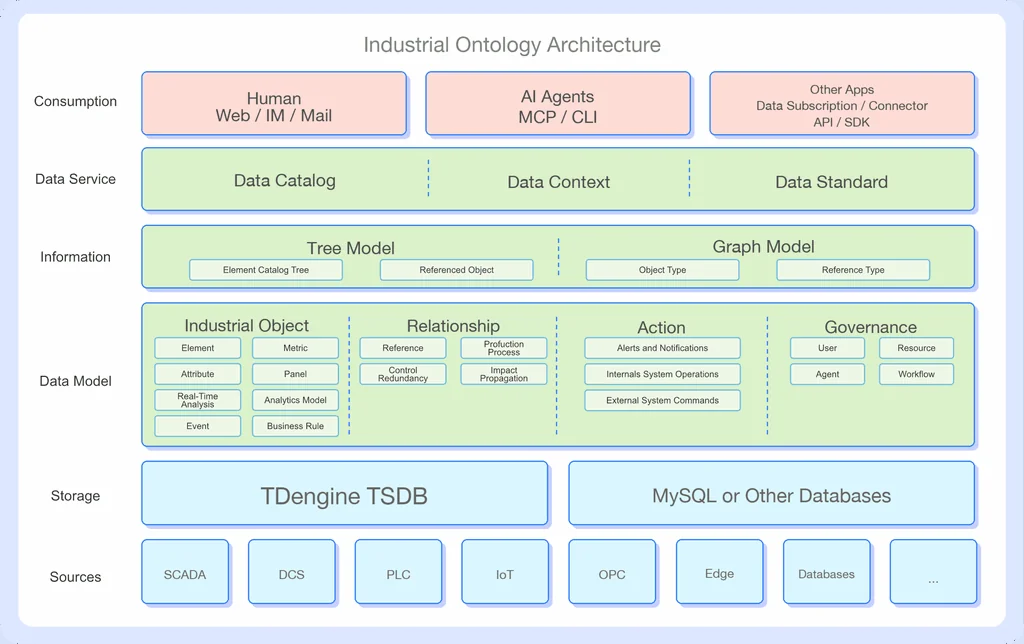
For operational context, TDengine’s Industrial Ontology is documented as a semantic layer for physical industrial assets, their data, and their relationships. It is different from TDengine IDMP’s Knowledge Graph, which organizes document-derived entities and relationships into a knowledge network.
Together, these documented capabilities can support workflows that connect time-series data, asset context, and documented knowledge. The design still depends on the decision, information quality, and review process.
Frequently asked questions about Industrial AI
Is Industrial AI the same as predictive maintenance?
No. Predictive maintenance is one possible use case. Industrial AI can also support process monitoring, quality investigation, engineering knowledge retrieval, operational reporting, and other tasks involving industrial data and context.
Does Industrial AI replace operators and engineers?
Not necessarily. Many Industrial AI applications are designed to support people by assembling evidence, identifying patterns, or making knowledge easier to find. Accountability for operational decisions remains with the people and procedures responsible for the work.
What data does Industrial AI need?
The answer depends on the use case. Start with data required for the decision, plus asset identity, units, operating condition, relationships, events, and supporting records. More data is not automatically better if its meaning and quality are unclear.