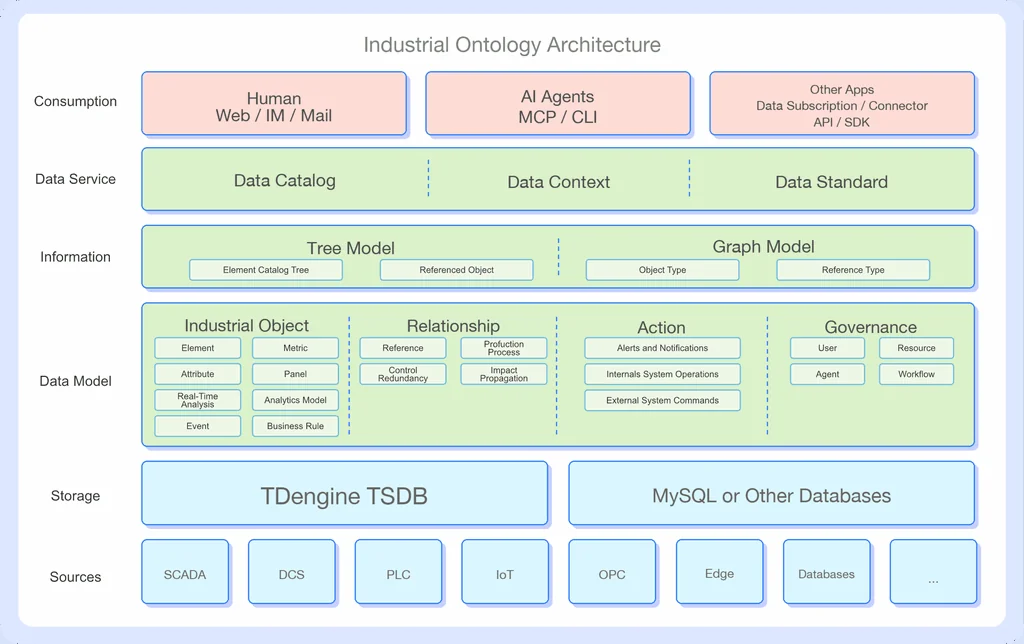
An industrial data platform for AI should help a team assemble reliable, interpretable evidence for a defined operational decision. It is not simply a database, a historian replacement, or an AI application. When PLC, historian, IoT, and operational data live in different systems, the selection question is whether the platform can make the right data usable in the plant’s actual technical and operating environment.
Start with one decision. For example: should a reliability engineer review a compressed-air pressure drop within an hour, and which evidence is needed? That answer sets the required sources, history, context, access controls, and response time. It is a more useful starting point than a generic list of AI features.
Start with the operational decision, not the platform label
Map the evidence needed for the decision before evaluating products. PLCs may hold current control values and equipment states. A historian may hold years of pressure, flow, and power trends. IoT sensors can add vibration or environmental measurements. Maintenance and production systems may hold work records, equipment identity, or operating context.
These sources do not need to be replaced to support one AI-related use case. The key question is whether the required evidence can be found, understood, governed, and accessed together at the necessary time scale. A platform that connects many sources but cannot preserve meaning or make historical data usable may still create a difficult analytics project.
What an industrial data platform for AI needs to handle
Connect sources while preserving time and history
Ask which sources are relevant, how new data is brought in, and how historical records can be accessed. Preserve timestamps, source identity, engineering units, and the difference between a live state and a historical event. These details affect whether an engineer can compare a recent pressure drop with earlier operating periods.
Do not assume that a platform must replace an existing historian. A practical evaluation should establish how it can work with the systems that already hold trusted operational history and whether the required data can be accessed without creating unmanaged copies.
Add asset context and make governance reviewable
A pressure value is more useful when it is connected to the compressor, header, line, unit, and operating mode it describes. Industrial data contextualization is the work of attaching that meaning, including relationships and semantics, to raw records. Without it, each analytics or AI effort may have to recreate the same tag mappings.
During selection, ask how asset identity, units, limits, source definitions, quality flags, lineage, and permissions are maintained and reviewed. Industrial Ontology is one example of a semantic approach to organizing assets, data, and relationships. The right approach depends on who will maintain it and how it fits existing engineering practice.
Support analytics and external AI workflows
The platform should make approved data accessible for the analysis or external AI workflow the team actually plans to use. This does not require a claim that the platform trains or deploys a model. It means checking how authorized users or downstream tools can retrieve the necessary time-series history and context, and whether data definitions and transformations remain traceable.
The detailed preparation of historian data, including labels and validation, is a separate task. See How to Prepare Historian Data for Industrial AI Models for that workflow rather than treating platform selection as model development.
Validate performance, reliability, and recovery behavior
Expected workload is an evaluation input, not a marketing claim. Before a decision, define the anticipated number of sources, sampling rates, retention period, concurrent users, and historical query patterns. Then validate whether the proposed design meets the response time needed for the pilot’s real question.
Also ask how the platform behaves during network interruptions, service failures, restore operations, and planned maintenance. Clarify ownership for monitoring, backups, recovery tests, and confirmation that restored data and services are usable. Recovery behavior matters because a platform that cannot be operated and restored predictably may not be a reliable foundation for operational analysis.
Include implementation effort and total cost of ownership
Selection should account for more than license price. Compare the initial work to connect and map the required sources, infrastructure and deployment needs, ongoing maintenance, support responsibilities, and compatibility with the existing historian. A smaller first use case can expose these costs and responsibilities before the organization standardizes on a wider architecture.
Practical scenario: a compressed-air line pilot
Suppose a plant wants to investigate periods when header pressure falls while compressor energy use rises. The pilot needs PLC compressor state and control values, historian pressure, flow, and power trends, IoT vibration readings, and maintenance records.
The pilot should answer whether the team can investigate this bounded question more consistently. It should not be framed as proof of automatic root-cause analysis, fault prediction, or energy savings.
Where TDengine fits in the evaluation
TDengine Industrial AI describes a data foundation that combines industrial data, context, knowledge, and AI-oriented capabilities. TDengine IDMP documentation describes data ingestion from documented industrial and IT sources, an asset model, data contextualization, analytics, and connections to time-series or relational databases. These capabilities can be evaluated against the compressed-air pilot’s requirements.
The fit still needs to be checked at implementation level: the exact source protocol, deployment model, security boundary, data-access method, expected workload, recovery process, and operational owner. This article does not claim that TDengine replaces every historian or provides an external model-training or model-deployment workflow.
Frequently asked questions
Does an AI project require replacing the existing historian?
No. Start by identifying the evidence and access needed for the use case. The evaluation can then determine whether the existing historian should remain a source, integrate with another platform, or require a separate change.
Is a platform with more connectors automatically more AI-ready?
No. Connectivity matters, but so do historical access, context, quality, governance, performance, reliability, and the ability to support the intended workflow.
What should a first evaluation prove?
It should prove that a bounded team can access trustworthy, contextualized data for one real operational decision under the required workload, security, and operating conditions.