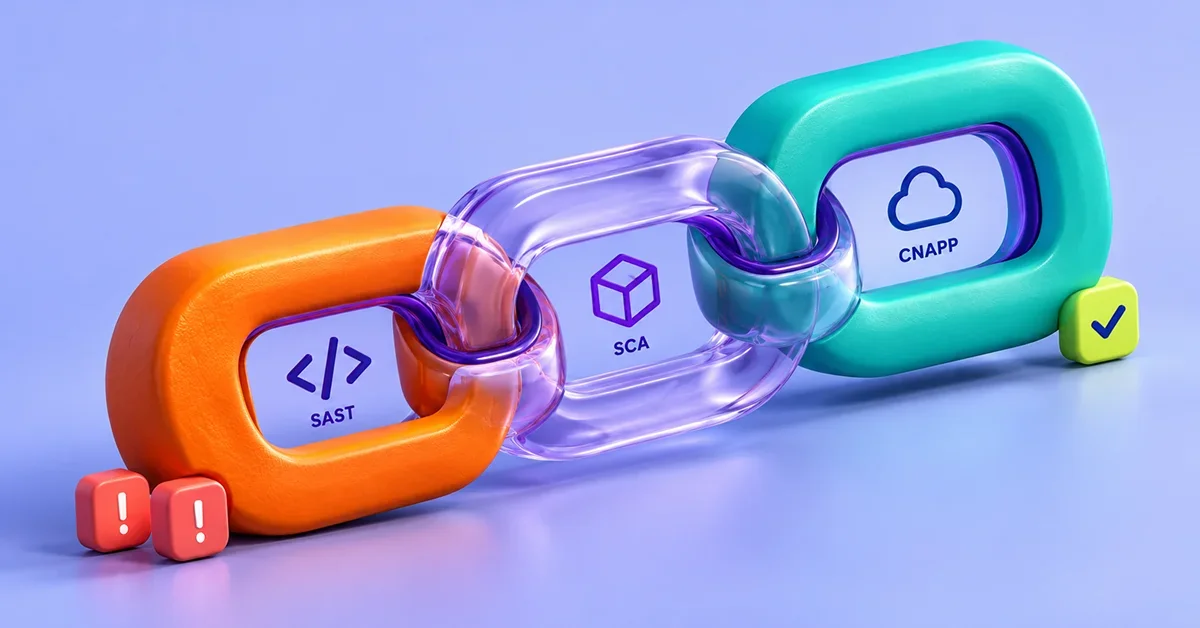
TL;DR
- Security tool sprawl is the build-up of overlapping security tools that report the same risks separately and leave gaps between them.
- Consolidating static application security testing (SAST), software composition analysis (SCA), and cloud-native application protection platforms (CNAPPs) means mapping what each tool covers, unifying findings in one shared context from code to runtime, and retiring a tool only once its coverage is proven elsewhere.
- Sprawl costs application security (AppSec) programs in three ways: duplicate alerts for the same issue, coverage gaps at the seams between tools, and context lost between code and cloud.
- SAST, SCA, and CNAPP overlap where the pipeline meets the cloud, through infrastructure-as-code (IaC) and container image scanning, and stay distinct at the layer each one reads.
- The number of AppSec tools an enterprise needs is set by coverage layers, not a headcount: one source of findings per layer, and one place where those findings correlate.
- A phased plan of inventory, map, unify, and retire consolidates without losing coverage, provided a parallel run proves parity before any tool is switched off.
- Consolidating to cut license spend, or onto a loosely coupled portfolio of acquired products, trades one sprawl problem for another.
What Is Security Tool Sprawl?
Security tool sprawl is the accumulation of security tools bought to fill one gap at a time, each with its own console, policy set, and finding format, until their coverage overlaps in some places and leaves gaps in others. The result is more findings, more consoles, and less certainty about what is actually covered.
In application security (AppSec), the pattern is familiar. Static application security testing (SAST) covers first-party code, software composition analysis (SCA) covers open-source dependencies, and a cloud-native application protection platform (CNAPP) covers cloud posture and running workloads. Secrets detection, infrastructure-as-code (IaC) scanning, container scanning, and API discovery tools sit beside them, often owned by different teams. Each new category adds another tool unless an existing platform absorbs it. AI security posture management (AI-SPM) is the latest example, and it poses the same choice between one more point tool and a move to an AI-native platform.
What Does Tool Sprawl Cost an AppSec Program?
Most security leaders already suspect they have too many tools. In 2025 research by Barracuda and Vanson Bourne covering 2,000 senior security decision-makers, 65% said they have too many security tools or vendors, and 53% said their tools can’t be integrated. Those figures cover security tooling as a whole. For AppSec teams, the cost of sprawl shows up in three specific places.
#1. Alert Duplication
One vulnerable open-source package can surface three times: as an SCA finding in the repository, as a container image finding in the registry, and as a runtime finding in the CNAPP. Each arrives with its own severity score, its own owner, and its own ticket. Triage time goes to reconciling the same issue three times over, and fixes stall while teams work out whether three tickets describe one problem or three.
#2. Coverage Gaps
Tool scopes are drawn by vendors, not by risk. IaC templates can fall between a code scanner that ignores them and a CNAPP configured only for live cloud accounts. Secrets may be left to developer-side tooling that security never sees, and APIs may go uninventoried because no tool owns them. Every tool reports clean on its own scope, and nothing reports on the seams.
#3. Context Loss
Each tool sees one layer. A cloud finding without its source code can’t be routed to the developer who owns the fix, and a code finding without runtime context can’t be ranked by whether the code is deployed, exposed, or reachable. Cloud findings that lack source-code context get patched in place or parked, while code findings are prioritized on severity alone. Both teams end up working from partial evidence.
Where SAST, SCA and CNAPP Overlap, and Where They Don’t
SAST, SCA, and CNAPP overlap where the pipeline meets the cloud, and stay distinct at the layer each one reads. SAST alone reads first-party logic, SCA alone tracks dependency versions and licenses, and a CNAPP alone sees what is deployed and running.
What Each Category Covers
The Open Worldwide Application Security Project (OWASP) describes SAST as source code analysis that finds security flaws in source or compiled code, and notes that it is frequently unable to find configuration issues because they are not represented in the code. OWASP defines SCA as the process of automating application security for third-party and open-source components, including their licensing. For CNAPPs, Gartner’s mandatory features include auditing cloud configuration and identity permissions, visibility into the runtime state of workloads, and, at a minimum, IaC scanning and container registry scanning.
That last requirement is where a CNAPP reaches back into the pipeline that code security tools already cover. Dynamic and interactive application security testing (DAST and IAST) sit beside SAST as separate testing methods with their own coverage.
Vendors Are Converging From Both Sides
Category lines are blurring from both directions. CNAPP vendors now sell SAST, AppSec vendors partner with CNAPP vendors to bring runtime context into their findings, and vendors that began in open-source dependency scanning now sell SAST alongside SCA. Category labels no longer predict which tool covers what, which makes overlap harder to see from a procurement list.
One CVE, Four Detection Points
OX’s writeup of NGINX Rift (CVE-2026-42945), an NGINX vulnerability disclosed in May 2026, shows what useful overlap looks like. OX describes finding the same vulnerability at four points between the prompt and runtime:
- At the Prompt: OX VibeSec stops an AI coding assistant from suggesting or installing vulnerable NGINX versions before the code is written.
- In the Repository: OX Code finds vulnerable NGINX versions pinned in Dockerfiles, Helm charts, Terraform modules, Kubernetes manifests, and other IaC, including in container layers.
- In the Running Environment: OX Cloud inventories cloud workloads, fingerprints the NGINX version on each, and confirms which vulnerable instances are loaded and exposed to the internet.
- Through Exploitation: OX Agentic Pentester runs a specific attack sequence against the exposed instance to produce a reproducible proof of exploit.
Overlap across lifecycle stages is useful coverage when the four detections resolve to one issue with one owner. It becomes noise when four tools file four tickets.
How Many AppSec Tools Does an Enterprise Actually Need?
There is no correct number of tools. The count that matters is one source of findings for each coverage layer, and one place where those findings correlate.
NIST’s Secure Software Development Framework (SSDF), SP 800-218, is a practical way to define those layers, because it names practices rather than products:
- PW.4, Reuse Existing, Well-Secured Software When Feasible Instead of Duplicating Functionality: Includes verifying that acquired third-party and open-source components meet security requirements, the work SCA serves.
- PW.7, Review and/or Analyze Human-Readable Code to Identify Vulnerabilities and Verify Compliance with Security Requirements: The work SAST serves.
- PW.8, Test Executable Code to Identify Vulnerabilities and Verify Compliance with Security Requirements: The work dynamic testing serves.
- RV.1, Identify and Confirm Vulnerabilities on an Ongoing Basis: Depends on findings from every layer once software is released.
The SSDF names tools only as examples, so it describes what must be covered rather than what must be bought. It also stops at development: cloud posture and runtime sit outside its scope, and that is the CNAPP’s layer (for how the framework applies in practice, see what the SSDF asks of AppSec teams). An enterprise therefore needs coverage for first-party code, dependencies, executable testing, cloud posture, and runtime, plus one place where findings from all of them correlate. Whether that takes five tools or one platform depends on whether those findings share context.
How to Reduce Application Security Tool Sprawl: A Phased Consolidation Plan
Consolidation works best as four phases run in order, with coverage verified before anything is switched off. The pressure behind it is broad: in Cisco’s 2025 Cybersecurity Readiness Index, a double-blind survey of 8,000 security and business leaders in 30 markets, more than 77% of organizations reported complex security infrastructures, dominated by more than ten point solutions, that impede their ability to respond to threats. Because tools are retired against their contract renewal dates, expect the work to span several renewal cycles rather than a single quarter.
Inventory
Start with a complete list of every security tool in use: who owns it, when its contract renews, which repositories, pipelines, and cloud accounts it covers, and who acts on its findings. Include the shadow tools bought by individual teams, since they often cover ground the central program assumes is uncovered, or duplicate what it already runs.
Map
Plot each tool against the coverage layers above and mark three things: layers covered twice, layers covered by nothing, and findings that duplicate across tools. The map sets the order of everything that follows. Gaps are closed first, and duplicated layers become the candidates for retirement.
Unify
Bring findings from the remaining tools into one platform that correlates them across code, pipeline, cloud, and runtime, so that a single issue carries its source, its deployment, and its reachability.