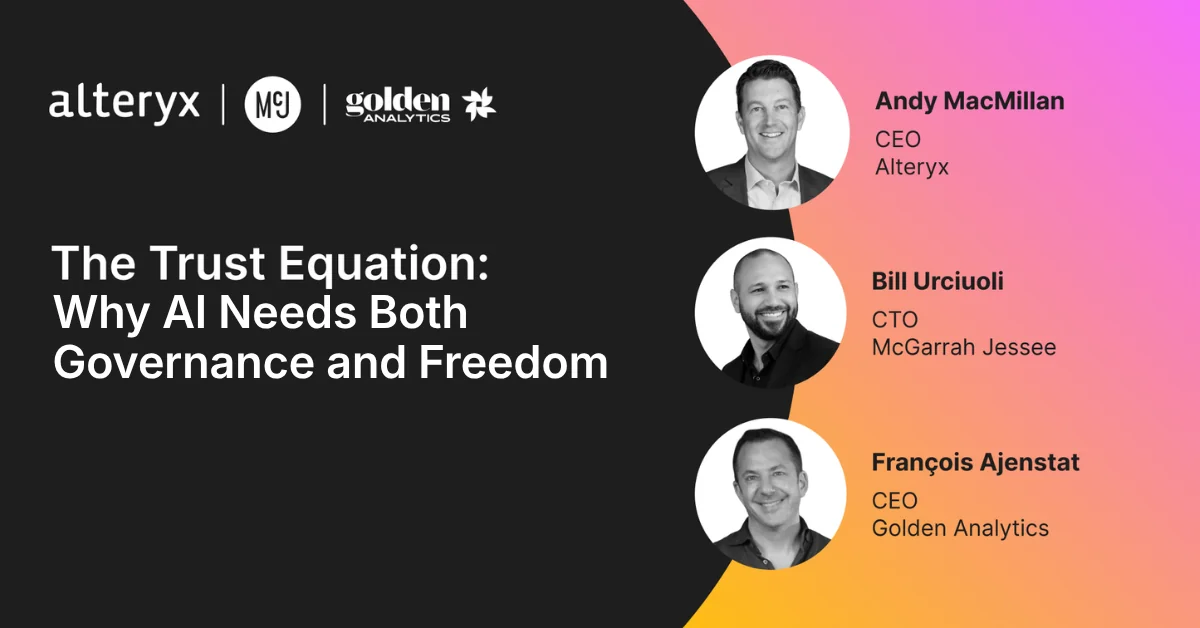
An Executive Panel with Andy MacMillan, François Ajenstat, and Bill Urciuoli
AI is making it easier than ever to get answers from data. But making answers easier to generate doesn’t automatically make them trustworthy.
As enterprise AI adoption continues to accelerate, the initial wave of unbridled optimism is giving way to a critical realization: speed without trust is an operational risk. When generative AI answers complex business questions, how can leaders ensure those outputs are grounded in reliable logic and verified data?
The next generation of analytics requires two things that have historically been difficult to combine: the confidence that comes from governed, trusted data and the freedom to explore without technical barriers.
Alteryx provides the governed workflows, calculations, and business logic. Golden Analytics makes it dramatically easier for people to explore that foundation, ask questions, and discover insights.
Trust + exploration. Governance + agency.
To explore this tension, three industry leaders sat down for an unscripted fireside conversation:
- Andy MacMillan, CEO of Alteryx
- François Ajenstat, CEO of Golden Analytics
- Bill Urciuoli, CTO of McGarrah Jessee (McJ)
Below is an edited transcript of their discussion on navigating Gartner’s trough of disillusionment, elevating the role of the analyst, and establishing guardrails for autonomous execution.
Grounded data vs. hype: navigating the AI trough of disillusionment
The AI landscape is shifting from pure excitement toward real-world scrutiny. How do we move past plausible-sounding AI outputs to verifiable, enterprise-grade trust?
François Ajenstat: The industry is passing through the classic Gartner trough of disillusionment around semantic models and ungrounded AI. There was a widespread belief that simply placing a semantic layer on top of raw data would magically solve enterprise analytics. Semantic models are an important foundation for trusted analytics. They provide consistent definitions and business context. But a semantic model alone doesn’t solve the problem of making analytics accessible.
You still need to make it easy for people to ask questions, explore the data, and understand the results.
Trust is essential. But trust without usability doesn’t create business value.
The dashboard has traditionally been the end product of analytics, but in an AI-native world, it becomes the beginning of a conversation. To earn trust, AI outputs must connect directly to the business logic and governed workflows organizations already rely on.
Andy MacMillan: If your AI is recalculating your revenue rules or logic every time a user asks a question, you don’t have an AI strategy—you have an operational risk. At Alteryx, we address this through our VURA framework:
- Visible: The underlying logic and workflows cannot remain a black box.
- Understandable: Business users and analysts must be able to comprehend how calculations are derived.
- Repeatable: Identical inputs must yield consistent, standardized outputs across the organization.
- Auditable: Full traceability must exist from the final answer back to the original source data.
Once AI produces a clearly wrong or unverified answer, user trust erodes almost instantly for future interactions. Grounding generative outputs in structured, repeatable workflows is the only way to solve that trust equation.
Bill Urciuoli: From the practitioner seat, trust isn’t earned inside a software demonstration—it is earned operationally inside the company. At McJ, true adoption moved when stakeholders could trace exactly where a number came from and feel empowered to adjust the business question themselves. Earning trust required showing people the lineage and changing how our teams work together, rather than just swapping out tools.
The future of the analyst: from ticket processors to strategic builders
As AI automates routine reporting and data manipulation, what happens to the human analyst? Are we augmenting their work or replacing it?
Bill Urciuoli: The honest version of our transformation story is that the analyst’s job shifted from building reports to owning questions. Historically, analysts spent their days processing Jira tickets, pulling standard queries, and delivering static report builds.
When you introduce AI-native analytics grounded in a solid data foundation, analysts stop spending time on manual report creation. They shift toward interrogating business problems before they emerge, acting as strategic advisors who guide leadership on what questions to ask next.
François Ajenstat: AI doesn’t eliminate the analyst. It amplifies their impact.
For years, analysts have been buried in requests to build reports, modify dashboards, and answer questions that should be easy to answer.
AI-native analytics changes that equation. When business users can explore trusted data themselves, analysts can spend more time on the work that matters: understanding the business, validating assumptions, uncovering opportunities, and helping organizations make better decisions.
The analyst doesn’t become less important. Their expertise becomes more valuable and reaches more people.
Andy MacMillan: Analysts are evolving into ‘builders’. They use AI tools to design and deploy automated solutions, defining the business rules and calculations that serve as the foundation for enterprise-wide analysis.
Transformation barriers & autonomous execution: managing the blast radius
As enterprise AI evolves toward autonomous agents that take action, what are the primary hurdles, and where must human judgment remain absolute?
Bill Urciuoli: When people discuss transformation barriers, they usually point to technical debt or organizational culture. I take a slightly contrarian view: the biggest hurdle is simply where people’s time is already committed. Teams are locked into legacy operational cadence, making it difficult to pause and re-architect workflows.
Andy MacMillan: There is also a critical distinction between trusting data, trusting an AI answer, and trusting autonomous execution. As we move toward AI agents that act, we have to evaluate the ‘blast radius’ of any automated decision.
- What AI can own: Mundane background research, initial data preparation, pattern identification, and routine workflow execution.
- What humans must always own: Final decision ownership and risk assessment. Even if an AI agent recommends or executes an action, a human must ultimately be accountable for the outcome.
François Ajenstat: The goal is to achieve fluid exploration without giving up governance, security, or control. By pairing Golden Analytics’ fluid front-end experience with Alteryx’s governed data layer, organizations strike the right balance: speed for the user and confidence for the enterprise.
Solving the trust equation isn’t about halting AI adoption; it is about establishing the visible, auditable foundations required to scale it safely. When enterprise business logic is grounded and analysts are empowered to own business questions, AI shifts from an uncertain experiment to a reliable operating layer for the business.
Watch the full discussion on-demand
Missed the live broadcast or want to revisit the full conversation? You can access the complete, unscripted session on demand.
- Speakers: Andy MacMillan (CEO, Alteryx), François Ajenstat (CEO, Golden Analytics), Bill Urciuoli (CTO, McGarrah Jessee)
- Topics Covered: Solving the trust equation, elevating human expertise, and managing autonomous AI execution.