Segway Brings Global Shared Micromobility Partners Together to Shape the Industry's Next Chapter
Image File
Original HTML

Segway Brings Global Shared Micromobility Partners Together to Shape the Industry's Next Chapter

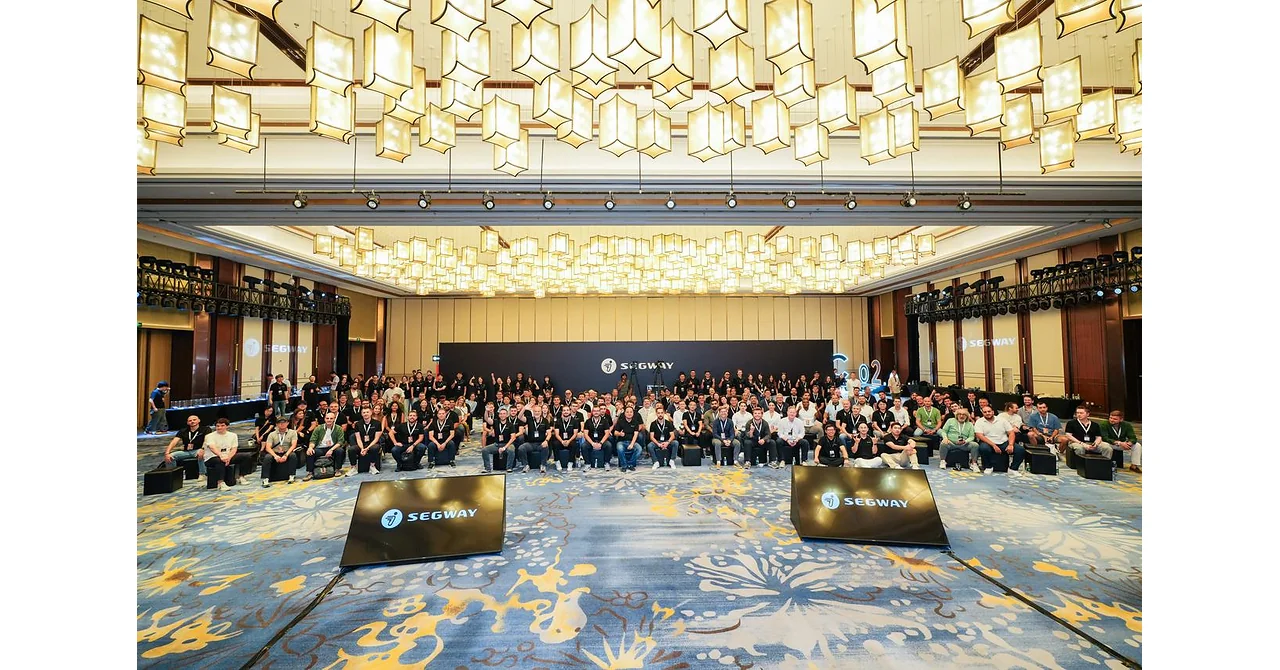
CHANGZHOU, China, Sept. 24, 2026 /PRNewswire/ -- Earlier this month, Segway brought together more than 160 guests in Changzhou, including representatives from over 60 shared mobility operators, industry partners and international and domestic media. The event combined factory visits, product launches, test rides and discussions around the operational challenges facing the sector.

Segway has worked with shared micromobility operators since the industry's early growth years. As operators have shifted their focus from fleet size towards profitability, uptime and long-term asset performance, Segway has expanded its role beyond hardware to technology, service and lifecycle support.

"We don't just provide products. We also provide services and solutions. We want to work with our partners to solve real-world challenges and help them operate more efficiently," said Cid Wang, CEO and Co-Founder of Segway.

A central theme of the event was TCO, Segway's framework for assessing fleet economics through revenue generation, operating expenditure and capital investment. Rather than focusing on purchase price alone, it considers vehicle availability, maintenance, energy use and asset life — all of which affect long-term fleet returns.

"TCO is never just about building a cheaper vehicle. It's about designing fleets that deliver stronger returns year over year," said Alan Zhao, General Manager of Segway-Ninebot Commercial Mobility Business Division.

Segway also unveiled its third-generation shared e-scooter, the R1, alongside the new C Series shared e-bikes, including the C100 and C200.

The platforms were developed around what Segway calls OCG — Operators, Consumers and Government. For operators, the focus is on uptime, serviceability and operating efficiency; for riders, safety, comfort and ease of use; and for cities, more accurate positioning, safer riding and more responsible fleet management.

The R1 features a modular architecture, integrated IoT, improved positioning and rider-assistance technologies. The C Series applies a similar platform approach to shared e-bikes, with greater component commonality and maintenance-focused design.

Segway also presented the F100, an e-bike developed for delivery applications, as it explores broader first- and last-mile use cases together with customers and partners.

For Segway, the next stage of shared micromobility is about keeping vehicles in service longer, reducing operating resources and helping fleets integrate more effectively into urban transport systems.

Share this article

Class (B2B/B2C)
B2B
Ingest Status
Rewritten
Dedupe hash
prn_302889101
Press Eligible
Yes
Press Eligible Reason
Company and industry news about Segway's shared micromobility products, technology, and fleet solutions for operators.
Source Name
Unknown Company
Original Summary

<p>CHANGZHOU, China, Sept. 24, 2026 /PRNewswire/ -- Earlier this month, Segway brought together more than 160 guests in Changzhou, including representatives from over 60 shared mobility operators, industry partners and international and domestic media. The event combined factory visits,...</p>

Image URL
https://mmx.prnewswire.com/media/MS1995787/20260924051607EDT_image_1.jpg?id=OA2969370&p=facebook
Content Hash (SHA-256, erste 32 hex)
2280fb50c6562c9683a9d769030620da
Underdog leverages Eventus Validus platform for trade surveillance across its markets
Image File
Original HTML

AUSTIN, Texas and NEW YORK, Sept. 24, 2026 /PRNewswire/ -- Eventus, a leading provider of comprehensive, at-scale trade surveillance and financial risk solutions, and Underdog, the sports prediction market and fantasy sports pioneer, today announced that Underdog is using the Eventus Validus platform for trade surveillance on its designated contract market (DCM). Surveillance and monitoring procedures are actively running across Underdog's markets, and the marketplace is continuing to expand its use of Validus capabilities.

In July, Underdog announced the launch of its own federally licensed prediction market exchange, wholly owned and operated by Underdog and licensed by the U.S. Commodity Futures Trading Commission (CFTC), which provides customers even more ways to express their opinions on sports, culture and beyond, all within the existing Underdog app.

Nick Thompson, Chief Compliance Officer (CCO) at Underdog Exchange, said Eventus' standing as a known, trusted platform among regulators, including the CFTC, and experience across exchanges, futures commission merchants (FCMs) and broker-dealers helped Underdog hit the ground running on surveillance infrastructure.

He said: "Underdog's mission is to build markets people can trust, and that starts with rigorous oversight. Robust trade surveillance isn't a compliance checkbox for us; it's core to maintaining a fair, orderly market as we scale. We take very seriously our responsibilities as a market operator, and we're investing in institutional-grade surveillance infrastructure proactively."

Underdog recognized that it needed a platform that would scale to accommodate rapid growth.

Thompson said: "As our volume and product set continue to grow, we need surveillance technology that grows with us. Validus' configurability lets us tailor alerts and monitoring procedures to our specific market structure rather than adapting our business to fit the tool. We're also excited about Eventus' investment in automation and machine learning."

He added: "I've used Eventus' Validus platform since 2019, first as CCO of a high-frequency trading firm, and later to lead swap execution facilities and DCMs through the thorough CFTC application process, where the surveillance demonstration is the centerpiece. Surveillance is where my compliance career started, not just a function I oversee. Eventus is the platform that's kept up with that standard across every environment I've deployed it in."

Eventus CEO Cameron Routh said: "Prediction markets are one of the fastest-growing and most closely watched corners of finance, and the surveillance bar has to match that scrutiny. Underdog is building in that oversight from the ground up, rather than treating it as an afterthought, and we're proud Validus is the platform they trust to do it. Partnerships like this shape our roadmap directly, and are why Validus keeps getting better for prediction markets, traditional capital markets and digital assets."

About Eventus

Eventus provides state-of-the-art, at-scale trade surveillance software across all lines of defense. Its powerful, award-winning Validus platform is easy to deploy, customize and operate across equities, options, futures, foreign exchange (FX), fixed income, digital asset and prediction/information markets. Validus is proven in the most complex, high-volume, and real time environments of Eventus' rapidly growing client base, including tier-1 banks, broker-dealers, futures commission merchants (FCMs), proprietary trading groups, market centers, buy-side institutions, energy and commodity trading firms, and regulators. Clients rely on the platform, coupled with the firm's responsive support and product development, to overcome their most pressing trade surveillance regulatory challenges. For more, visit www.eventus.com.

About Underdog

Founded in 2020, Underdog's mission is simple: make sports more fun by building products focused on what fans actually want. The company offers sports prediction markets, fantasy sports games, and an industry-leading breaking-news operation — all designed to deepen how fans experience the games they love. Built for fans, by fans. Visit underdogsports.com.

SOURCE Eventus

Share this article

Class (B2B/B2C)
B2B
Ingest Status
Need Review
Dedupe hash
prn_302888547
Press Eligible
Yes
Press Eligible Reason
QA FAIL (need review): The final paragraph is generic company boilerplate copied/condensed from the 'About Eventus' section, listing products and clients with no news relevance, rather than ending with news context or a natural summary.
Source Name
Unknown Company
Original Summary

<p>AUSTIN, Texas and NEW YORK, Sept. 24, 2026 /PRNewswire/ -- Eventus, a leading provider of comprehensive, at-scale trade surveillance and financial risk solutions, and Underdog, the sports prediction market and fantasy sports pioneer, today announced that Underdog is using the Eventus...</p>

Image URL
https://mmx.prnewswire.com/media/MS464615/Eventus-Systems-Logo.jpg?id=OA2968550&p=facebook
Generated Article_json
{"target_audience": "b2b", "is_medical": false, "ai_generated_title": "Underdog Deploys Eventus Validus for CFTC-Licensed Prediction Market Surveillance", "body_html": "<p><strong>Austin, Texas -- [CURRENT_DATE] --</strong> Eventus said its Validus trade surveillance platform is now live across Underdog's designated contract market (DCM), monitoring trading activity on the sports prediction and fantasy sports operator's newly launched CFTC-licensed exchange.</p><h5>Underdog activates surveillance infrastructure on its CFTC-licensed exchange</h5><p>Underdog launched its own federally licensed prediction market exchange in July 2026, wholly owned and operated by the company and regulated by the U.S. Commodity Futures Trading Commission. The exchange lets users trade on sports, culture and other outcomes directly within the existing Underdog app. Validus is now running surveillance and monitoring procedures across those markets, with Underdog expanding its use of the platform's capabilities as volume grows.</p><h5>Compliance chief cites prior Validus deployment history dating to 2019</h5><p>Nick Thompson, Chief Compliance Officer at Underdog Exchange, said he has used Validus since 2019, first as CCO of a high-frequency trading firm and later while leading swap execution facilities and DCMs through CFTC licensing applications, where surveillance demonstrations form the centerpiece of regulatory review. Thompson said Eventus' standing as a trusted platform among regulators, including the CFTC, and its track record across exchanges, futures commission merchants and broker-dealers allowed Underdog to move quickly on surveillance infrastructure.</p><p>\"As our volume and product set continue to grow, we need surveillance technology that grows with us,\" Thompson said. He added that the configurability of Validus lets Underdog tailor alerts and monitoring procedures to its specific market structure rather than adapting its business to the tool, and pointed to Eventus' investment in automation and machine learning as a factor in the decision.</p><h5>Eventus CEO ties the deal to broader growth in prediction market oversight</h5><p>Eventus CEO Cameron Routh said prediction markets have become one of the fastest-growing and most closely scrutinized segments of finance, requiring surveillance standards that match regulatory attention. Routh said Underdog is building oversight into its market structure from the outset rather than treating it as an afterthought, and that the partnership will shape further development of Validus for prediction markets, traditional capital markets and digital assets.</p><p>Validus is deployed across equities, options, futures, foreign exchange, fixed income, digital asset and prediction market environments for a client base that includes tier-1 banks, broker-dealers, futures commission merchants, proprietary trading groups, market centers, buy-side institutions, and energy and commodity trading firms.</p>", "meta_description": "Underdog deploys Eventus' Validus platform for trade surveillance on its CFTC-licensed prediction market exchange, expanding oversight as volume grows.", "seo_keywords": "Eventus, Validus, Underdog, trade surveillance, CFTC, prediction markets, designated contract market, compliance technology", "companies": ["Eventus", "Underdog"], "industries": ["Finance & Investment"], "markets_regions": ["United States"], "news_type": ["product_launch", "regulatory_update"], "products": ["Validus"], "themes": ["regulatory_compliance", "digital_transformation"], "events": [], "cta_text": "Details on the Eventus-Underdog trade surveillance partnership and Validus platform capabilities", "learn_more": "https://www.eventus.com", "fact_check": {"accuracy_score": 100, "legal_risk": "low", "corrections_made": [], "recommendation": "publish"}}
Content Hash (SHA-256, erste 32 hex)
5a9ff89a08f2980513ef7f7531358c7f
EcoPhage and CNI AG Signed a Non-Exclusive Distribution Agreement for GoldenEco® in the U.S. Market
Image File
Original HTML

EcoPhage and CNI AG Signed a Non-Exclusive Distribution Agreement for GoldenEco® in the U.S. Market

Strategic partnership will support the commercialization of EcoPhage's innovative phage-based biological solution for bacterial diseases in tomatoes and peppers

REHOVOT, Israel, Sept. 24, 2026 /PRNewswire/ -- EcoPhage, a leader in the development of sustainable phage-based biopesticides for the control of bacterial plant diseases, today announced that it has entered into a non-exclusive distribution agreement with CNI AG for the marketing and sales of its innovative biological product, GoldenEco®, in the United States.

The agreement represents an important milestone in EcoPhage's commercial expansion in the U.S. market and brings together EcoPhage's proprietary phage-based technology platform with CNI AG's extensive distribution network and strong relationships with independent agricultural retailers across the country.

GoldenEco® is a phage-based biological product developed to address bacterial diseases affecting tomatoes and peppers, including diseases caused by Xanthomonas and Pseudomonas species. EcoPhage submitted GoldenEco® to the U.S. Environmental Protection Agency (EPA) in late 2023 and currently expects regulatory approval later this year.

A New Approach to Bacterial Disease Management

Bacterial diseases remain a significant challenge for growers, while disease-management programs have historically relied heavily on copper-based products. The emergence of resistance, concerns regarding environmental and chemical footprints, and evolving regulatory requirements are increasing the demand for innovative and more sustainable solutions.

EcoPhage's proprietary research and development platform is designed to identify, develop, and optimize phage-based solutions targeting bacterial plant pathogens across multiple crops. The platform supports the development of natural, non-GMO and zero-residue biological products, with the potential to provide effective disease management while supporting more sustainable agricultural practices.

Expanding Access to Biological Solutions for U.S. Growers

CNI AG, founded in 1974 by independent agricultural business owners, is a nationwide wholesale distributor supplying crop protection products, fertilizers, and seeds to independent agricultural retailers. CNI AG operates 24 distribution centers across 40 states and serves more than 600 independent agricultural retailers.

Through this partnership, EcoPhage and CNI AG will work together to introduce GoldenEco® to the U.S. agricultural market and provide growers with access to EcoPhage's new biological approach to bacterial disease management.

"We are excited to see GoldenEco® receive EPA approval and to help bring this innovative phage-based technology to U.S. growers", said Conner Maple, CNI AG's Business Unit Lead, Specialty Ag. "Bacterial diseases remain a significant challenge in tomato and pepper production, and growers are looking for additional effective and sustainable tools. GoldenEco® represents an important addition to the biological toolbox, and we look forward to working closely with EcoPhage and growers to support its introduction and adoption across the U.S."

"We are thrilled to partner with CNI AG, an organization with an extensive network and strong relationships throughout the U.S. agricultural retail channel," added Guy Elitzur, CEO of EcoPhage. "This agreement is an important step in our U.S. commercial strategy and reflects the growing demand for effective and sustainable biological solutions for bacterial diseases. We believe GoldenEco® has the potential to provide growers with a valuable new tool for disease management while supporting efforts to reduce reliance on conventional copper-based programs."

With EPA approval now secured, the parties are moving forward with their collaboration to bring GoldenEco® to U.S. growers and provide an effective biological tool for managing bacterial diseases in tomatoes and peppers.

About CNI AG

Founded in 1974 by independent agricultural business owners, CNI AG is a nationwide wholesale distributor serving independent agricultural retailers across the United States. The company distributes crop protection products, fertilizers, seeds, and other agricultural inputs through its network of 24 distribution centers across 40 states, serving more than 600 independent agricultural retailers

About EcoPhage

EcoPhage is an agricultural biotechnology company developing innovative biological solutions for the control of bacterial plant diseases. Based on its proprietary phage discovery and development platform, EcoPhage develops targeted, natural, non-GMO and zero-residue biopesticides designed to provide effective disease management across a broad range of crops.

The company is advancing a growing pipeline of phage-based products targeting important bacterial diseases and is focused on delivering sustainable solutions that support growers and the future of modern agriculture.

Media Contact:

Email: [email protected] 

SOURCE EcoPhage

Share this article

Class (B2B/B2C)
B2B
Ingest Status
Need Review
Dedupe hash
prn_302888911
Press Eligible
Yes
Press Eligible Reason
QA FAIL (need review): TARGET inaccurately describes tomatoes/peppers as 'row crops' and claims GoldenEco 'targets copper-resistant pathogens', neither of which is accurately supported by SOURCE. SOURCE discusses tomatoes/peppers and general resistance pressure, not row crops or specific efficacy against copper-resistant strains.
Source Name
Unknown Company
Original Summary

<p>Strategic partnership will support the commercialization of EcoPhage's innovative phage-based biological solution for bacterial diseases in tomatoes and peppers REHOVOT, Israel, Sept. 24, 2026 /PRNewswire/ -- EcoPhage, a leader in the development of sustainable phage-based biopesticides...</p>

Image URL
https://ecophage.com/wp-content/themes/ecophage/screenshot.png
Generated Article_json
{"target_audience": "b2b", "is_medical": false, "ai_generated_title": "EcoPhage Taps CNI AG to Distribute Phage Biopesticide in U.S.", "body_html": "<p><strong>Rehovot, Israel -- [CURRENT_DATE] --</strong> EcoPhage has signed a non-exclusive U.S. distribution agreement with CNI AG for GoldenEco®, a phage-based biological product targeting bacterial diseases in tomatoes and peppers.</p><h5>CNI AG's 24-center network to carry GoldenEco® to over 600 retailers</h5><p>Under the deal, CNI AG -- a nationwide agricultural wholesaler founded in 1974 -- will market and sell GoldenEco® through its 24 distribution centers spanning 40 states, reaching more than 600 independent agricultural retailers.</p><h5>EPA review targets diseases from Xanthomonas and Pseudomonas pathogens</h5><p>EcoPhage submitted GoldenEco® to the U.S. Environmental Protection Agency in late 2023 to address bacterial diseases in tomatoes and peppers, including those caused by Xanthomonas and Pseudomonas species. The company said it currently expects regulatory approval later this year, and the parties said they are moving forward with plans to bring the product to U.S. growers following that clearance.</p><h5>Product targets copper-resistant pathogens as growers seek alternatives</h5><p>Copper-based products have long dominated bacterial disease management in row crops, but resistance and environmental scrutiny are pushing growers toward alternatives. EcoPhage positions GoldenEco® as a natural, non-GMO, zero-residue tool designed to reduce reliance on conventional copper programs.</p><p>\"Bacterial diseases remain a significant challenge in tomato and pepper production, and growers are looking for additional effective and sustainable tools,\" said Conner Maple, CNI AG's Business Unit Lead, Specialty Ag.</p><h5>Deal marks EcoPhage's formal entry into U.S. commercial agriculture</h5><p>Guy Elitzur, CEO of EcoPhage, called the agreement an important step in the company's U.S. commercial strategy, citing rising demand for sustainable biological solutions to bacterial plant diseases. EcoPhage is developing a pipeline of additional phage-based products targeting bacterial pathogens across multiple crops beyond tomatoes and peppers.</p>", "meta_description": "EcoPhage partners with CNI AG to distribute phage-based biopesticide GoldenEco® across 40 U.S. states, targeting bacterial diseases in tomatoes and peppers.", "seo_keywords": "EcoPhage, CNI AG, GoldenEco, phage biopesticide, bacterial plant disease, EPA approval, agricultural distribution, sustainable crop protection", "companies": ["EcoPhage", "CNI AG"], "industries": ["Agriculture & Food Production"], "markets_regions": ["United States"], "news_type": ["product_launch", "regulatory_update"], "products": ["GoldenEco"], "themes": ["supply_chain", "regulatory_compliance", "sustainability"], "events": [], "cta_text": "Details on the EcoPhage-CNI AG distribution partnership and GoldenEco's U.S. rollout", "learn_more": "", "fact_check": {"accuracy_score": 95, "legal_risk": "low", "corrections_made": ["Reconciled source's conflicting EPA approval status (pending vs. 'now secured') by presenting approval as expected/pending with company statements about moving forward"], "recommendation": "publish"}}
Content Hash (SHA-256, erste 32 hex)
817fd2c6b65a21f06c5cd2eb10652cbf
OceanaGold Reports Exceptional High-Grade Drill Results at Wharekirauponga and Progress on Waihi North Project
Image File
Original HTML

VANCOUVER, BC, Sept. 24, 2026 /CNW/ -- OceanaGold Corporation (TSX: OGC) (NYSE: OGC) ("OceanaGold" or the "Company") announces results from 16 new drill holes from the ongoing exploration and resource conversion program at Wharekirauponga, located approximately 10 kilometres ("km") north of the Company's Waihi Operation in New Zealand.

The Company is also providing an update on the Waihi North Project, which continues to progress to plan, and on the evaluation of several value-enhancing technical studies which are expected to be included in the upcoming Waihi District technical report planned for release in January 2027. These include a potential processing plant expansion to 1.2 million tonnes per annum ("Mtpa") that would support the continuation of mining at the Martha Underground mine ("MUG") concurrent with mining the Wharekirauponga Underground mine ("WUG") once it is in production in 2032.

6.3 m @ 97.2 g/t Au from 481.5 m, East Graben ("EG") Vein (WKP146C)

8.5 m @ 41.5 g/t Au from 399.0 m, EG Vein (WKP150)

9.6 m @ 18.5 g/t Au from 401.0 m, EG Hanging Wall ("HW") Veins (WKP146A)

6.6 m @ 24.0 g/t Au from 403.4 m, incl.1.2 m @ 107.7 g/t Au, EG HW Veins (WKP146C)

5.9 m @ 25.9 g/t Au from 485.6 m, EG Vein (WKP146B)

4.2 m @ 32.4 g/t Au from 602.9 m, EG Vein (WKP147A)

Gerard Bond, President and CEO of OceanaGold, said "Drill results from Wharekirauponga continue to demonstrate the exceptional grade and continuity of the EG Vein zone, and include some of the highest-grade intercepts reported to date. These results confirm further continuity and up-dip extension of the southern high-grade zone which currently lies outside of reported reserves, therefore representing outstanding conversion and growth potential. With five drill rigs now active and the Wharekirauponga orebody remaining open in multiple directions, we continue to accelerate drilling towards the southern end to further unlock value for shareholders at this phenomenal deposit.

"I am also excited about the upcoming Waihi District technical report. With the improved performance of the Martha Underground and good drilling results, we see the potential to extend the life of the Martha Underground and increase processing capacity from that assumed in our last technical report which would enable concurrent mining and processing of both Martha and Wharekirauponga ore, driving increased value for the Waihi District."

VRIFY note: Drill results reflect only those set forth in OceanaGold's news release dated September 24, 2026, and do not include all historical results except those relevant to the current Wharekirauponga drill program.

Waihi North Project Development Update

Construction and underground tunnelling activities at the Waihi North Project continue to advance to plan. Decline development, which commenced in May 2026, has advanced approximately 350 metres ("m") to date. Construction of the first ventilation shaft has commenced, with a second jumbo expected to be added in the first half of 2027 to begin development of the twin tunnel toward the Wharekirauponga orebody. Bulk earthworks at the Willows Portal site continue, with water management related activities involving sedimentation ponds, haul roads, waste rock stack and magazine now completed, and the surface facilities area remaining on track for completion by year-end. The water treatment plant began staged commissioning in September 2026 and early works on the new tailings storage facility are expected to commence in the fourth quarter of this year.

Waihi District Technical Report

The Waihi District comprises the Company's Waihi Operation, which includes the currently producing Martha Underground (MUG), and the Waihi North Project, which includes Wharekirauponga Underground (WUG).

An updated National Instrument 43-101 – Standards of Disclosure for Mineral Projects ("NI 43-101") technical report on the Waihi District is planned for release in January 2027 and will include updated Mineral Reserves and Mineral Resources estimates.

The technical report is planned to include an updated mine plan for the Waihi District, incorporating the results of ongoing technical evaluations. These evaluations are assessing the potential to extend mining at MUG beyond 2033, in conjunction with the commencement of mining at WUG. To support this opportunity, the Company is also evaluating a potential processing plant expansion to increase throughput capacity up to 1.2 Mtpa from the 0.8 Mtpa contemplated in the previous technical report.

Wharekirauponga Drill Results

Drilling activity at Wharekirauponga has accelerated with the recent expansion of the fleet to five active rigs, and the construction of a new drill site (Drill Site 10), which is strategically positioned to better target the open southern high-grade zone.

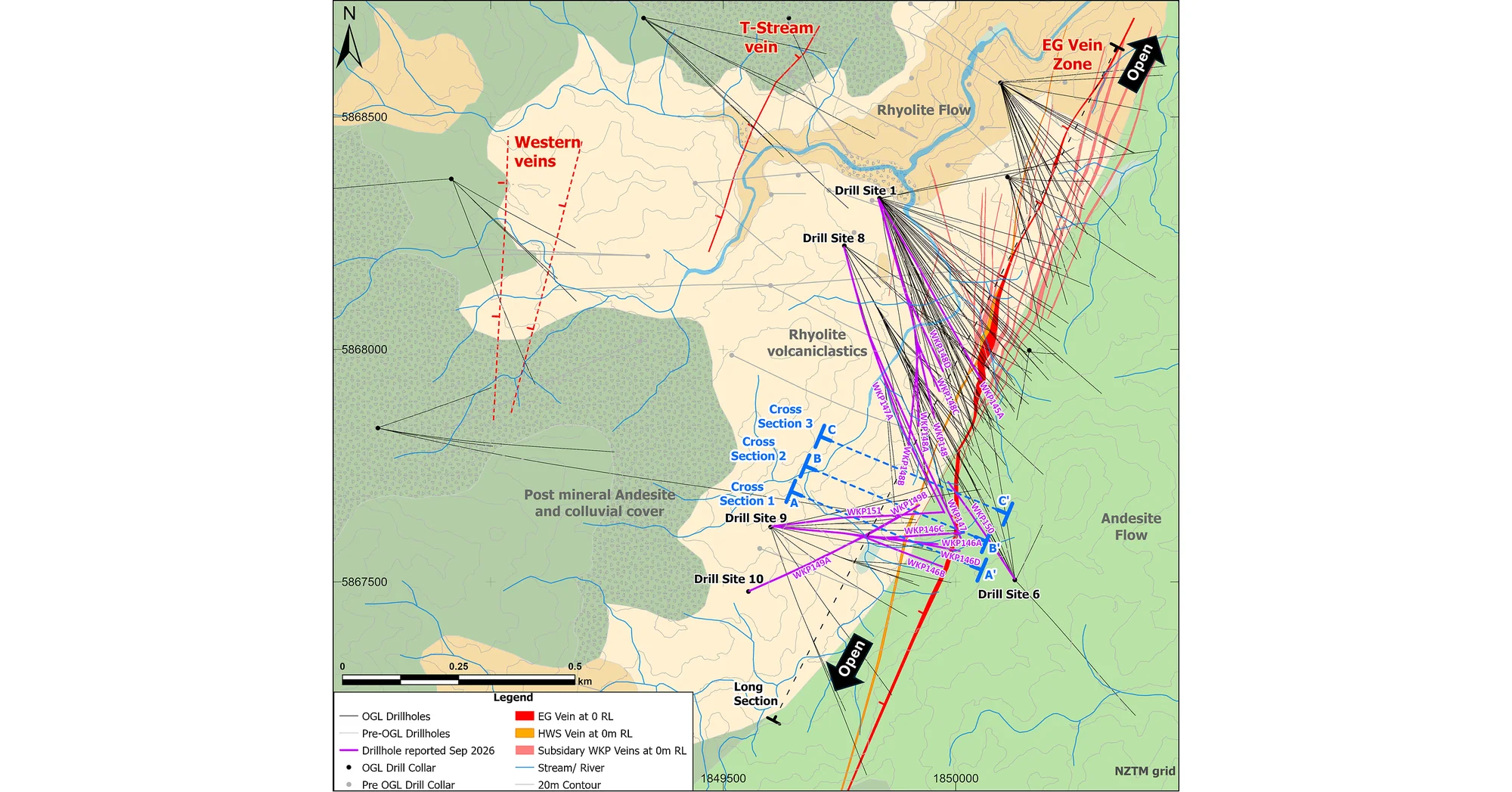
Since the Company's April 1, 2026 news release, a total of sixteen drill holes have been completed from five drill sites with results returned from the EG, HW and footwall ("FW") Veins, collectively referred to as the "EG Vein zone" (Figure 1). Results both within the EG Vein and its HW structures continue to confirm continuity and quality of the southern high-grade zone. Importantly, this area remains unconstrained, with mineralization open along strike, up-dip and at depth, and significant scope remains to further grow the Mineral Resource through additional drilling.

East Graben Vein

Drilling on the EG Vein returned multiple wide, high-grade intercepts demonstrating the continuity of the system to the south (Figure 2). Results include 6.3 m @ 97.2 g/t Au (WKP146C) in the upper part of the vein, one of the highest-grade results returned to date. Nearby holes, including 5.9 m @ 25.9 g/t Au (WKP146B) and 4.2 m @ 32.4 g/t Au (WKP147A), also returned high-grade intercepts confirming the grade and continuity of the vein in this area. A further 110 m to the north, drill hole WKP150 returned 8.5 m @ 41.5 g/t Au, strengthening confidence in the continuity, thickness and grade of the EG Vein in this area.

Across the sixteen EG Vein intercepts reported, results continue to extend mineralization up-dip, demonstrating incremental growth of the southern high-grade zone (Figure 3, Figure 4).

This drilling supports the potential upgrade of a substantial portion of the southern high-grade zone from Inferred to Indicated Mineral Resources, underpinning an expected increase to Mineral Reserves in the Company's 2026 year-end Mineral Resource and Mineral Reserve statement and in the upcoming NI 43-101 technical report.

Hanging Wall Veins

The HW Veins and associated sub-parallel structures that lie immediately west of the EG Vein also yielded strong results. Drilling of the HW Veins continues to demonstrate a broadening zone of mineralization, headlined by 9.6 m @ 18.5 g/t Au and 1.2 m @ 107.7 g/t Au (WKP146A and WKP146C, respectively) (Figure 5). Several holes, notably WKP146C, which returned three separate high-grade HW intercepts in addition to its EG Vein result, intersected multiple, closely stacked mineralized structures, pointing to a well-developed vein array in this part of the system. These results continue to highlight a zone of high-grade mineralization outside the current resource model, which remains a target for future growth.

Wharekirauponga 2026 Exploration Program

With five active drill rigs now operating at Wharekirauponga, drilling through the remainder of 2026 will focus on both resource conversion and growth-oriented step-out drilling along strike of the EG Vein, reflecting the substantial upside that remains in this open, unconstrained vein system.

Table 1: Wharekirauponga drill intersections subsequent to the news release dated April 1, 2026

OceanaGold is a global intermediate gold and copper producer committed to safely and responsibly maximizing the generation of Free Cash Flow from our operations and delivering strong returns for our shareholders. We have a portfolio of four operating mines: the wholly-owned Haile Gold Mine in the United States of America; the wholly-owned Macraes and Waihi Operations in New Zealand; and the 80%-owned Didipio Mine in the Philippines.

Qualified Person Statement

The scientific and technical information in this news release relating to Mineral Reserves, mine planning, mine scheduling and mine development for the Waihi District, including the Martha Underground and Wharekirauponga Underground mines and the Waihi North Project, has been reviewed and approved by Mr. Euan Leslie, Chartered Professional Member of the Australasian Institute of Mining and Metallurgy, Group Mining Engineer for OceanaGold and an employee of the Company, a qualified person as defined by NI 43-101.

The scientific and technical information in this news release relating to exploration results, drilling, sampling, data verification, quality assurance and quality control, and Mineral Resources has been reviewed and approved by Mr. Leroy Crawford-Flett, Chartered Professional Member of the Australasian Institute of Mining and Metallurgy, Exploration & Geology Manager of the Waihi Operation and an employee of the Company, a qualified person as defined by NI 43-101. Mr. Crawford-Flett has verified the sampling, analytical and test data underlying the exploration information disclosed in this news release, including review of assay certificates and the performance of certified reference materials, blanks and duplicates against the Company's QA/QC protocols, and the drillhole database. No limitations on that verification were identified other than the reduced core recovery in drill hole WKP146D described above.

Quality Assurance and Quality Control ("QA/QC")

All exploration samples are assayed for gold by 30g fire assay with Atomic Absorption Spectrometry ("AAS") finish. Since mid-2022, drill core sample intervals where visible electrum is logged are followed up by a subsequent screen fire assay after the routine 30g fire assay.
Class (B2B/B2C)
B2B
Ingest Status
Rewritten
Dedupe hash
prn_812702682
Press Eligible
Yes
Press Eligible Reason
Corporate mining company reports high-grade exploration results, project development progress, and planned processing expansion.
Source Name
Unknown Company
Original Summary

<p>VANCOUVER, BC, Sept. 24, 2026 /CNW/ -- OceanaGold Corporation (TSX: OGC) (NYSE: OGC) ("OceanaGold" or the "Company") announces results from 16 new drill holes from the ongoing exploration and resource conversion program at Wharekirauponga, located approximately 10 kilometres ("km") north...</p>

Image URL
https://mmx.prnewswire.com/media/MS1995583/OceanaGold-Corporation-OceanaGold-Reports-Exceptional-High-Grade.jpg?id=OA2968700&p=facebook
Content Hash (SHA-256, erste 32 hex)
76715be62e1a1b376dc3de37d577c387
$3.3 Million in New Philanthropic Commitments for Good Jobs Western North Carolina from The Rockefeller Foundation, John M. Belk Endowment, and NC GSK Foundation
Image File
Original HTML

The Rockefeller Foundation becomes the first national philanthropy to commit to this regional initiative, triggering a matching commitment from the John M. Belk Endowment.

$3.2 million in previously raised funds awarded to 11 community colleges in the region to train and place 1,200 people into good jobs, promising jobs, and work-based learning in health care, skilled trades, and manufacturing.

ASHEVILLE, N.C., Sept. 24, 2026 /PRNewswire/ -- America Achieves today announced $3.3 million in new philanthropic commitments to Good Jobs Western North Carolina, a regional effort to help residents of 23 counties land good jobs and to build the talent systems that will keep that work going. The New York-based Rockefeller Foundation is committing $1 million over two years – the first national philanthropy to invest in this effort – triggering a matching two-year $2 million investment from John M. Belk Endowment. The North Carolina GlaxoSmithKline Foundation also recently announced it is joining the Good Jobs WNC funding coalition, adding an in-state partner with deep roots in apprenticeship and work-based learning. Good Jobs WNC is a large-scale rural regional talent system intervention, and its built-in learning loop will surface the specific barriers that keep people from reaching good jobs, giving policymakers, policy shapers, college and K-12 leaders, and philanthropists a clear picture of what needs to change in policy, funding, and institutional practice to scale and sustain this work.

MC Belk Pilon, President and Board Chair of the John M. Belk Endowment, and Jon Schnur, CEO of America Achieves, made the announcements at the Good Jobs Western North Carolina Summit, which brought together hundreds of employers, education and workforce leaders, policymakers, local funders, and 11 national foundations to advance the region's work and consider what it means for communities nationwide. The Summit is co-hosted by the John M. Belk Endowment, America Achieves, AMY Wellness Foundation, Dogwood Health Trust, The Leon Levine Foundation, and WNC Bridge Foundation, several of which have been engaged in Western North Carolina's recovery since the earliest days after the storm.

That work is the backdrop for this week's announcements, which come two years after Hurricane Helene struck the region. The recovery that followed has been extraordinary in its scope and its persistence: rebuilding roads, homes, water systems, and businesses, and sustaining families and communities through a long and difficult stretch. Many of the philanthropies now backing Good Jobs Western North Carolina funded immediate relief and then the slower, less visible work of rebuilding. As the region moved from response to recovery, its community colleges and local partners began asking what their role should be in rebuilding the regional economy for the long term, and how to connect residents to good jobs. Good Jobs Western North Carolina emerged from that locally led effort.

The Rockefeller Foundation's commitment will support its Big Bet on Good Jobs for America, a three-year, $100 million strategy launched in April 2026. The strategy supports locally driven approaches that connect people, particularly in distressed and underserved communities, to good jobs, while spreading effective practices to expand economic opportunity in communities across the country.

The Good Jobs Western North Carolina Steering Committee also announced today $3.2 million from the Good Jobs Program Fund to help all 11 community colleges in the region train and place 1,200 people into good jobs, promising jobs, and work-based learning in the region's 23 counties. The funding will help colleges expand and redesign training with local employers so more residents can access jobs with good pay, benefits and opportunities to advance.

"This funding will provide western North Carolinians new opportunities to build careers in the communities they call home," said Governor Josh Stein."This initiative is preparing people for good jobs, supporting businesses' searches for skilled workers, and strengthening the region's economic recovery for years to come."

"Good Jobs Western North Carolina is a model for how to help people get and keep good jobs at a time of profound transformation in the labor market," said Dr. Rajiv J. Shah, President of The Rockefeller Foundation. "This effort stood out to us because it brings together employers, educators, and the public sector to train people for the work employers need and help them get hired. The Rockefeller Foundation is proud to be the first national philanthropy to join this initiative as part of our $100 million Big Bet to connect Americans to the dignity of work in a changing economy."

The Good Jobs Framework, developed by America Achieves, guides the initiative's work across 11 community colleges and 23 counties to expand education, training and employment access for low-income residents of Western North Carolina. The goal is twofold: prepare and place more residents into good jobs in Western North Carolina, and translate that experience and lessons learned to build evidence, tools, and recommendations to improve education and workforce policy at large scale at the state and national levels.

"This work began with listening to the people who know Western North Carolina best: its community college leaders, employers, and residents," said MC Belk Pilon, President and Board Chair of the John M. Belk Endowment. "Their leadership has brought us to this point. We are thrilled that national philanthropy will build on local communities to help make sure that this region not only delivers strong local programs but develops lessons learned and tools to take lasting pathways to economic mobility to a much larger scale."

"Western North Carolina's colleges and employers are working together to build scalable models to help people get good jobs that employers need to fill," said Jon Schnur, CEO of America Achieves. "This initiative and the Good Jobs Framework guide and support that programming – and will inform the design of a system enabling this type of work statewide for the long-term. Philanthropy is intended here to finance the transition, not permanently subsidize the system."

The initiative will share tools, labor-market findings, playbooks, and policy recommendations gained from implementation so other communities and states can adapt the approach.

The initiative builds on bipartisan National Governors Association (NGA) calls for states to take action. Good Jobs Western North Carolina was introduced publicly in April as part of America Achieves' broader Good Jobs Economy national work that was first announced by then-NGA Chair Oklahoma Governor Stitt and current NGA Chair Maryland Governor Wes Moore at the NGA summer meeting in 2025. At the time, Governor Stitt called on governors to "build strong bridges between millions of Americans seeking good jobs and the employers excited to hire them" – including by establishing a "Good Jobs Fund that supports scaleable, high-impact workforce solutions."

Investments in 11 Community Colleges across Western North Carolina

These investments will help local residents attain good-paying jobs, address labor market shortages in health care, advanced manufacturing and skilled trades, and support the region's recovery from Hurricane Helene. Programs range from expanded nursing education and paid manufacturing training to shorter skilled-trades certificates and class schedules that better accommodate working adults.

The initiative builds on early support from North Carolina philanthropy, including the John M. Belk Endowment and The Leon Levine Foundation – and then an expansion of that support from NCCCS Foundation, SECU Foundation, AMY Wellness Foundation, WNC Bridge Foundation, C.D. Spangler Foundation, Cannon Foundation, Dogwood Health Trust, Pisgah Health Foundation, and NC GSK Foundation.

Through its Good Jobs Program Fund, the initiative pairs flexible funding with hands-on support to help colleges redesign programs around employer demand and track whether participants move into better-paying work. America Achieves provides technical assistance in partnership with the John M. Belk Endowment and regional funder leaders.

Today's grants build on an initial planning phase that brought all 11 colleges together to examine labor market data, identify priority occupations and develop programs with employers. Colleges used a regional labor market analysis from Strada Education Foundation and the Good Jobs Western North Carolina Data Hub, powered by Julius Education and co-developed with America Achieves.

The resulting portfolio involves 48 employer partners engaged in activities that include curriculum development, hiring and financial or other contributions. Partnerships connect classroom learning with opportunities such as paid work experience, clinical training and guaranteed interviews.

Current college plans project approximately 1,200 participants during the first two years – about 900 in job placements and about 300 in work-based learning such as internships, clinical rotations and apprenticeships. The projections include new program completers, existing students and workers pursuing advancement. Colleges will track credential completion, job placement, wages and retention. Investments in instructors, equipment and employer partnerships build capacity to serve additional students each academic year.

"The education we provide must reflect the skills and expectations of today's employers, and the best way to ensure that alignment is to design programs with employers at the table from the very beginning," said Dr. Mark Poarch, President of Caldwell Community College and Technical Institute. "For working learners, access is equally important. Programs must fit the realities of their lives through flexible scheduling, relevant instruction, comprehensive support services, and clear pathways to employment.

Class (B2B/B2C)
B2B
Ingest Status
Need Review
Dedupe hash
prn_302888536
Press Eligible
Yes
Press Eligible Reason
QA FAIL (need review): TARGET contains an inaccurate/truncated proper noun 'Dr. Rajiv J. Sh' instead of 'Dr. Rajiv J. Shah', and the quote is left incomplete mid-sentence, making the attribution incorrect.
Source Name
Unknown Company
Original Summary

<p>The Rockefeller Foundation becomes the first national philanthropy to commit to this regional initiative, triggering a matching commitment from the John M. Belk Endowment. $3.2 million in previously raised funds awarded to 11 community colleges in the region to train and place 1,200...</p>

Image URL
https://mmx.prnewswire.com/media/MS1827492/America-Achieves-logo.jpg?id=OA2968403&p=facebook
Generated Article_json
{"target_audience": "b2b", "is_medical": false, "ai_generated_title": "Rockefeller Foundation Commits $1M to Western North Carolina Jobs Push", "body_html": "<p><strong>Asheville, N.C. -- [CURRENT_DATE] --</strong> The Rockefeller Foundation has committed $1 million over two years to Good Jobs Western North Carolina, becoming the first national philanthropy to back the regional workforce initiative and triggering a matching $2 million investment from the John M. Belk Endowment. America Achieves, which coordinates the effort, announced $3.3 million in total new philanthropic commitments at the Good Jobs Western North Carolina Summit in Asheville.</p><h5>Coalition adds North Carolina GSK Foundation as in-state apprenticeship partner</h5><p>The North Carolina GlaxoSmithKline Foundation has joined the Good Jobs WNC funding coalition, bringing experience in apprenticeship and work-based learning to the 23-county effort. The Summit drew hundreds of employers, education and workforce leaders, policymakers, and 11 national foundations, and was co-hosted by the John M. Belk Endowment, America Achieves, AMY Wellness Foundation, Dogwood Health Trust, The Leon Levine Foundation, and WNC Bridge Foundation.</p><h5>$3.2 million targets 1,200 job placements across 11 community colleges</h5><p>The Good Jobs Western North Carolina Steering Committee separately allocated $3.2 million from the Good Jobs Program Fund to all 11 community colleges in the region. Colleges will use the funds to expand and redesign training programs with local employers, targeting 1,200 residents for job placement or work-based learning in health care, skilled trades and manufacturing over the first two years. Roughly 900 participants are projected for direct job placements and about 300 for work-based learning such as internships, clinical rotations and apprenticeships.</p><h5>Rockefeller ties funding to its $100 million national jobs strategy</h5><p>The commitment draws on the Rockefeller Foundation's Big Bet on Good Jobs for America, a three-year, $100 million strategy launched in April 2026 to connect residents of distressed and underserved communities to good jobs. \"This effort stood out to us because it brings together employers, educators, and the public sector to train people for the work employers need and help them get hired,\" said Dr. Rajiv J. Sh"}
Content Hash (SHA-256, erste 32 hex)
5f9770b4f1516fe375b1dc1f995d5770
/C O R R E C T I O N -- Basecamp Research/
Image File
Original HTML

/C O R R E C T I O N -- Basecamp Research/

In the news release, Basecamp Research raises $140M to advance AI-designed therapeutics, issued 23-Sep-2026 by Basecamp Research over PR Newswire, we are advised by the company that information has changed in the first bulleted subheadline and in the fourth paragraph. The complete, corrected release follows:

Basecamp Research raises $140M to advance AI-designed therapeutics

- Oversubscribed Series C led by S32 with backing from NVIDIA, Menlo Ventures' Anthology Fund, Catalio Capital Management, European Tech Collective, Firebrand River Capital, Inception Fund, King Philanthropies, NATO Innovation Fund, PostScriptum, Redalpine, The Rockefeller Foundation, Singular, Sovereign AI, and True Ventures.

- Funding will advance a pipeline of EDEN-designed therapeutics, starting with in vivo cell therapy, and expand pharmaceutical partnerships

- The company has demonstrated strong preclinical results across multiple modalities and disease areas

LONDON and BOSTON, Sept. 23, 2026 /PRNewswire/ -- Basecamp Research, a frontier AI company developing AI-designed medicines, today announced a $140M Series C financing to train a new generation of EDEN models and advance a pipeline of AI-designed therapeutics towards clinical development.

Basecamp's ambition is to develop cures for diseases that remain incurable by designing medicines that reprogram the body to repair itself. The company combines frontier AI models trained on proprietary biological data with technology for writing DNA sequences into cells.

"We believe the future of medicine lies in reprogramming the body to repair itself. We design the models and the medicines to teach it how," said Glen Gowers, co-founder and CEO of Basecamp Research. "AI-based approaches promise to change what's possible for patients who currently have few alternatives. This funding brings this technology closer to those who need it most."

The oversubscribed round was led by S32, with participation from Menlo Ventures' Anthology Fund, Catalio Capital Management, European Tech Collective, Firebrand River Capital, Inception Fund, King Philanthropies, NATO Innovation Fund, NVIDIA, PostScriptum, Redalpine, The Rockefeller Foundation, Singular, Sovereign AI and True Ventures.

Additional investment comes from senior leaders from across pharma, biotech, and global industry, including André Hoffmann, Vice-Chairman of Roche, who said: "The biotechnology revolution that began fifty years ago transformed how we make medicines. Personalised, AI-designed therapeutics represent the next transformation of that journey. Basecamp Research has built the full platform to deliver it, from biological data to trained models to designed therapies. This will be key in helping the industry to continue to innovate."

Applying EDEN to develop new therapies

Basecamp Research is applying EDEN, its biological foundation model, to in vivo cell therapy – reprogramming a patient's cells inside the body. Today's cell therapies are limited both in the complexity of what they can deliver and by a manufacturing process that costs hundreds of thousands of dollars per patient.

By pairing EDEN's ability to design long and complex DNA sequences with large serine recombinases that can precisely integrate them into the genome, Basecamp's platform aims to underpin the future of cell therapies, making them more sophisticated, more customisable and simpler to administer. This has the potential to transform how we treat cancer, autoimmune disease, and more.

The company has demonstrated strong preclinical results across multiple modalities and disease areas. To expand its pharmaceutical partnerships, Basecamp has appointed Richard Pearce, formerly of Biogen, as Chief Business Officer.

Andy Conrad, General Partner at S32 and former CEO of Google's Verily, who joins the Board of Directors, said: "AI is opening up new possibilities across every part of society, but perhaps nowhere is the potential more meaningful than in human health. The ability to combine AI, biological data and scientific insight could transform how we understand disease, discover medicines and ultimately improve and extend people's lives. Basecamp Research is building an important technology platform at the center of that opportunity."

The AI and data powering Basecamp Research's therapies

At the centre of Basecamp Research's AI platform is the Trillion Gene Atlas, the world's largest proprietary biological AI training dataset. Built with partners including NVIDIA, Anthropic, PacBio and Ultima Genomics, the Atlas draws on biological data collected through access and benefit-sharing partnerships in more than 30 countries across all seven continents.

Trained on this data, the company's EDEN models recognise patterns across a huge breadth of previously unseen biology. Unlike AI systems developed for a single scientific task, EDEN models aim to deliver a universal understanding of how DNA works across all of life.

This means that the models can generate potential therapeutic candidates directly from information about a disease, an approach already demonstrated through Basecamp's collaboration with Anthropic on Claude Science. The EDEN models' capabilities include designing cell and gene therapies, enzymes and peptides.

About Basecamp Research

Basecamp Research trains frontier AI models for therapeutic design. The EDEN models are trained on the Trillion Gene Atlas, the world's largest proprietary genomic dataset, collected through partnerships in more than 30 countries worldwide. Its pipeline of EDEN-designed therapeutics, beginning with in vivo cell therapy, is advancing towards clinical development. Basecamp Research is headquartered in London with offices and labs in Cambridge, MA.

Share this article

Class (B2B/B2C)
B2B
Ingest Status
Rewritten
Dedupe hash
prn_302887620
Press Eligible
Yes
Press Eligible Reason
Basecamp Research announced a $140M Series C to advance AI-designed therapeutics and biotech partnerships.
Source Name
Unknown Company
Original Summary

<p>In the news release, Basecamp Research raises $140M to advance AI-designed therapeutics, issued 23-Sep-2026 by Basecamp Research over PR Newswire, we are advised by the company that information has changed in the first bulleted subheadline and in the fourth paragraph. The complete,...</p>

Image URL
https://mmx.prnewswire.com/media/MS1994261/Basecamp-Research-Series-C-Expedition.jpg?id=OA2964791&p=facebook
Content Hash (SHA-256, erste 32 hex)
2f3ee201b5854494862eacb5d2980c10
Clywedog Therapeutics Announces Final Results from a Phase 1b Study of Balomenib in Type 2 Diabetes Patients, Showing Glycemic Improvement Sustained for Three Months After a Three-Week Course of Treatment
Image File
Original HTML

- Placebo-adjusted mean HbA1c reduction of 0.77% at Week 12 (p0.01) and 0.70% at Week 16 (p0.05) — three months after the last dose — following only three weeks of balomenib treatment

- Statistically significant improvement in oral glucose tolerance at Day 85, eight weeks after the last dose: placebo-adjusted reductions of 203 mmol•min/L in total glucose AUC (p=0.019), 2.03 mmol/L in peak glucose (p=0.013) and 2.46 mmol/L in two-hour glucose (p=0.010) — differences versus placebo of 11%, 11% and 15% — with the two treatment arms superimposable at baseline

- Placebo-adjusted mean fasting plasma glucose reduction of 1.29 mmol/L (23 mg/dL) at Week 12 (p0.05)

- No drug-related serious or severe adverse events, no therapy-related discontinuations during the study

- Results are consistent with preclinical data in ZDF rats, in which HbA1c was 5.9% in balomenib-treated animals versus 10.9% in vehicle controls 35 days after dosing ceased

- Phase 2a study evaluating an extended 12-week treatment course expected to initiate in Q4 2026.

DOVER, Del., Sept. 24, 2026 /PRNewswire/ -- Clywedog Therapeutics, Inc., a clinical-stage biopharmaceutical company developing menin inhibitors for the treatment of metabolic disease, today announced positive final results from its Phase 1b study (ZE63-0302-0002) of balomenib, an investigational oral small-molecule menin inhibitor, in adults with type 2 diabetes. The study completed its last patient visit on 11 July 2026.

The randomized, double-blind, placebo-controlled study enrolled 60 adults with type 2 diabetes across three countries, randomized 1:1 to balomenib or placebo for 28 days of treatment (the first week of which being a pre-dosing titration period) followed by a 12-week off-treatment observation period, with final assessments at Week 16. The primary endpoint was safety and tolerability at Week 4; measures of glycemic control were prespecified as exploratory endpoints. Participants entered with a mean baseline HbA1c of 8.84% (balomenib) and 8.52% (placebo) and were taking up to three background antidiabetic agents, excluding insulin. Subject retention was high, with 28 to 30 participants per arm evaluable at every scheduled timepoint through Week 16.

Balomenib met the primary objective of the study and was generally well tolerated. There were no unexpected drug-related adverse events, no serious adverse events and no discontinuations attributed to study drug. Across exploratory endpoints, improvement in glycemic control emerged during the four-week dosing period, reached its maximum at Week 12, and remained statistically significant at Week 16 — three months after the final dose of study drug. Other metabolic parameters also improved both during the dosing and post-dosing observation period, including body weight, lipids, triglycerides and indirect measurements of insulin sensitivity and insulin secretion (HOMA IR and HOMA B, respectively). "The central observation is that after only a three-week course of treatment, balomenib produced sustained improvements in glycemic control consistent with a disease-modifying mechanism of action" commented Iain Dukes, M.A. D.Phil., Clywedog Therapeutics. "Inhibition of menin signaling resulted in pluralistic improvements in insulin sensitivity and insulin secretion, effects which should be expected to deepen following longer courses of treatment".

The clinical findings are directionally consistent with the durability observed preclinically. In Zucker diabetic fatty (ZDF) rats, where balomenib normalized glycemia during dosing and maintained that benefit long after treatment stopped, 35 days after the final dose (Day 93) HbA1c was 5.9% in balomenib-treated animals versus 10.9% in vehicle controls (p0.001). Animals treated with the SGLT2 inhibitor canagliflozin, which lowered glucose comparably during dosing, returned to an HbA1c of 9.7% over the same off-treatment period. Histologic assessment showed larger and more numerous pancreatic islets and increased insulin-positive pancreatic area in balomenib-treated animals at the end of the off-treatment phase.

Phase 2a Study

Clywedog will initiate a Phase 2a study of balomenib in type 2 diabetes in Q4 2026. The randomized, double-blind, placebo-controlled study is designed to enroll participants and extend the treatment period to 12 weeks while retaining an off-treatment follow-up period, in order to characterize the depth and duration of the effect observed in the Phase 1b study.

About Balomenib

Balomenib (ZE63-0302) is an investigational, orally administered small-molecule inhibitor of menin being developed by Clywedog Therapeutics for the treatment of type 2 and type 1 diabetes. Menin acts as a brake on β-cell turnover and function. The proposed mechanism of balomenib involves time-limited menin-target protein interaction inhibition intended to enable proliferation, preservation and reactivation of functional, insulin-producing β cells, with the goal of durable improvement in glycemic control.

About Clywedog Therapeutics, Inc.

Clywedog Therapeutics is a small-molecule drug discovery company dedicated to developing first- and best-in-class therapies for the management and potential reversal of type 1 and type 2 diabetes. For further details go to https://www.clywedogther.com.

Contact

Iain Dukes, M.A. D.Phil.

[email protected] 

SOURCE Clywedog Therapeutics, Inc.

Share this article

Class (B2B/B2C)
B2B
Ingest Status
Rewritten
Dedupe hash
prn_302888988
Press Eligible
Yes
Press Eligible Reason
Clinical-stage biotech company reports Phase 1b results for an investigational diabetes treatment and plans a Phase 2a study.
Source Name
Unknown Company
Original Summary

<p>Placebo-adjusted mean HbA1c reduction of 0.77% at Week 12 (p<0.01) and 0.70% at Week 16 (p<0.05) — three months after the last dose — following only three weeks of balomenib treatment Statistically significant improvement in oral glucose tolerance at Day 85, eight weeks after the last...</p>

Image URL
https://mmx.prnewswire.com/media/MS1995724/Clywedog-Therapeutics-logo.jpg?id=OA2969031&p=facebook
Content Hash (SHA-256, erste 32 hex)
c0d0f38134d81cb78e27655d6f983958
LUCY GOODS LAUNCHES THE FIRST NON-STIMULANT ENERGY GUM
Image File
Original HTML

LUCY GOODS LAUNCHES THE FIRST NON-STIMULANT ENERGY GUM

LUCY REVIVE gives the body more energy without adding another stimulant, launching direct-to-consumer at lucy.co and on Amazon.

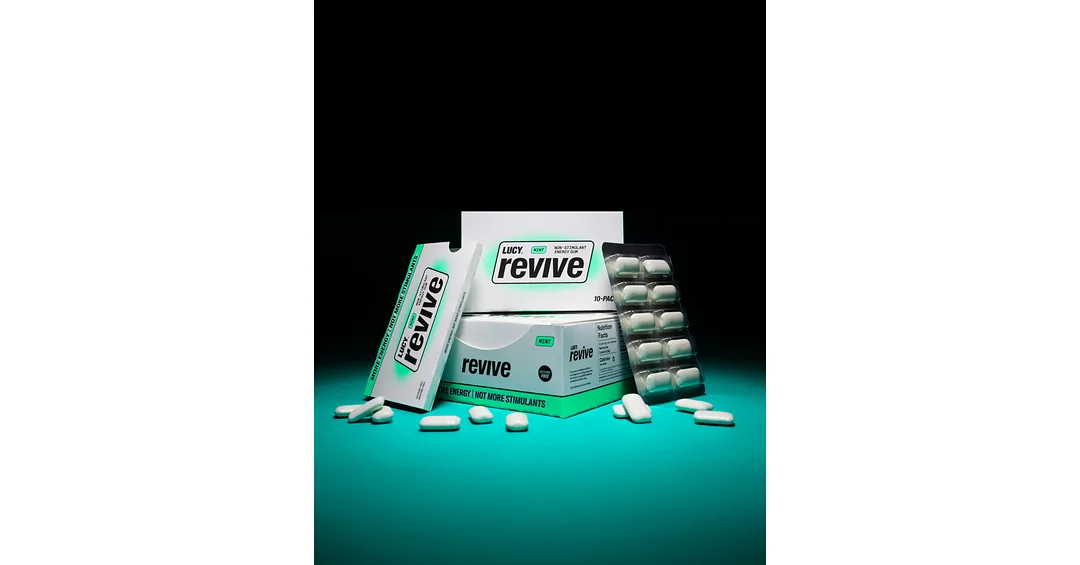
LAS VEGAS, Sept. 24, 2026 /PRNewswire/ -- Today, Lucy Goods, Inc. launched LUCY REVIVE, the first non-stimulant energy gum and Lucy's first non-nicotine product.

The energy aisle has been solving one problem the same way for decades. Coffee, energy drinks, and energy shots all work by blocking the signal that says a person is tired, not by making more energy. That approach has a limit. Once someone is past the limit, the next stimulant only adds jitters and sets up the crash that follows.

LUCY REVIVE works from the other direction. It is a researched blend of micronutrients and nootropics built to support the body's own cellular energy, not to mask fatigue with another stimulant. It does not ask anyone to give up their morning coffee or energy drink. It is what they reach for alongside it or in place of their second cup.

LUCY REVIVE is real chewing gum made using a traditional gum-making process, not a compressed powder tablet with a candy shell, so it chews like gum rather than tolerates like a supplement. Up to six pieces a day, spaced out however the day requires. It launches in Mint, with no caffeine and no nicotine, labeled on pack and online exactly as what it is: non-stimulant energy gum.

LUCY was founded as a nicotine product company to produce premium tobacco-free nicotine products, with the goal of reducing tobacco-related deaths to zero. Behind that mission has always been the drive to help people responsibly enjoy and better understand functional substances whose benefits are often overlooked or underestimated.

Lucy Goods has already proven it can build a category people did not know they were waiting for. The company has built a loyal base of adult consumers without relying on broad retail distribution to prove demand first, driven by a research-first approach from founders with Harvard and Caltech backgrounds. REVIVE was built the same way. Every nootropic and micronutrient in it was chosen for a specific, researched role in focus and cellular energy, not added for the label. The gum itself comes from one of the oldest chewing gum manufacturers in the United States, produced by American workers in upstate New York.

REVIVE launches exclusively direct-to-consumer at lucy.co, right where its buyer is already looking for an alternative to another caffeine hit.

The energy category has spent decades adding more of the same stimulant. REVIVE is the first thing in it that adds something else instead. "Every energy product before this one works the same way: block the tired signal and hope the crash doesn't come back for it," said David Renteln, founder and CEO of Lucy Goods. "REVIVE doesn't do that. It supports the energy the body already makes, and it works alongside the coffee people already drink, not against it." — David Renteln, Founder and CEO, Lucy Goods, Inc.

LUCY REVIVE is available now in Mint at lucy.co.

About Lucy Goods

Lucy Goods, Inc. is a modern nicotine company and independent challenger to legacy tobacco brands, with a portfolio spanning nicotine and nootropic products. The company has grown through direct partnerships, digital-first distribution, and products designed around how adult consumers actually use them.

LUCY REVIVE is the company's first product built outside nicotine, a non-stimulant energy gum for anyone who has already hit the limits of caffeine. Lucy Goods is headquartered in Las Vegas, Nevada.

Media Contact

Media Inquiries: [email protected]

Website: lucy.co

SOURCE Lucy Goods, Inc.

Share this article

Class (B2B/B2C)
B2C
Ingest Status
Rewritten
Dedupe hash
prn_302888460
Press Eligible
Yes
Press Eligible Reason
Company product launch for a consumer energy gum sold direct-to-consumer, with substantive product and business information.
Source Name
Unknown Company
Original Summary

<p>LUCY REVIVE gives the body more energy without adding another stimulant, launching direct-to-consumer at lucy.co and on Amazon. LAS VEGAS, Sept. 24, 2026 /PRNewswire/ -- Today, Lucy Goods, Inc. launched LUCY REVIVE, the first non-stimulant energy gum and Lucy's first non-nicotine product....</p>

Image URL
https://mmx.prnewswire.com/media/MS1995430/Lucy-Goods-energy-gum-image.jpg?id=OA2968399&p=facebook
Content Hash (SHA-256, erste 32 hex)
90774ae5dc936bf0bdd2a94ed463438f
AOI Brings First Live Quantum30 3.0GHz Concept Demo to SCTE TechExpo in Atlanta
Image File
Original HTML

Company Publishes White Paper on Expanding CATV Spectrum to 3.0GHz

SUGAR LAND, Texas, Sept. 24, 2026 /PRNewswire/ -- AOI (NASDAQ: AAOI), a leading provider of advanced optical and HFC networking products powering AI, today announced plans for a future-forward 3.0GHz demo at next week's SCTE TechExpo in Atlanta, September 29 – October 2, at booth H1448.

The company has also published a new whitepaper examining the cable TV (CATV) industry's plans to expand network capacity to meet bandwidth demands, titled "Beyond 1.8 GHz: Evaluating Paths to 3.0 GHz HFC Networks."

While the cable industry is working to deploy DOCSIS 4.0 at 1.8GHz capacity, operators and suppliers are already evaluating what comes next. Extending HFC network capacity toward 3.0GHz brings increased focus to the physical plant, looking at amplifiers, power, and the overall outside plant architecture. The DOCSIS and DAA layer will need to evolve as well, to fill the spectrum when available.

As considerations are discussed for a 3.0GHz standard, AOI's proof-of-concept demo and whitepaper are intended to help the industry understand the engineering requirements the new standard will need to address.

"The cable industry is moving fast on DOCSIS 4.0 at 1.8GHz, but the engineering decisions for what comes next at 3.0GHz need to start now, well before any standard is set," said Corey Chapman, Senior Director of Product Management for AOI's Broadband Access Business Unit. "Operators have to understand what changes at these higher frequencies: the amplifier architectures, the outside plant implications, and the power demands. That's exactly why we built this demo. We want to show customers real working hardware at 3.0GHz, gather their feedback, and bring AOI's learnings into the standards process when and where it matters."

About the Quantum30 Proof-of-Concept Demo

- Demonstrates a live downstream operation at 3.0GHz over a coaxial plant, showing how the spectrum migration path continues beyond 1.8GHz.

- Consists of actual working hardware featuring a 3.0GHz concept amplifier, SC-QAMs, OFDM channels, and a 3.0GHz DOCSIS signal generator.

- Builds on the engineering foundation AOI established for its Quantum18 Quantum Bandwidth product family.

About the White Paper: Beyond 1.8 GHz: Evaluating Paths to 3.0 GHz HFC Networks

- Presents a three-part decision framework for operators evaluating spectrum expansion, including engineering constraints, engineering responses, and operational/economic considerations

- Covers key networking constraints at 3.0GHz: higher cable attenuation, increased power and thermal demands, tighter mechanical tolerances, signal integrity challenges

- Reviews emerging amplifier architectures under consideration: high-TCP wideband, low-TCP/distributed gain, split-band and channelized, and hybrid analog/digital approaches

- Concludes practical guidance: design for flexibility, modernize the outside plant strategically, and planning beyond 3.0GHz.

- Download the whitepaper here.

Learn more by listening to the Podcast: 'The Layer 1 Lounge' in the AOI Studio

Why 3.0GHz, and why now? In this episode, Corey Chapman breaks down what the shift to 3.0GHz really means, the planning timelines operators should be thinking about today, how amplifier architectures will need to evolve, and what the outside plant constraints will look like in practice.

View the Podcast here. 

Additional Resources:

About AOI  

Applied Optoelectronics, Inc. (AOI) is a leading developer and manufacturer of advanced optical and HFC networking products that are the building blocks for AI datacenters, CATV and broadband fiber access networks around the world. AOI supplies this critical infrastructure to tier-one customers across cloud computing, CATV broadband, telecom, and FTTH markets. The company has R&D facilities in Atlanta, GA, and engineering and manufacturing facilities at its corporate headquarters in Sugar Land, TX, as well as in Taipei, Taiwan and Ningbo, China. For additional information, visit www.ao-inc.com. 

SOURCE Applied Optoelectronics, Inc.

Share this article

Class (B2B/B2C)
B2B
Ingest Status
Rewritten
Dedupe hash
prn_302888539
Press Eligible
Yes
Press Eligible Reason
AOI announces a 3.0GHz HFC technology demonstration and publishes an industry white paper for cable network operators and suppliers.
Source Name
Unknown Company
Original Summary

<p>Company Publishes White Paper on Expanding CATV Spectrum to 3.0GHz SUGAR LAND, Texas, Sept. 24, 2026 /PRNewswire/ -- AOI (NASDAQ: AAOI), a leading provider of advanced optical and HFC networking products powering AI, today announced plans for a future-forward 3.0GHz demo at next week's...</p>

Image URL
https://mmx.prnewswire.com/media/MS1995468/AOI_Whitepaper_3GHz_HFC_Thumbnail-copy.jpg?id=OA2968473&p=facebook
Content Hash (SHA-256, erste 32 hex)
7e39fe069dfb790ba30494504d41f126
JAGUAR URANIUM REPORTS RARE EARTH OXIDES ASSOCIATED WITH URANIUM-PHOSPHATE-VANADIUM MINERALIZATION AT THE BERLIN ASSET IN COLOMBIA
Image File
Original HTML

Selected retained-core intervals contain rare earth elements, including neodymium, praseodymium, terbium and dysprosium (magnet rare earths), together with uranium, vanadium and phosphate mineralization.

0.63 m @ 3,570 ppm TREO (0.357%) and 607 ppm MREO, the highest TREO value reported from the selected intervals in this resampling program.

Additional selected intervals returned 1.53 m @ 2,267 ppm TREO and 329 ppm MREO and 0.50 m @ 2,532 ppm TREO and 414 ppm MREO, with reported Nd-Pr-Tb-Dy enrichment within the sampled U-V-phosphate horizon.

Positioned as a potential Western Hemisphere critical minerals project and within the scope of the recent U.S. – Colombia Critical Minerals Cooperation Agreements

TORONTO, Sept. 24, 2026 /PRNewswire/ -- Jaguar Uranium Corp. (NYSE American: JAGU) ("Jaguar" or the "Company") today announced assay results from its historical drill-core resampling program at the Berlin Uranium–Rare Earth Project in the Department of Caldas, Colombia. Results indicate a polymetallic system that includes rare earth elements with uranium, vanadium and phosphate mineralization in the selected intervals tested, Selected intervals returned up to 3,570 ppm TREO and 607 ppm MREO. The tested core was drilled between 2010 and 2012, and the resampling program was first announced on March 17, 20261.

Rare earth elements (REE) comprise 17 metallic elements, 15 of which are reported. In this press release, analytical results are expressed as Total Rare Earth Oxides (TREO). Praseodymium, neodymium, terbium and dysprosium are reported collectively as Magnet Rare Earth Oxides (MREO) because these elements are used in permanent-magnet applications2.

The Company plans to evaluate whether the REO (Rare Earth Oxides) results warrant incorporation into future geological modelling and mineral resource work. Any such work would require additional drilling, continuity assessment, analytical review and other supporting technical studies.

These results constitute exploration results only and do not represent a mineral resource or mineral reserve. The economic viability of the reported mineralization has not been established.

Selected intervals from the resampling program returned the following rare earth element results:

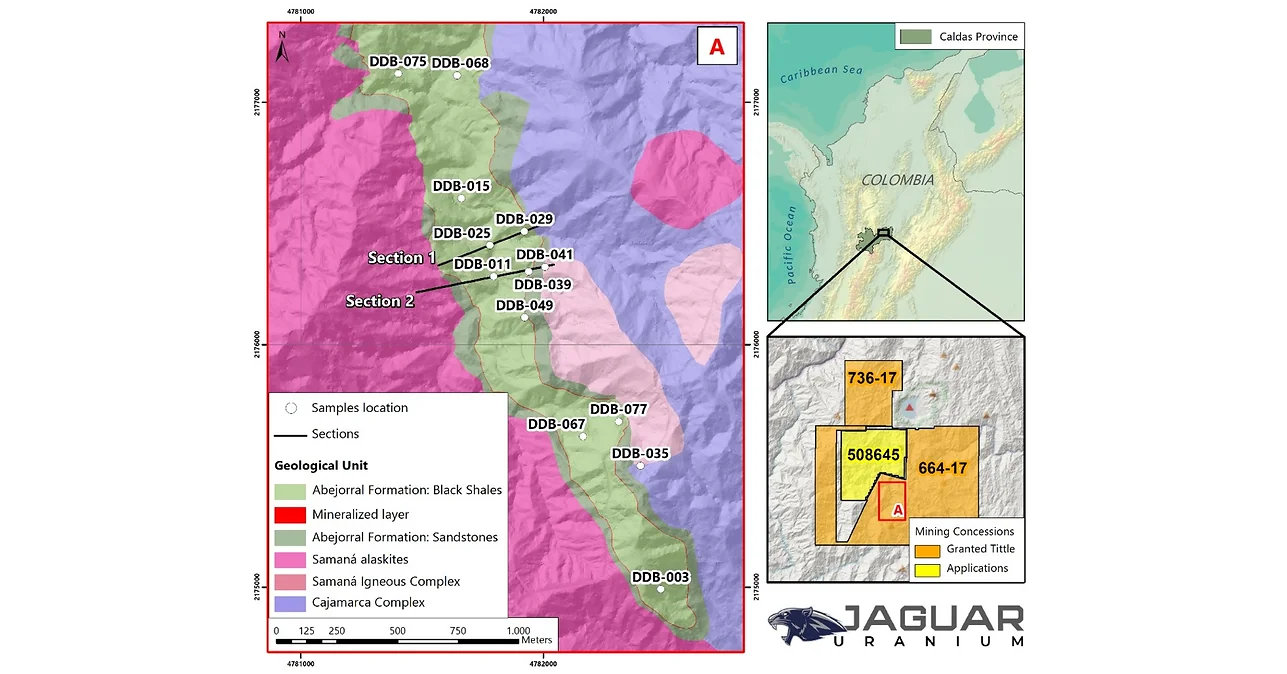
DDB-041: 0.63 m grading 3,570 ppm TREO and 607 ppm MREO (from 170.57 m to 171.20 m).

DDB-003: 1.53 m grading 2,267 ppm TREO and 329 ppm MREO (from 80.77 m to 82.30 m).

DDB-015: 1.00 m grading 2,176 ppm TREO and 349 ppm MREO (from 162.86 m to 163.86 m).

DDB-068: 0.50 m grading 2,532 ppm TREO and 414 ppm MREO (from 435.86 m to 436.36 m).

The intervals were selected for the purposes described under "Resampling Results and Analytical Procedures" and are not necessarily representative of the mineralized horizon as a whole.

"The initial results indicate that rare earth elements occur with uranium, phosphate and vanadium mineralization in the selected Berlin core intervals. We plan to use these results, together with trenching, geophysics and drilling, to refine the geological model and evaluate the continuity of mineralization. This multi-commodity profile directly aligns with the accelerating strategic cooperation between Colombia and the United States on secure critical-mineral supply chains and nuclear energy," said Steven Gold, President & Chief Executive Officer.

The Barranquilla Accords – U.S.-Colombia Framework on Critical Minerals

On September 8, 2026, the Barranquilla Accords were established as a U.S.-Colombia framework to mark a significant strengthening of U.S.–Colombia cooperation in critical minerals, rare earth elements and civil nuclear energy. The agreements establish a framework to advance secure supply chains, geological knowledge, investment and development of strategic mineral resources. With uranium, rare earth elements, vanadium and phosphate mineralization, Jaguar's Berlin Project is well positioned within this emerging strategic framework and Colombia's growing role in secure critical-mineral and nuclear supply chains.

Background and Historical Data

Berlin is an exploration-stage polymetallic project with historically reported uranium mineralization and associated rare earth elements and other commodities, including vanadium, phosphate, nickel, molybdenum, rhenium, yttrium and neodymium. More than 20,000 metres of historical drilling have been reported for the project.

The drill core subject to this resampling program was obtained during two historical exploration campaigns conducted by U3O8 Corp. The first campaign took place in 2010 and 2011, and the second campaign was conducted in 2012.

Storage Location: The drill core has been maintained since 2015 in a secure, locked core storage facility (Figure 2). Originally established by U3O8 Corp., the facility was acquired by Jaguar in 2024. It is situated directly within the project area on mining concession 664-17, where access remains strictly limited to authorized personnel to ensure continuous sample integrity.

Physical Integrity: The sampled intervals showed no signs of degradation or mineral oxidation.

Resampling Results and Analytical Procedures

The program selected and analyzed intervals from retained historical core to test REE occurrence and grade variation across the syncline, including samples from both flanks and the hinge and from positions above and below the mineralized horizon (Figure 3 and Figure 4). The Company selected the intervals from the available retained core; the tested samples do not constitute a systematic resampling of all historical mineralized intervals. The current results were not designed to verify any historical estimate. REE concentrations are reported as Total Rare Earth Oxides (TREO) and Magnet Rare Earth Oxides (MREO), and reported intervals are core lengths; true widths have not been determined3.

Sampling and Analytical Procedures

Samples from 13 selected historical drill core intervals were collected, labelled, and submitted for laboratory analysis using procedures intended to preserve sample identity and chain of custody (Table 1). Sample lengths were selected to match the original sample lengths collected by U3O8 Corp. The batch consisted of 150 samples, comprising 136 drill core samples (108 from direct core sampling and 28 pulp samples from previous analyses) and 14 QA/QC inserts. The core samples consisted of quarter-cores cut from the remaining half-cores sampled at average 1-metre lengths (maximum 2.98 m and minimum 0.20 m). Reported intervals are core lengths. True widths have not been determined from the current resampling program. Note that a material proportion of these intervals came from DDB-035 and DDB-077, which were sampled for historical-geochemical verification only and are not representative of true thickness. Full results are provided in Table 2.

Sample preparation was performed at SGS Colombia S.A.S. in Medellín, Colombia (ISO 9001 accredited for sample preparation and management), and chemical analysis was conducted at SGS Callao, Peru (ISO/IEC 17025 for testing and calibration). Whole-rock geochemical analyses were conducted utilizing a dual-method approach to guarantee total element recovery. Samples underwent a four-acid digestion followed by ICP-MS analysis (SGS method ICM40B) for standard trace element characterization. For the accurate quantification of REE in resistate mineral phases, a sodium peroxide fusion with an ICP-MS finish (SGS method ICM90A) was systematically applied. This approach also accounted for any over-limit analyses encountered. Uranium was reported using the ICM40B method to account for over-limit results. Methods and detection limits are indicated on Table 2.

Quality Assurance and Quality Control (QA/QC)

The resampling program was executed under strict chain-of-custody protocols from the storage facilities in Colombia to the independent laboratories. As part of the QA/QC program, coarse blank material and certified reference materials (CRM) supplied by OREAS (ORE Research & Exploration Pty Ltd., Australia), an ISO 17034-accredited reference material producer, were inserted. OREAS 474 was used for rare earth control, featuring certified values for TREO and individual rare earth elements, as well as certified U and Th contents. For uranium control, OREAS 121 (~215 ppm U) was used as a low-grade standard and OREAS 124 (~1,845 ppm U) as a high-grade standard.

Of the 150 submitted samples, 14 were QA/QC inserts (9.33% of the total batch), consisting of: 7 coarse blanks (4.67%) and 7 CRMs (4.67%). The CRMs included 3 insertions of OREAS 474 (2.0%), 2 of OREAS 121 (1.33%), and 2 of OREAS 124 (1.33%). Controls were distributed throughout the sampling sequence to avoid clustering. The QP reviewed the blank and certified-reference-material results against the program's acceptance criteria and affirms that the data passed internal and external validation checks and is suitable for the purpose of this exploration disclosure.

Qualified Person Statement

Andrés Cáceres, an AIPG Certified Professional Geologist (CPG), meets the requirements of a Qualified Person under NI 43-101 and Subpart 1300 of Regulation S-K. Mr. Cáceres has reviewed the technical integrity of the data in this press release, evaluated the QA/QC results, and approves the publication of this technical disclosure. Mr. Cáceres is an independent contractor hired by Jaguar Uranium Corp. His experience includes eight years as Project Manager in Colombia with U3O8 Corp., where he led the Berlin Project; four years with the Colombian Geological Survey (SGC) as a Senior Consultant conducting research and exploration programs focused on uranium and rare earth element resources; and two years as Vice President of Exploration for Biondi Resources, leading uranium and rare earth element exploration activities in Brazil.

Andrés Cáceres, CPG, designed the resampling program, supervised data collection and interpreted the scientific and technical results.

Class (B2B/B2C)
B2B
Ingest Status
Rewritten
Dedupe hash
prn_302888574
Press Eligible
Yes
Press Eligible Reason
Mining company reports rare earth, uranium, vanadium and phosphate exploration assay results from its Colombia project.
Source Name
Unknown Company
Original Summary

<p>Selected retained-core intervals contain rare earth elements, including neodymium, praseodymium, terbium and dysprosium (magnet rare earths), together with uranium, vanadium and phosphate mineralization. 0.63 m @ 3,570 ppm TREO (0.357%) and 607 ppm MREO, the highest TREO value reported...</p>

Image URL
https://mmx.prnewswire.com/media/MS1995526/Jaguar-Uranium-JAGUAR-URANIUM-REPORTS-RARE-EARTH-OXIDES-ASSOCIAT.jpg?id=OA2968576&p=facebook
Content Hash (SHA-256, erste 32 hex)
6f62f1e39333192f186c81eb48db694b